
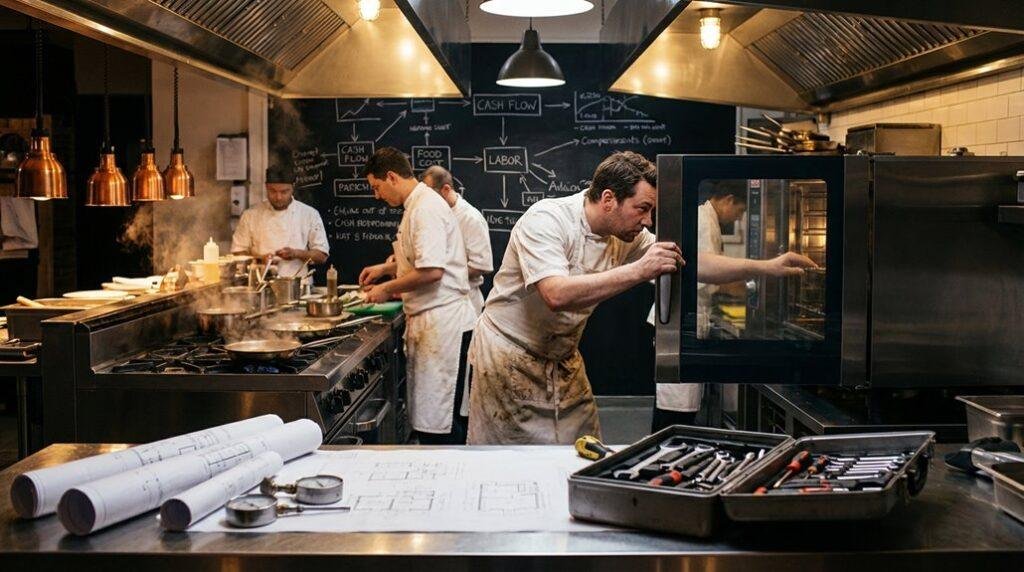
We understand kitchen repairs can devastate restaurant revenues, with potential weekend downtime costing up to $25,000.
Our solution is leveraging innovative financial tools like revenue-based advances and merchant cash advances that provide quick capital within hours.
You may be interested


By prioritizing predictive maintenance and flexible funding strategies, we can help you minimize operational interruptions and preserve your restaurant’s financial health.
Keep exploring to access your uptime potential.
Key Takeaways
- Utilize revenue-based advances that adjust payment structures to match sales performance, providing immediate capital for kitchen equipment repairs.
- Implement predictive maintenance strategies to anticipate potential equipment failures and proactively manage repair costs before critical breakdowns occur.
- Consider flexible merchant cash advances that offer rapid funding within hours, enabling quick kitchen repair interventions without lengthy bank processes.
- Establish dedicated repair accounts that allocate monthly profit percentages to create a financial safety net for unexpected kitchen equipment maintenance.
- Leverage embedded finance solutions that use sales velocity data instead of traditional credit scoring to secure faster, more responsive repair funding.
The Existential Threat of Kitchen Downtime

In 2026, restaurant owners face an unparalleled threat where a single mechanical failure can obliterate revenue streams and digital reputation more swiftly than a line cook can flip a burger. Equipment downtime costs can reach up to 11% of annual revenue, transforming a simple repair into a potential business extinction event. Our AI-driven search ranking ecosystem now punishes downtime with brutal efficiency, altering what was once a simple repair into a potential business extinction event. We’ve calculated that closing a kitchen for just one weekend can crater your search visibility by 40% and trigger a cascading economic impact that extends far beyond the immediate repair costs. To mitigate this risk, operators can access emergency liquidity when critical appliances fail, ensuring that they can respond swiftly without jeopardizing service continuity.
Why Mechanical Failure is a Revenue Killer in 2026
Three the critical three minutes time can obliterate a restaurant’s financial abilities in 2026, converting simple mechanical failure into a revenues catastrophe.
Kitchen downtime mitigation is represents an existential threat where every minute seconds of production loss translates economic decimation. Restaurant kitchen repair cash flow requires demands innovative responses to transform reactive maintenance into strategic resilience.
Predictive maintenance strategies can dramatically reduce the financial risk of unexpected equipment failures by providing early warning systems for potential breakdowns.
Revenue-based repair capital provides strategies now provide immediate technological interventions. Prolonged operational disruptions monitoring systems detect potential failures before catastrophic breakdowns occur, allowing preemptive interventions that preserve both restaurant infrastructures.
Smart financial instruments now capital deployment, ensuring minimal interruption and maximum operational continuity.
Predictive maintenance isn’t optional—it’s a fundamental survival strategy in restaurant economics.
The Impact of Equipment Downtime on AI Search Rankings
Restaurant operators now face a digital survival challenge beyond mechanical failures: AI search rankings that ruthlessly punish operational interruptions.
When your kitchen goes down, your digital reputation plummets quicker than your refrigeration temperature. Emergency restaurant funding and immediate kitchen repair loans become vital lifelines in maintaining your working capital and online visibility.
Modern AI algorithms track restaurant performance carefully, downgrading establishments with frequent service disruptions. A single weekend of closed services can crater your search rankings by up to 40%, making recovery exponentially harder. Preventive maintenance strategies can mitigate the risk of catastrophic digital reputation loss by ensuring continuous operational reliability.
Smart operators understand that restaurant working capital isn’t just about cash flow—it’s about maintaining an uninterrupted digital presence. Proactive maintenance and swift repair strategies are now critical for survival in the hyper-competitive 2026 foodservice environment.
Analyzing the Real Cost of Closing for a Weekend
Every weekend during kitchen downtime represents a potential $15,000 toward $25,000 revenue catastrophe for mid-sized restaurants. We understand that embedded equipment finance is not just a financial tool, it is survival technology for modern food service operations. Inefficient appliances can waste up to 80% of a restaurant’s energy, turning mechanical failures into systemic operational risks. Ghost kitchen uptime becomes impossible when emergency repair expenses stack up and force extended closures. Critical appliance failures convert weekend service windows into revenue black holes, crushing potential earnings and customer relationships. Modern restaurants cannot afford traditional repair wait times, each hour of downtime exponentially multiplies lost transaction potential. Strategic operators now utilize immediate capital solutions that change mechanical failures from business-ending events into manageable operational hiccups.
Modern Liquidity Solutions for the 2026 Restaurant

In 2026, restaurant owners are revolutionizing their financial strategies by embracing embedded finance solutions that alter traditional lending models. Mobile kitchen rental costs can now be strategically financed through dynamic capital platforms that understand the unique economic pressures of restaurant infrastructure investments. These lending solutions are designed to boost business performance, providing timely access to funds during critical moments. We’re witnessing a seismic shift from rigid FICO-based credit assessments to fluid sales velocity underwriting, where your restaurant’s actual revenue performance becomes the primary collateral for instant capital access. These revenue-based advances provide a lifeline for operators, allowing them to protect operating margins and maintain business continuity with unmatched speed and flexibility.
Understanding Embedded Finance and POS Integrated Lending
When mechanical failures threaten to derail your restaurant’s momentum, embedded finance changes traditional capital access from a bureaucratic nightmare into a strategic superpower.
In 2026 hospitality liquidity, pos-driven lending alters how restaurants secure emergency funds. We’ve moved beyond slow bank approvals to instant, data-driven capital solutions that align directly with your restaurant’s sales performance. Cloud-based POS analytics now enable financial platforms to instantly evaluate a restaurant’s financial health and lending potential.
Modern POS systems now function as financial gatekeepers, analyzing your revenue streams in real-time to release immediate financing. This signifies when your kitchen equipment breaks, you’re not left scrambling you’re strategically positioned to secure funds within hours.
The result? Minimal downtime, preserved revenue, and a financial safety net that adjusts to your unique business rhythm. Embedded finance isn’t just a tool, it’s your operational lifeline.
The Shift from Legacy FICO Scores to Sales Velocity Underwriting
Restaurant operators have witnessed the dramatic evolution in capital access, moving beyond the rigid constraints from legacy FICO scoring toward a more animated sales velocity underwriting model. Equipment financing strategies are fundamentally reshaping how restaurants evaluate and secure critical capital investments.
We’re seeing innovative financing strategies that prioritize real-time business performance over unchanging credit history. This shift means restaurants can now utilize their daily sales data as powerful financial credentials.
Velocity-based underwriting alters how we access capital, offering swift approvals and more flexible terms that align with our ever-changing industry. Traditional credit scoring models are becoming obsolete, replaced by intelligent systems that understand the intricate cash flow patterns of modern hospitality businesses.
How Revenue-Based Advances Protect Your Operating Margins
Three critical factors define the modern restaurant’s approach toward capital preservation during unexpected kitchen repairs: speed, flexibility, and strategic financial management.
Revenue-based advances protect operating margins by automatically adjusting payment structures to match actual sales performance. When kitchen equipment fails, these innovative funding solutions allow restaurateurs to access immediate capital without compromising daily operational reserves.
By tying repayment percentages directly to credit and debit card transactions, operators maintain financial stability during repair periods. The collateral-free nature of these advances eliminates traditional barriers to capital access, enabling swift equipment replacement without risking core business assets.
Our approach changes unexpected mechanical failures from potential catastrophes into manageable operational challenges, ensuring restaurants can rapidly restore kitchen functionality and maintain consistent service quality.
Triage: Prioritizing Urgent Kitchen Repairs

When urgent kitchen repairs strike, we know refrigeration and HVAC systems represent the critical lifelines that can make or break a restaurant’s operational integrity.
Our strategic approach prioritizes these non-negotiable uptime drivers, focusing on rapid assessment and immediate action to minimize revenue disturbance.
We’ll investigate targeted repair strategies that balance modular equipment fixes against total line replacements, ensuring we allocate resources precisely where they’ll deliver maximum operational resilience.
Refrigeration and HVAC: The Non-Negotiable Uptime Drivers
Because kitchen equipment failures can topple a restaurant’s bottom line, we must prioritize refrigeration and HVAC systems as mission-critical infrastructure. These systems represent the backbone of food safety and operational stability.
With repair costs averaging between $519 and $1,000 per incident, preventative maintenance isn’t just recommended—it’s crucial. Our data shows that monitoring can yield 15-30% energy savings and dramatically reduce unexpected downtime.
Regular filter changes, coil cleaning, and systematic inspections prevent efficiency losses and potential catastrophic failures. By treating these systems as strategic assets rather than mere utilities, restaurants can alter potential interruptions into predictable, manageable maintenance cycles.
The goal isn’t just avoiding breakdowns, it’s creating a proactive, data-driven approach to kitchen infrastructure management.
Modular Equipment Repair vs. Total Line Replacement
If restaurant proprietors want to maximize operational efficiency, comprehending the strategic nuances between modular equipment repair and total line replacement becomes critical. Our triage method prioritizes high-ROI equipment with immediate business impact, concentrating on components that drive daily performance.
We analyze breakdown frequency, parts availability, and repair history to determine the most cost-effective strategy. When repair costs consistently exceed 20% of replacement value, switching to new equipment often proves more economical.
Modern modular systems allow targeted interventions, reducing total system downtime. By tracking maintenance expenses and performance metrics, we can predict ideal replacement windows before critical failures emerge.
The aim isn’t just fixing equipment—it’s maintaining uninterrupted kitchen operations that sustain revenue and customer satisfaction.
Funding the Gap Between Insurance Claims and Immediate Costs
Navigating the financial landscape between insurance claim processing and urgent kitchen repairs requires strategic prioritization and proactive cash flow management. We’ve identified vital pathways to bridge immediate repair needs while awaiting thorough insurance settlements:
- Exploit pre-approved lines of credit specifically designed for restaurant equipment emergencies, allowing rapid allocation of funds within 24-48 hours.
- Employ revenue-based financing through POS systems, which can provide instant capital based on historical sales performance without traditional credit checks.
- Negotiate partial advance payments from insurers by presenting detailed damage documentation and immediate repair estimates.
These innovative financial strategies convert potential operational interruptions into manageable challenges, ensuring restaurants maintain momentum during critical repair windows.
Comparing Fast Funding vs. Traditional Bank Debt
We’ve seen directly how restaurant owners can get trapped in slow, expensive financing cycles when critical kitchen equipment breaks down.
Quick funding options now offer a radical alternative: approvals in hours instead of weeks, with repayment models that automatically scale with your daily sales volume.
Speed of Funding: 4 Hours vs. 4 Weeks
When restaurant owners confront critical kitchen equipment failures, the speed for funding becomes a make-or-break financial strategy that can determine business survival.
Traditional bank loans drag out the process over weeks, creating significant operational risks. Our analysis reveals three critical funding speed differences:
- Online lenders deliver capital within 4 hours, compared to 4-week bank processing timelines.
- Merchant cash advances provide immediate funds without complex documentation requirements.
- Equipment financing platforms utilize real-time data to accelerate approval decisions.
Modern restaurateurs can’t afford prolonged financial bureaucracy. The digital financing ecosystem now permits instant capital access, changing equipment repair from a potential business interruption into a manageable technical challenge.
Swift funding isn’t just convenient, it’s a strategic imperative in today’s high-velocity hospitality environment.
Elastic Repayment Models: Scaling Payments with Daily Sales
Because restaurant owners need financial solutions that breathe with their business’s natural rhythm, flexible repayment models represent a groundbreaking approach for managing kitchen repair cash flow.
These innovative funding strategies actively adjust payments based on daily sales, providing unparalleled flexibility for restaurants facing unforeseen equipment failures.
| Funding Model | Payment Structure | Sales Flexibility |
|---|---|---|
| Elastic MCA | Daily Percentage | High |
| Bank Loan | Fixed Monthly | Low |
| Credit Card | Minimum Payment | Medium |
| Equipment Lease | Predictable Rates | Low |
| Revenue-Based | Sliding Scale | High |
Avoiding the “Credit Card Trap” for Commercial Repair Costs
Restaurant owners comprehend the perilous terrain of commercial repair financing, where credit card debt can swiftly alter a simple kitchen equipment failure into a long-term financial nightmare. We’ve identified critical strategies to maneuver this intricate setting:
- Recognize credit card interest rates can escalate repair costs by 30-50% beyond the original expense.
- Investigate alternative financing models that align with restaurant cash flow fluctuations.
- Prioritize solutions offering quicker funding and more flexible repayment structures.
Modern restaurateurs need innovative financial tools that understand their unique operational challenges.
Rapid funding options provide strategic alternatives to traditional credit card traps, offering swifter approvals, more adjustable terms, and preservation of critical working capital.
Building an Uptime Insurance Strategy
We know that modern restaurant operators can’t afford unexpected kitchen downtime, so we’re building extensive uptime insurance strategies that proactively protect our revenue streams.
By integrating predictive maintenance data into our financial planning, we can secure more favorable lending rates and create financial buffers that prevent catastrophic equipment failures. This methodology emphasizes the importance of high-efficiency updates as a means to sustain operational integrity in the face of mechanical challenges.
Our approach connects operational stability directly with staff retention, ensuring that one mechanical breakdown doesn’t trigger a cascade of workforce disarray.
Integrating Financial Drawdowns into Your Operational Workflow
When strategic financial planning meets operational resilience, restaurant owners access a powerful approach for managing unexpected kitchen equipment failures.
Our workflow integration strategy changes repair budgets from reactive expenses into proactive investments. We’ve developed a thorough drawdown approach that minimizes operational interruptions:
- Streamline monthly profit allocations into dedicated repair accounts, creating a financial safety net.
- Embed real-time equipment monitoring triggers within POS systems to predict potential failures before they occur.
- Strategically stagger drawdown releases alongside vendor payments and payroll cycles to maintain ideal cash positioning.
Using Predictive Maintenance Data to Secure Better Lending Rates
Predictive maintenance data has evolved from a technical curiosity into a powerful financial instrument for securing more favorable lending rates.
By leveraging real-time equipment performance metrics, restaurants can now demonstrate operational reliability directly to financial institutions. Our data-driven approach reshapes traditional lending assessments, replacing subjective evaluations with objective performance tracking.
Sensor networks and AI analytics provide lenders with transparent perspectives into equipment health, reducing perceived risk and enabling more competitive financing terms. We’re seeing institutions reward proactive operators with lower interest rates and more flexible lending structures.
The key is building a thorough data ecosystem that proves operational excellence. Predictive maintenance isn’t just about preventing breakdowns, it’s about creating a financial narrative of reliability that opens doors to smarter, more strategic capital access.
Maintaining Staff Retention Through Consistent Operational Stability
Because operational stability has become the linchpin for restaurant staff retention in 2026, strategic approaches for minimizing workplace disturbance are now mission-critical for hospitality leaders.
We recognize that consistent operational environments directly impact team performance and longevity. Our research reveals three key stability strategies:
- Implement predictive scheduling technology that anticipates staffing needs
- Develop cross-training programs for reducing individual role stress
- Create transparent communication channels using AI-native platforms
Maximizing Your Return on Uptime
We know that protecting your restaurant’s uptime isn’t just about quick repairs—it’s about strategically minimizing revenue disturbances and maintaining your brand’s digital reputation.
By treating equipment failures as opportunities for swift, data-driven interventions, we can change potential catastrophes into manageable moments that actually strengthen your operational resilience.
Our approach focuses upon immediate action, leveraging modern financial tools and predictive maintenance technologies to guarantee that every minute of potential downtime becomes a calculated investment in your restaurant’s long-term success.
In addition, utilizing modern lending solutions for culinary equipment upgrades can further enhance your operational efficiency.
The ROI of Immediate Repair over Delayed Action
When restaurant operators delay critical kitchen equipment repairs, they unknowingly trigger a cascading financial breakdown that rapidly erodes profitability and operational stability. Our data reveals the hidden costs of procrastination:
- Emergency repairs cost 3-4x more than preventive maintenance
- Equipment downtime can reduce annual revenue by up to 22%
- Delayed repairs accelerate asset depreciation by 50%
Immediate intervention alters potential disaster into strategic opportunity. We’ve observed that restaurants implementing rapid repair protocols minimize revenue disruption and preserve operational integrity.
By treating equipment maintenance as a critical investment rather than an optional expense, operators can protect their most precious assets. The math is clear: investing in timely repairs isn’t just about fixing machines.
It’s about sustaining your restaurant’s competitive edge in an increasingly unforgiving marketplace.
Protecting Your Brand Reputation in the Age of Instant Reviews
Although digital reputation management has become increasingly complex, successful restaurants in 2026 understand that online reviews are now the primary gateway for customer acquisition and retention.
We recognize that every moment of downtime risks damaging our carefully constructed digital reputation. A single negative review triggered by kitchen equipment failure can cascade into significant revenue loss.
Modern restaurant operators must treat their online presence like a mission-critical system, employing proactive strategies to mitigate potential reputation risks. Instant repair solutions aren’t just about maintaining equipment, they’re about preserving our brand’s digital credibility.
Future-Proofing Your Cash Flow Against Mechanical Volatility
Because mechanical volatility threatens restaurant profitability, strategic cash flow management represents the cornerstone of operational resilience in 2026’s changing hospitality environment.
We understand that equipment breakdowns can interfere with revenue streams and create unexpected financial pressure. To future-proof our cash flow, we must adopt innovative strategies that change mechanical risk into strategic opportunity:
- Implement predictive maintenance tracking that anticipates equipment failure before catastrophic breakdowns occur
- Develop flexible financial instruments that provide immediate capital for rapid repairs
- Create shifting budget reserves that flexibly adjust based on real-time operational data
Our approach changes potential interferences into calculated risk management, ensuring continuous kitchen performance and sustainable financial health.
Frequently Asked Questions
How Quickly Can I Get Kitchen Repair Funds Deposited Into My Account?
We’ll get your kitchen repair funds deposited within 3-6 hours using our AI-driven, sales-velocity financing. Your POS data becomes instant capital, converting downtime into a strategic opportunity.
Will My Credit Score Impact My Ability to Secure Repair Financing?
We’ve transformed financing so your credit score matters less. Our embedded POS systems now analyze real-time sales velocity, enabling instant repair funding that bypasses traditional credit barriers.
Can I Use Restaurant Sales Data as Collateral for Emergency Repairs?
We’re leveraging sales data as prime collateral in 2026. Our POS systems now function as financial passports, altering daily transaction records into instant repair funding without traditional credit barriers.
What Happens if Repair Costs Exceed My Initial Financing Estimate?
We’ll adjust your financing flexibly. If repair costs spike, our embedded POS lending platform recalculates repayment terms, ensuring you’re not locked into rigid payments that could strangle your cash flow.
Are There Penalties for Early Repayment of Kitchen Repair Capital?
We’ve designed our repair financing to reward speed, with zero early repayment penalties. Our flexible terms mean you’ll pay exactly what you need, when you require this, without punitive charges.
