
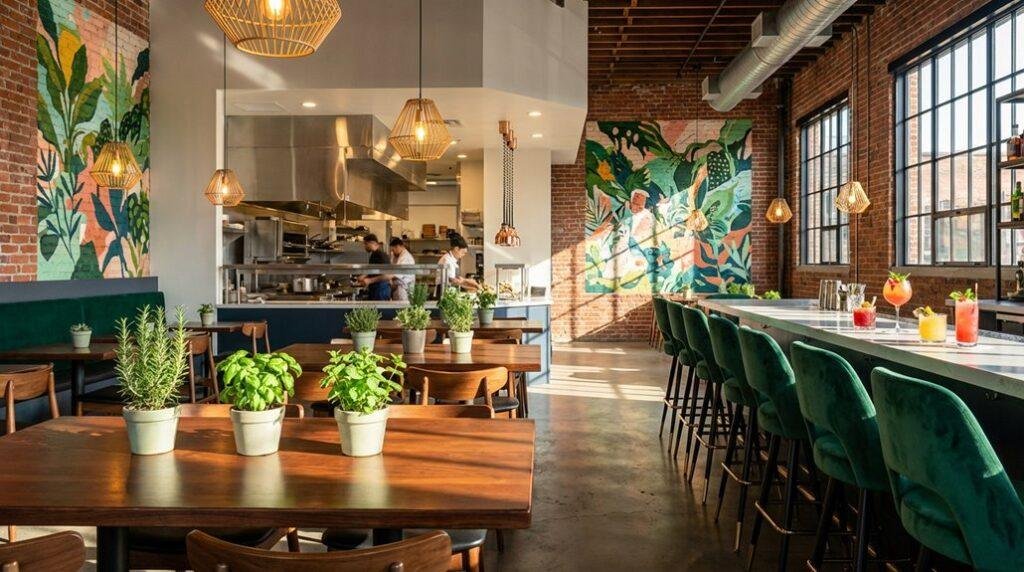
We’re seeing restaurant remodeling capital evolve dramatically in 2026. Revenue-based financing and embedded POS platforms like Toast now offer rapid funding solutions for strategic renovations.
By leveraging targeted automation, AI-driven inventory management, and smart tax strategies like Section 179 deductions, restaurants can change spaces with minimal financial risk.
You may be interested


Our approach integrates technology, efficiency, and brand identity, and we’re just getting started.
Key Takeaways
- Revenue-based financing platforms like Toast and SpotOn offer rapid, non-dilutive capital solutions for restaurant remodeling within hours of application.
- Green grants and ESG-compliant incentives, such as California’s Restaurants Care Resilience Fund, provide strategic funding for sustainable technology upgrades.
- Cost segregation strategies and Section 179 tax deductions enable restaurants to maximize capital recovery and accelerate technological investments during remodeling.
- Modular construction techniques and pre-fabricated kitchen systems provide efficient renovation options that minimize operational disruption and reduce overall project timelines.
- Experiential design investments that create immersive dining spaces can attract customers, with targeted capital allocation supporting aesthetic and technological modernization.
The Economic Shift in the 2026 Hospitality Market

We’re witnessing a fundamental economic alteration in restaurant operations where traditional labor models are being systematically decoupled from physical floor plans. AI-driven technological shifts are transforming operational strategies, with labor costs rising by 15.3% and pushing restaurants to seek innovative staffing solutions. To stay competitive, many establishments are opting for rapid capital investments in modernized dining spaces that can attract customers quickly.
The 2026 hospitality market demands an experiential dining aesthetic that goes beyond mere food service, requiring restaurants to rethink their spaces as fluid, technology-integrated environments. Modernization isn’t just recommended, it’s now a critical strategy for margin protection, with restaurants that fail to adjust facing inevitable market obsolescence.
Decoupling Labor from Physical Floor Plans
Because labor economics have fundamentally reshaped restaurant operations, smart operators are decoupling physical floor plans from traditional staffing models. Labor forecasting tools enable precise workforce allocation by leveraging real-time POS data and demand patterns.
Capital for restaurant remodel 2026 now prioritizes smart kitchen upgrades and mechanized front of house tech that alter spaces into productivity engines.
We’re seeing floor plans re envisioned as efficiency platforms where technology absorbs repetitive tasks, allowing human talent to focus on customer experience and complex operational needs. Mechanized ordering kiosks, AI powered prep stations, and integrated POS systems are replacing static kitchen layouts.
By strategically redesigning physical spaces, restaurants can reduce labor dependencies, enhance workflow, and maintain profitability in an increasingly complex market.
The future of hospitality isn’t about replacing workers it’s about enabling them through intelligent design and technology integration.
The Rise of the Experiential Dining Aesthetic
As the hospitality environment evolves in 2026, the experiential dining aesthetic has emerged as a revolutionary economic force reshaping how restaurants compete and connect with consumers. We’re witnessing a strategic alteration where dining isn’t just about food, but creating immersive narratives that drive experiential dining ROI. With a 46% increase in experiential dining, restaurants are transforming their core business model to prioritize memorable customer interactions beyond traditional meal service.
| Design Element | Technology Integration | Customer Impact |
|---|---|---|
| Mood Lighting | AI Sound Curation | Improved Engagement |
| Texture Design | Interactive Menus | Sensory Experience |
| Local Storytelling | Sustainability Tech | Brand Connection |
| Spatial Layout | Performance Tracking | Economic Optimization |
Restaurants now utilize eco-friendly restaurant design and innovative restaurant expansion loans to create spaces that transcend traditional dining.
Why Modernization is Mandatory for 2026 Margin Protection
If restaurant operators hope for survival in the economic turbulence for 2026, strategic modernization isn’t just recommended—it’s existential.
We’re witnessing a critical moment where restaurant renovation financing becomes a survival strategy. Non-dilutive remodeling capital offers operators a lifeline to convert outdated spaces into efficient profit centers. Transformative technology operations are revolutionizing how restaurants can leverage AI and automated systems to dramatically reduce operational overhead.
Section 179 for restaurants in 2026 provides unparalleled tax incentives that effectively subsidize technological upgrades. By investing in smart kitchen configurations and mechanized systems, restaurants can slash labor costs while maintaining, even improving, service quality.
The math is clear: modernization isn’t an expense, it’s an investment. Those who adjust will thrive; those who resist will become obsolete. Strategic remodeling is no longer optional—it’s the difference between margin protection and market extinction.
Evaluating Your Remodeling Capital Sources

We’re seeing a capital revolution in restaurant remodeling, with Revenue Based Financing offering extraordinary flexibility through elastic repayment models that match cash flow. This innovative funding approach allows restaurateurs to access capital aligned with their revenue streams, empowering them to make timely renovations. Embedded POS lending now enables lightning-fast 4-hour funding cycles, changing how quickly restaurateurs can access capital for strategic upgrades. Alternative financing strategies are emerging as crucial tools for restaurants seeking strategic renovation investments, leveraging innovative funding models beyond traditional bank loans.
Green grants and ESG-compliant renovation incentives are further accelerating our industry’s technological change, making smart remodeling not just possible, but financially strategic.
Revenue Based Financing: The Elastic Repayment Edge
Because traditional financing models can strangle restaurant growth, Revenue Based Financing (RBF) emerges as a strategic capital solution that breathes flexibility into remodeling projects. Microlending platforms offer complementary support for restaurants seeking alternative funding mechanisms. We recognize that commercial kitchen automation funding requires innovative financial approaches. RBF allows restaurants to secure capital based on sales performance, with repayment structures that adjust to revenue fluctuations. This signifies no fixed monthly payments, but instead a percentage-based model that grows or contracts with your business. The outcome? Reduced financial stress during renovation and improved cash flow management. Restaurants can now invest in tech upgrades, kitchen reconfigurations, and efficiency improvements without the rigid constraints of conventional loans.
Embedded POS Lending: 4-Hour Funding Cycles
When restaurant owners step into the 2026 financing environment, embedded POS lending modifies capital acquisition from a bureaucratic marathon into a strategic sprint. Cloud-native architectures are revolutionizing how financial technology platforms assess and deploy capital with unprecedented speed and precision.
Our data reveals a groundbreaking arena where payment platforms like Toast and SpotOn now function as de facto credit officers, providing 4-hour funding cycles that obliterate traditional bank timelines.
| Platform | Funding Speed | Credit Limit | Risk Assessment | Compliance |
|---|---|---|---|---|
| Toast | 4 hours | $250K | AI-driven | PCI DSS |
| SpotOn | 3-4 hours | $300K | Predictive | SOC 2 |
| Clover | 4-5 hours | $200K | Transaction-based | PCI |
| Square | 4 hours | $225K | Machine Learning | GDPR |
| Stripe | 3 hours | $275K | Real-time | ISO 27001 |
This approach equips restaurateurs with rapid, data-driven capital access, reshaping remodel financing from a challenge into a strategic opportunity.
Green Grants and ESG-Compliant Renovation Incentives
As restaurateurs steer through the complex environment of 2026 capital sources, green grants and ESG-compliant renovation incentives have emerged as strategic financial lifelines for altering restaurant infrastructure.
State and federal programs now prioritize sustainability, offering targeted funding for technology upgrades and operational changes. With equipment improvements comprising 31% of resilience program grants, restaurants can utilize these resources to modernize kitchens, reduce carbon footprints, and improve efficiency.
Technology-focused incentives cover 9% of available funds, supporting critical investments in digital infrastructure. By strategically maneuvering through these grant opportunities, from California’s Restaurants Care Resilience Fund to targeted state programs, savvy operators can secure capital that not only supports immediate renovations but positions their businesses for long-term sustainability and competitive advantage.
Smart Kitchen Integration and ROI
We’re seeing smart kitchen integration alter restaurant economics through targeted automation that slashes labor costs and maximizes operational efficiency. By investing in robotic prep stations and real-time inventory technologies, operators can reduce waste, predict demand more accurately, and cut utility overhead by up to 30%. The ROI for these systems isn’t just incremental, it’s revolutionary, with payback periods shrinking to less than 12 months and creating a sustainable competitive advantage in the increasingly tech-driven hospitality environment. Alternative financing options can further ease the upfront costs associated with these innovative upgrades, making them accessible to more bootstrapped businesses.
Funding Automated Prep Stations and Robotics
By 2026, restaurant owners are revealing that investing $20,000 to $50,000 in mechanized prep stations isn’t just a technological upgrade, it’s a strategic financial lifeline.
Automated kitchen solutions are revolutionizing how we manage operational costs and labor challenges. The investment environment now offers flexible funding models that make robotic integration more accessible than ever.
Smart Funding Matters:
- Predictive platforms forecast demand and enhance inventory
- Leasing options reduce upfront capital requirements
- Tax incentives offset initial technology investments
- Modular implementation allows phased technological adoption
Kitchen mechanization isn’t just about replacing workers, it’s about enabling them. We’re seeing ROI through reduced errors, improved efficiency, and stronger margins.
The future of restaurant technology is here, and it’s financially smarter than ever.
Real-Time Inventory Tech and Waste Reduction
Restaurant operators can now employ real-time inventory tech to radically alter their waste reduction strategies, turning data into a powerful operational weapon.
AI-driven demand forecasting redefines how we predict inventory needs, slashing waste across fruits, vegetables, and dairy products. By integrating smart POS systems with inventory management, we can track usage in real-time, enhance ordering efficiency, and make precision-driven decisions.
These technologies don’t just reduce waste. They create an extensive operational ecosystem that predicts demand, alerts teams to potential shortfalls, and maintains ideal inventory levels.
With 38 percent of produce typically wasted, our new tech solutions represent a critical intervention in restaurant economics, turning potential loss into strategic advantage.
The Impact of High-Efficiency Gear on Utility Overhead
Smart kitchen technologies are revolutionizing utility overhead management, changing restaurant operational efficiency from a cost center into a strategic performance driver. High-efficiency appliances now deliver measurable financial advantages beyond traditional energy savings.
We’re seeing significant changes across restaurant infrastructure through intelligent design and integrated systems.
Key efficiency advantages include:
- Mechanized energy consumption tracking with real-time dashboards
- AI-powered operational adjustments reducing peak power demand
- Integrated smart systems synchronizing device performance
- Predictive maintenance preventing unexpected equipment failures
These innovations aren’t just technological upgrades, they are strategic investments. By implementing smart kitchen gear, restaurants can reduce utility overhead by up to 30%, create more predictable operational expenses, and position themselves competitively in an increasingly technology-driven marketplace.
The future of restaurant efficiency is here, powered by intelligent, interconnected systems.
Maximizing 2026 Tax Benefits for Renovations
We’ve got a game-changing opportunity with Section 179 that can slash your restaurant renovation costs by permitting full equipment deductions in the year of purchase. Strategic bonus depreciation for modular kitchen designs lets us accelerate capital recovery, changing your remodel from a financial burden into a tax-optimized investment.
Through careful cost segregation strategies, we can reveal rapid tax benefits that make your 2026 restaurant conversion not just a visual upgrade, but a financially intelligent move.
Utilizing Section 179 for Full Equipment Deductions
While maneuvering through the intricate terrain of restaurant renovations, savvy operators can employ Section 179 as a powerful tax strategy that alters equipment purchases into immediate financial advantages.
Our strategic approach allows restaurants to convert capital investments into tax-efficient opportunities by maximizing deduction potential.
Key strategic advantages include:
- Full equipment expense deduction in the purchase year
- Immediate tax savings up to $290,000 on $1,160,000 investments
- Accelerated cash flow through aggressive tax planning
- Extensive coverage for kitchen tech and operational assets
Bonus Depreciation Strategies for Modular Design
Because the environment pertaining restaurant renovation is constantly changing, modular design strategies offer an innovative approach for maximizing 2026 tax benefits through strategic bonus depreciation. Shipping container kitchens provide a prime example, classifying as personal property with accelerated 5-7-15 year depreciation schedules instead in place of traditional 39-year structures.
By treating components separately—shell, HVAC, electrical, plumbing, and built-in equipment—restaurateurs can expense costly elements immediately. The post-January 19, 2025 timing allows full bonus deduction, enhancing cash flow and enabling quicker reinvestment.
Modular approaches alter tax strategy from a compliance exercise into a financial optimization tool, letting innovative operators convert renovation expenses into strategic advantages that support rapid business evolution.
Cost Segregation for Rapid Capital Recovery
Steering through the intricate terrain of restaurant renovations demands strategic financial planning, and cost segregation emerges as a powerful tool for rapid capital recovery in 2026. By reclassifying building components into shorter depreciation schedules, we reveal immediate tax advantages that alter renovation expenses into strategic investments.
Our approach to cost segregation centers around four key strategies:
- Reclassify kitchen equipment to 5-year depreciation
- Utilize 100% bonus depreciation for qualified improvements
- Identify personal property components for accelerated deductions
- Maximize Section 179 expensing for technological upgrades
This method isn’t just about tax savings. It’s about reimagining capital deployment.
We’re turning renovation expenses into a financial lever that funds innovation, reduces tax liability, and provides restaurants with the competitive edge needed in today’s ever-changing hospitality environment.
The Construction Sprint: Minimizing Downtime
We’ve identified the critical need for rapid restaurant remodeling that minimizes operational downtime and utilizes strategic capital placement.
Our approach focuses on modular construction techniques that can alter a space within 72 hours, utilizing prefabricated components and precision project management.
Modular Remodeling Techniques for 72-Hour Turnarounds
Although traditional restaurant remodeling once meant months of downtime and disturbance, modular construction techniques in 2026 have overhauled how operators approach physical alterations.
We’re revolutionizing restaurant changes through precision-engineered solutions that dramatically compress project timelines. Our approach focuses on strategic efficiency, ensuring minimal operational interruption.
Key modular remodeling advantages include:
- Pre-fabricated kitchen systems ready for immediate implementation
- 72-hour turnaround potential for complete restaurant reconfiguration
- Off-site construction enabling continuous restaurant operations
- Smooth integration of advanced technological infrastructure
Restaurant owners now view remodeling as a strategic sprint rather than a prolonged interruption.
Using Capital to Bridge Revenue Gaps During Closures
When restaurant owners confront the financial complexities regarding strategic remodeling, capital utilization becomes a critical lifeline for bridging potential revenue interruptions during construction periods.
We recognize that minimizing downtime is paramount, requiring precise financial orchestration. Strategic capital allocation allows restaurants to revolutionize potential revenue losses into investment opportunities.
| Capital Strategy | Revenue Impact |
|---|---|
| Short-Term Loans | 20-30% Speed Recovery |
| Operational Reserves | Maintain Cash Flow |
| Phased Renovation | Reduce Closure Duration |
| Technology Investment | Efficiency Gains |
| Flexible Financing | Mitigate Risk |
Our approach utilizes revenue-based financing models that align repayment with actual restaurant performance.
Managing GC Logistics in a High-Tariff Environment
Steering through the complexities of restaurant renovation in a high-tariff environment demands strategic precision and proactive logistics management. We’ve learned that successful construction hinges on thorough planning and flexible strategies.
Our approach prioritizes critical success factors:
- Pre-construction coordination with designers and developers
- Permit acquisition before project commencement
- Strategic scheduling to minimize operational disruption
- Real-time problem resolution through site management
Construction teams must anticipate supply chain volatility, negotiate change orders, and maintain project momentum.
Future-Proofing Your Brand Identity
We’re altering restaurant spaces into viral marketing engines that effortlessly blend social media appeal with operational efficiency.
Our approach integrates frictionless pickup zones and hybrid delivery configurations that not only capture consumer focus but also simplify multi-unit scalability. By strategically designing spaces that tell an engaging brand story through visual storytelling and technological integration, we’re helping restaurateurs future-proof their concepts in an increasingly competitive environment.
Optimizing Spaces for Social Media Virality
In 2026, the three-dimensional restaurant space changes from mere dining environment into a strategic social media content generator. Successful brands now design spaces that inherently create viral moments, understanding that physical layout directly impacts digital shareability.
Our research reveals critical design strategies for maximizing social media potential:
- Create Instagram-worthy backdrop walls with unique textures and lighting.
- Design intentional “selfie zones” near distinctive structural features.
- Incorporate interactive digital displays that encourage customer engagement.
- Develop modular spaces that change effortlessly for different content styles.
These strategic design choices convert restaurants from consumption spaces into content production studios. By prioritizing visual aesthetics and shareable moments, establishments can utilize customer-generated marketing, expanding reach without traditional advertising costs.
The space itself becomes a powerful marketing asset, driving brand awareness and customer acquisition through intentional, visually engaging design.
Integrating Frictionless Pickup and Hybrid Delivery Zones
From visual content creation towards operational efficiency, restaurant design has evolved beyond aesthetic considerations into a strategic technological playground.
We’re altering pickup zones into intelligent brand interaction spaces that flawlessly blend digital and physical experiences. By integrating geofencing technology and mobile app precision, restaurants can now orchestrate hybrid delivery modes that enhance order timing and reduce operational friction.
Self-service kiosks with AI-driven personalization enable quick transactions while capturing significant customer data. Autonomous delivery options like sidewalk robots and drone networks are altering last-mile logistics, allowing restaurants to expand service capabilities without massive infrastructure investments.
The future of restaurant design isn’t just about space, it’s about creating flexible, tech-enabled environments that anticipate customer needs and refine operational workflows.
Scaling the Multi-Unit Model with Sustainable Capital
Capital velocity converts restaurant portfolios from singular experiments into synchronized revenue machines. Our strategic approach changes fragmented single-unit operations into powerful multi-location networks by implementing disciplined financial structures:
- Start with proven single-unit performance, targeting 85%+ customer retention
- Capitalize on standardized operational procedures across expanding locations
- Employ technology systems before reaching critical multi-unit scaling threshold
- Maintain strong cash flow reserves for sustainable growth
Smart capital allocation becomes our competitive advantage. By systematically reducing investment percentages with each new unit, from 100% initial investment to 50% for later expansions, we create a repeatable model.
The key isn’t just adding units, but engineering each location to contribute predictably to our broader financial ecosystem. Our multi-unit strategy converts individual restaurants from standalone businesses into an interconnected revenue generation platform.
Frequently Asked Questions
How Quickly Can I Secure Restaurant Remodel Financing in 2026?
We’ll secure your restaurant remodel financing in moments, not months, through revenue-based financing and embedded tech platforms that turn your POS system into an instant credit gateway.
Will My Restaurant’s Tech Integration Impact Loan Approval Rates?
We’re seeing tech integration directly enhance loan approval rates. Innovative restaurateurs who demonstrate AI-driven efficiency, data-informed workflows, and strategic operational technologies become more appealing to lenders seeking low-risk investments.
Can I Qualify for Renovation Capital With Limited Operating History?
We’ll utilize alternative financing through revenue-based models and tech integrations that validate our operational potential, converting limited history into an engaging investment narrative for forward-thinking capital partners.
What Percentage of Remodel Costs Can Be Tax-Deductible This Year?
We’ll deduct up to 75% of qualified remodel costs immediately in 2026, with the remainder capitalized across multiple tax years. Strategic renovations can change your restaurant’s financial terrain.
How Do Ai-Driven Kitchen Upgrades Affect Financing Opportunities?
AI-driven kitchen upgrades dramatically enhance financing by proving operational efficiency, reducing labor costs, and demonstrating predictive performance metrics that make lenders view restaurants as innovative, data-driven investment opportunities.
