
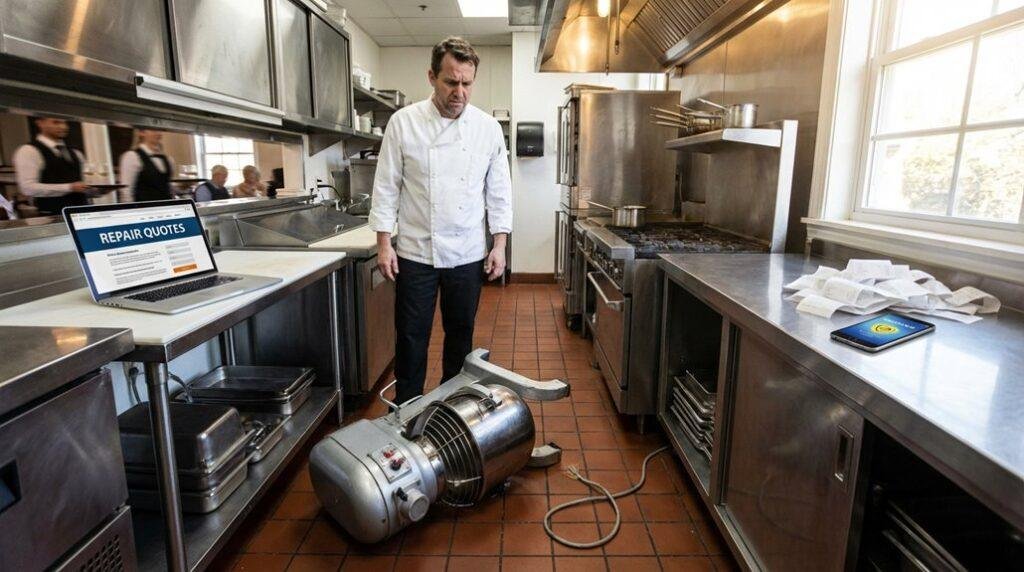
When restaurant equipment breaks, we initially assess repair urgency to prevent downtime and safety risks.
We check insurance policies, especially Equipment Breakdown Coverage, for claims.
You may be interested


Filing a damage claim quickly with detailed documentation speeds reimbursement.
If insurance falls short, we investigate small business loans or emergency grants designed for repairs.
Crowdfunding is also an option for swift funds.
Budgeting for repairs and preventive maintenance reduces future costs.
Keep going to uncover more ways to secure funds and maintain equipment.
Key Takeaways
- File an equipment breakdown insurance claim promptly with detailed documentation for repair or replacement costs coverage.
- Apply for emergency grants like PACE Restaurant Equipment Grant or local food-industry grants for financial support.
- Use SBA loans or equipment financing options for quick access to funds using equipment as collateral.
- Launch a crowdfunding campaign on platforms like Kickstarter or Foodstart to raise repair funds from community support.
- Allocate and maintain an emergency repair fund covering 1-3% of annual sales for immediate equipment repair needs.
How To Assess The Urgency Of Equipment Repairs
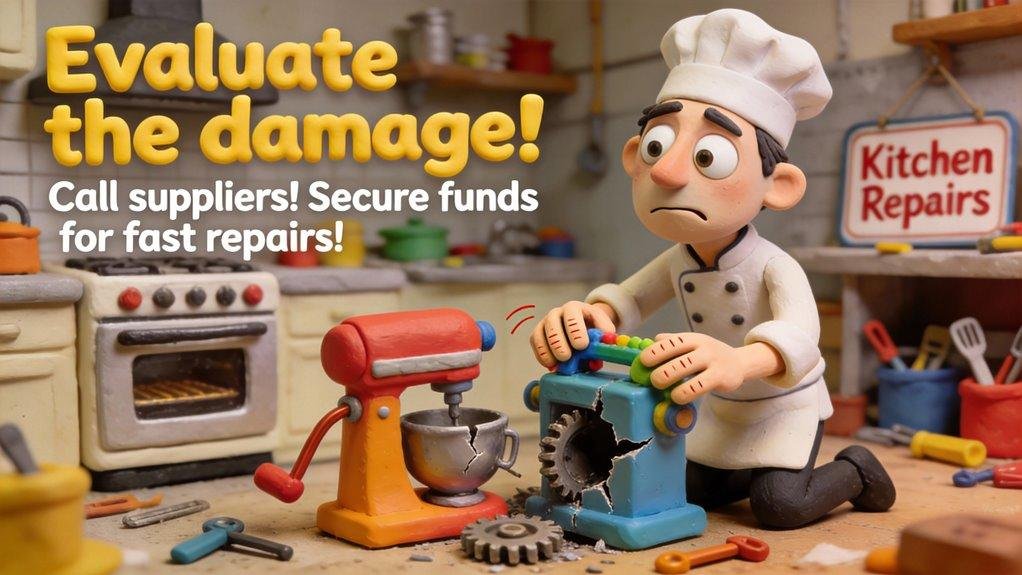
When restaurant equipment breaks, we initially need to assess how urgent the repairs are so as to keep your kitchen safe and running smoothly. To do this, we evaluate key urgency factors like safety risks and operational impact. Equipment posing fire, electrical, or gas hazards demands immediate focus to prevent accidents. Delaying repairs can incur high financial costs, making prompt attention essential. Additionally, access to emergency liquidity can provide operators with the necessary funds to address equipment failures quickly.
We also prioritize repairs based on how a failure interrupts your service, recognizing that major breakdowns stall orders and productivity, especially during peak hours. Performance degradation signs and visible damage guide repair prioritization by signaling worsening conditions that could escalate.
What Insurance Covers Broken Restaurant Equipment?
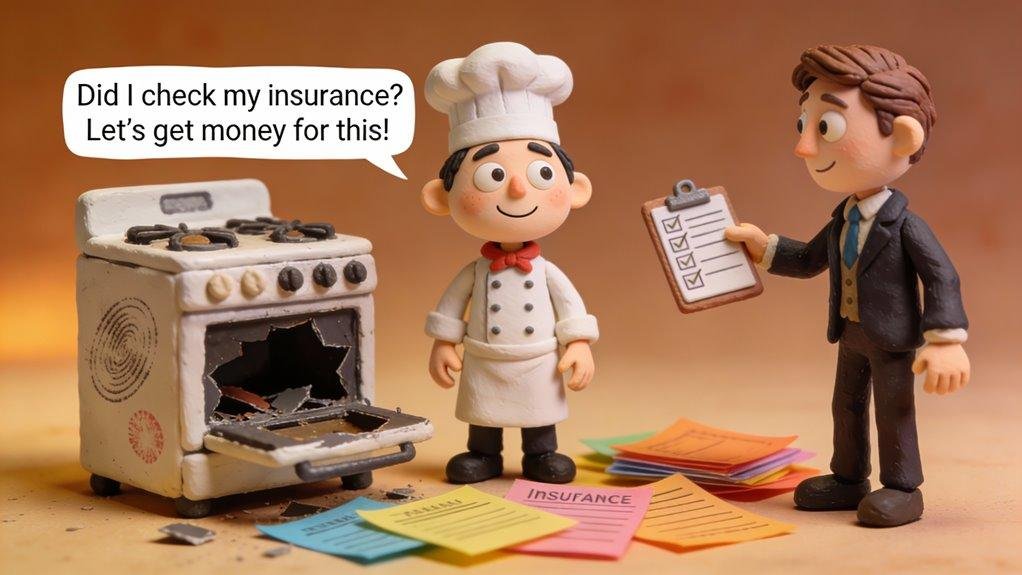
When restaurant equipment breaks, Equipment Breakdown Coverage usually handles the repair or replacement costs for key kitchen machinery. Property insurance may also play a role, but this is important to know exactly what your policy includes. Commercial property insurance typically covers damages caused by external events like fire or theft, but not internal malfunctions. Understanding the claim process helps us get reimbursed quickly and keep operations running smoothly. It is also crucial to ensure your policy includes coverage for internal malfunctions to avoid unexpected expenses.
Equipment Breakdown Coverage
Since restaurant equipment plays a vital role in daily operations, having equipment breakdown coverage is vital for protecting your business from unexpected malfunctions.
This coverage handles sudden breakdowns caused by mechanical failures, electrical shorts, or power surges that standard property insurance usually doesn’t cover. It includes repair or replacement costs, labor for restoration, and even spoilage expenses. These unexpected failures can lead to significant additional costs that might disrupt daily business activities.
While we focus on advanced equipment maintenance tips and preventative measures to reduce risks, breakdowns still happen. Equipment breakdown coverage steps in to minimize downtime and financial loss.
It covers important gear like refrigerators, cooking appliances, HVAC systems, and POS technology. By integrating this coverage into your insurance plan, you guarantee resilience against internal failures, letting your restaurant innovate and operate smoothly without fear of costly interruptions.
Property Insurance Role
Although equipment breakdown coverage specifically handles internal malfunctions, property insurance plays an essential role when restaurant equipment suffers damage from external events like fire, theft, or natural disasters.
Property insurance protects key assets, including kitchen appliances, furniture, and the building itself, often through a business owners policy. It reimburses repairs or replacements caused by covered perils such as fire or vandalism. Commercial Property Insurance covers building structures and contents, helping ensure comprehensive protection of restaurant property.
Nonetheless, it’s important to understand coverage exclusions. Property insurance generally doesn’t cover mechanical breakdowns, normal wear, or neglect. Moreover, spoilage and power surges might require specific add-ons.
Claim Process Essentials
While dealing with broken restaurant equipment can hinder our daily operations, understanding what insurance covers helps us manage these challenges efficiently.
Equipment Breakdown Coverage typically protects mechanical or electrical failures, including refrigerators, ovens, HVAC systems, and POS devices. It excludes normal wear and tear or damage from external events like fire. Restaurant insurance often includes this type of coverage to protect against equipment-related financial losses.
To steer through claims smoothly, having reliable claim representation guarantees we advocate effectively. We’ll provide detailed claim estimates covering repair costs, labor, and business interruption losses.
Key aspects to concentrate upon include:
- Verifying coverage details to avoid surprises
- Documenting the breakdown thoroughly for accurate claim estimates
- Working closely with claim representation for timely resolution
How To File A Damage Claim For Restaurant Equipment
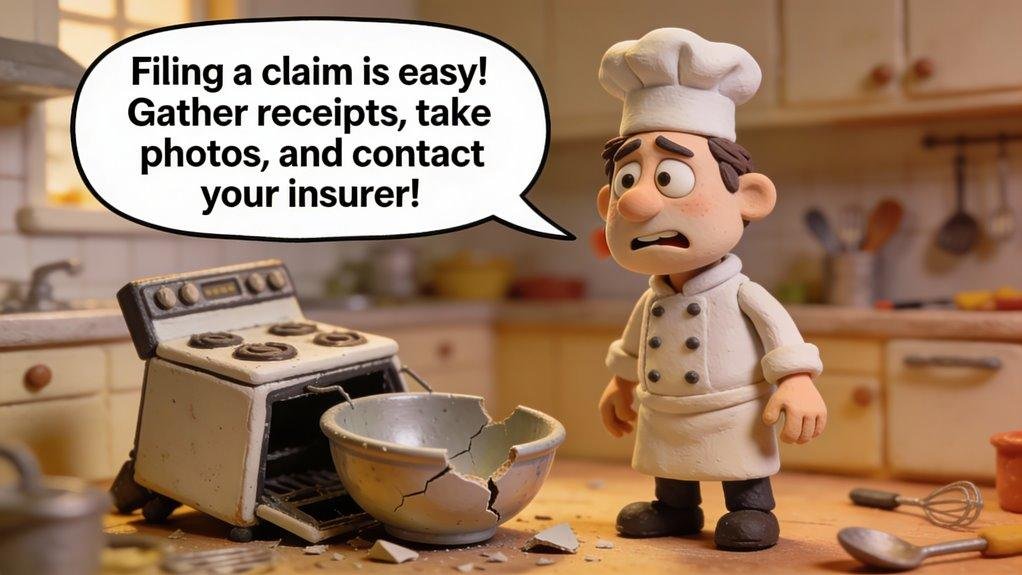
When equipment breaks, the initial step is to gather all the necessary documentation like photos, videos, and detailed lists of damaged items. Next, we need to contact our insurance provider promptly in order to start the claims process and understand their specific requirements. Staying organized and proactive at that stage makes filing the claim smoother and improves our chances of a successful outcome. Additionally, considering high-efficiency updates can also aid in avoiding future equipment failures and securing funding for renovations that enhance futuristic renovations.
Gather Necessary Documentation
In order to file a damage claim for restaurant equipment successfully, we need to gather thorough documentation right away. Accurate damage documentation and precise equipment valuation form the foundation of a strong claim.
We should document every detail to guarantee no damage is overlooked, which might affect the outcome or reimbursement amount.
Let’s focus on three critical steps:
- Capture extensive photographic and video evidence showcasing all visible damage from multiple angles. It is important to be aware that hidden damages frequently go underestimated and overlooked by adjusters.
- Maintain detailed observations about the incident’s timing, situation, and hidden damage like water intrusion or electrical faults.
- Obtain professional assessments and repair estimates that clearly outline costs and scope of work.
Contact Your Insurance Provider
In order to move forward effectively, we need to contact our insurance provider immediately after the equipment breaks down. Prompt insurance notifications are essential; filing a claim within 48 hours helps guarantee that it won’t be denied due to delay.
We’ll start by reviewing our policy to confirm coverage for mechanical failures or power surges, avoiding claims for excluded issues like wear and tear. Using our provider’s dashboard, we’ll file a detailed claim, including the time, location, and a clear description of the incident.
Strong claim strategies involve collaborating closely with adjusters to assess damages and negotiate fair compensation. By acting swiftly and following precise protocols, we can reduce downtime and secure the funds needed to repair or replace vital equipment efficiently.
Where To Find Small Business Loans For Restaurant Equipment
Although obtaining funds for restaurant equipment might seem challenging, we have several solid loan options to examine that fit different needs and credit profiles.
Understanding the right loan providers and the application process can help us get the equipment we require quickly and efficiently.
Here are three innovative options to evaluate:
- SBA Loans offer up to $5 million with flexible credit terms and long repayment periods, ideal for major equipment investments.
- Term and Equipment Loans provide quick access to funds, sometimes within 24 hours, using the equipment itself as collateral to reduce upfront costs.
- Vendor and Leasing Financing allows us to avoid large initial payments with low monthly fees, perfect for maintaining cash flow while upgrading crucial kitchen gear.
Exploring these options guarantees we stay ahead without compromising innovation or financial stability. Modern lending solutions for culinary equipment upgrades can also enhance our operational efficiency.
How To Qualify Quickly For A Restaurant Equipment Loan
Qualifying quickly for a restaurant equipment loan depends largely on meeting a few key criteria that lenders look for.
Initially, maintaining a minimum personal credit score around 620 helps, but even scores near 600 can work if other factors are strong. Demonstrating consistent cash flow is essential, so having the last three months of bank statements ready can speed up approval.
Typically, having at least one year in business and monthly revenues above $10,000 better positions us for equipment financing. Lenders also prefer clear documentation like tax returns and equipment quotes.
Using equipment as collateral can accelerate approval, sometimes within 24 hours. Additionally, understanding the importance of monthly cash flow cycles can enhance our overall funding strategies. Ultimately, taking advantage of online applications designed for efficiency can lead to same-day funding, helping us replace broken equipment without delay.
How To Decide Between Leasing And Buying Restaurant Equipment
How do we decide whether to lease or purchase restaurant equipment? The choice hinges upon factors like Equipment Lifespan and financial goals, making the Lease vs. Buy debate central to our strategy.
Leasing offers lower upfront costs and flexible upgrades, great for tech that evolves swiftly. Buying, meanwhile, builds equity and maximizes long-term savings for durable, high-use gear.
In order to guide us:
- Opt for buying durable equipment like ovens to benefit from longevity and ownership.
- Use leasing for short-term or specialized tools, such as POS systems, to stay current with innovation.
- Consider maintenance and repair coverage in leases to reduce downtime and unexpected expenses.
Balancing these points lets us align investments with both budget and operational needs confidently and strategically.
Using Equipment Financing To Improve Restaurant Cash Flow
Choosing whether to lease or purchase restaurant equipment shapes our overall approach, but managing our cash flow effectively can be just as impactful.
Equipment loan options offer us a smart way to acquire vital kitchen appliances or point-of-sale systems without draining our working capital. By using the equipment itself as collateral, these loans often require low down payments and provide flexible terms from months to years.
This setup lets us make fixed monthly payments while putting new gear to work immediately, preserving cash for daily operations and unexpected expenses. Furthermore, financing covers installation and taxes, which simplifies budgeting.
Negotiating Better Payment Terms With Equipment Vendors
When negotiating with equipment vendors, one must understand their standard payment terms initially so we know where to begin. We can then request extensions that fit our cash flow needs without straining the relationship.
Flexible financing options often provide the best path toward easing immediate expenses while maintaining good vendor partnerships.
Understanding Standard Payment Terms
Although standard payment terms like Net 30 are common in the restaurant equipment industry, we can often negotiate better arrangements that suit our cash flow and enterprise needs.
Understanding these terms gives us advantage in vendor relations, ensuring smooth transactions and financial flexibility. Common payment terms include variations like Net 7, 15, or even 90 periods, as well as End of Month or Cash upon Delivery conditions.
In order to innovate our approach, we can:
- Align payment terms with our cash flow cycles for better budgeting.
- Use clear contracts to document terms and protect interests.
- Utilize early payment discounts when feasible to save costs.
Mastering payment terms strengthens vendor relations and boosts our ability to respond quickly when equipment breaks.
Strategies For Requesting Extensions
Gaining proficiency in payment terms gives us an advantage when approaching vendors confidently while requesting extensions.
We start by analyzing why we need more time and identifying cash flow goals. Targeting key suppliers based on strategic value helps focus our efforts.
Clear, customized messaging that highlights mutual benefits strengthens our position during supplier negotiations. Demonstrating how extensions can lead to increased orders or future business supports our case.
Creative solutions like early payment discounts or supply chain financing can ease vendor concerns while providing cost reduction. Implementing a phased approach guarantees consistency and makes negotiations manageable.
Equipping our team to address objections professionally builds credibility. Overall, these strategies align innovation with fiscal responsibility, enabling us to secure flexible payment terms that keep our restaurant equipment running smoothly without compromising vendor relationships.
Benefits Of Flexible Financing
Even if cash flow is tight, flexible financing options let us acquire vital restaurant equipment without a heavy upfront cost.
By negotiating flexible terms with vendors, we can ease immediate financial pressure while securing indispensable assets. These financing options often come with lower down payments or minimal initial fees, preserving cash flow for daily operations.
They also offer predictable monthly payments, making budgeting smoother and reducing surprises.
Key benefits include:
- Low or no upfront fees, reducing initial capital needs
- Customizable payment plans designed for our cash flow cycles
- Potential tax advantages through expense deductions
How To Access Emergency Grants For Restaurant Equipment Repairs
When restaurant equipment breaks unexpectedly, accessing emergency grants can provide the funding needed to quickly repair or replace vital tools.
Initially, we should review grant eligibility carefully. Programs like the PACE Restaurant Equipment Grant focus upon energy-efficient upgrades in Boulder County, while Los Angeles Food-Industry Grants support small food-service businesses with up to $15,000 for equipment improvements.
Review eligibility carefully; grants like PACE and Los Angeles Food-Industry support energy upgrades and equipment improvements.
The application process often requires submitting permits, financial documents, and explanations of fund usage. We can also investigate options such as the Restaurants Care Resilience Fund for unpredictable hardships or utility rebates like LADWP’s Food Service Program.
Staying organized and acting promptly is key for securing funds before they run out. By understanding eligibility and following application steps, we position ourselves to access innovative grants and keep our operations running smoothly.
How To Crowdfund Quick Capital For Repairs
How can restaurants quickly raise capital for urgent equipment repairs? Crowdfunding strategies offer an innovative path to emergency funding by connecting directly with your community and beyond.
Platforms like Kickstarter and Indiegogo provide flexible models to match your funding urgency. Specialized sites like Foodstart and Honeycomb Credit cater specifically to food businesses, letting you offer perks or local investment options.
To crowdfund effectively, consider these key tactics:
- Create a persuasive pitch outlining the repair’s urgency and impact.
- Offer enticing perks such as discounts, free meals, or exclusive events.
- Engage consistently with your backers, addressing comments and fulfilling promises.
Budgeting For Surprise Restaurant Equipment Repairs
Relying on outside funding like crowdfunding can help in urgent situations, but the best approach toward managing surprise restaurant equipment repairs starts with solid budgeting.
We recommend allocating 1-3% of annual sales to repair budgeting based on industry standards. Performing a thorough equipment assessment, including age, condition, and past repairs, helps tailor a realistic budget.
Tracking maintenance history lets us predict upcoming expenses and adjust reserves accordingly. Setting up a dedicated emergency repair fund guarantees quick access to cash without interrupting operations.
Using spreadsheets to monitor equipment details and cash flow projections keeps our budget responsive to changes. Regularly reassessing repair budgets in alignment with equipment wear keeps the plan innovative and practical, minimizing downtime and unexpected costs.
Preventing Equipment Breakdowns To Save Money Over Time
Preventing equipment breakdowns requires us to stay proactive with regular care and focus. By embracing preventive maintenance, we extend our equipment lifespan and reduce costly interruptions.
Regular upkeep helps catch minor issues before they escalate, keeping our kitchen running smoothly. Here are three key actions to innovate your maintenance strategy:
- Implement daily cleaning routines that include wiping surfaces and checking refrigeration seals.
- Schedule weekly tasks like cleaning condenser coils and inspecting gas connections for safety.
- Perform monthly inspections with lubrication and calibrate temperature controls to enhance performance.
These steps not only improve reliability but also protect our investment. Incorporating structured preventive maintenance plans guarantees we save money over time and maintain state-of-the-art operational efficiency, minimizing the risk of unexpected equipment failures.
Frequently Asked Questions
What Are Common Signs That Restaurant Equipment Needs Repair?
We notice wear and tear through performance issues like inconsistent temperatures, unusual noises, visible damage, and efficiency drops. By identifying these early, we innovate repair strategies to keep equipment reliable and minimize downtime.
How Long Do Typical Restaurant Equipment Repairs Take?
We know typical repair timelines for restaurant equipment range from 2-6 hours, depending on the issue. Prioritizing equipment maintenance helps us innovate, reducing downtime and enhancing efficiency in our rapid kitchen environments.
Can I Continue Operating Safely With Broken Equipment?
We can’t continue operating with broken equipment; strict safety protocols prevent injuries and regulatory issues. Addressing equipment impact swiftly protects our team and innovation flow, ensuring productivity doesn’t compromise safety or quality.
Are There Tax Deductions for Restaurant Equipment Repairs?
Yes, we can claim tax benefits by immediately deducting routine repairs without repair depreciation. That smart approach reduces taxable income and accelerates savings, letting us innovate while maintaining kitchen gear efficiently and compliantly.
How Do I Find a Reliable Repair Technician Quickly?
We find reliable repair services swiftly by checking technician reviews online and prioritizing CFESA-certified technicians. Let’s use tech-savvy platforms that showcase ratings, ensuring we connect with skilled experts who innovate and resolve issues rapidly.
