

We’ve found that monthly revenue-based payments offer a smarter alternative for daily cash advances for restaurants.
Such a model aligns repayments with actual sales, reducing overdraft risks and supporting better cash flow management. It consolidates daily withdrawals into one predictable monthly payment, cutting fees and easing financial planning.
You may be interested


Additionally, it improves credit building and supplier relationships. Technology now enables quick approval, making funds accessible without bank hassles.
Exploring further reveals how it can change your restaurant’s financial stability.
Key Takeaways
- Monthly revenue-based payments align with restaurant sales cycles, offering flexible repayments tied to actual daily sales volume.
- This alternative reduces overdraft risks and stabilizes cash flow by consolidating daily cash advances into one predictable monthly payment.
- Using real-time sales data integration ensures accurate monthly payments, streamlining financial management and preventing manual calculation errors.
- Monthly repayments improve budgeting, minimize NSF fees, and accelerate debt payoff without requiring personal guarantees or collateral.
- Digital underwriting via private credit enables quick approval within 24 hours, bypassing banks and focusing on revenue-based qualification.
The Death Of The Daily Draw In Hospitality
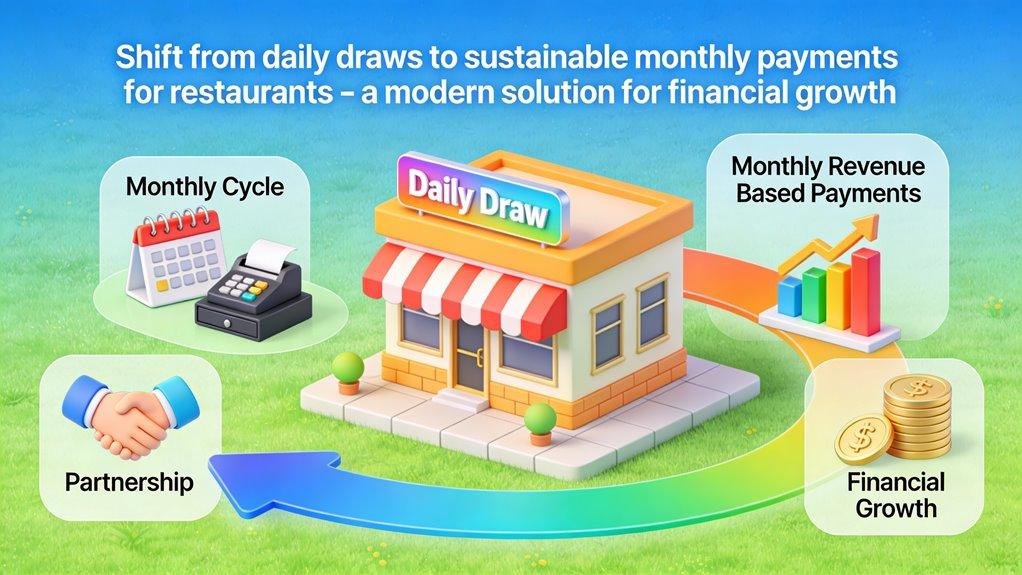
We’re seeing how daily withdrawals are quietly strangling restaurant profitability by draining cash flow before owners can make strategic decisions. This survival-mode funding keeps restaurants stuck in a cycle of short-term fixes rather than supporting real growth. Utilizing monthly revenue-based payments instead of daily draws helps protect liquidity by matching payment structures to the asset’s useful life. Additionally, adopting blockchain innovation in financing can enhance transparency and efficiency in revenue-based lending. This is time to shift our focus toward monthly revenue-based payments that align with business performance and create breathing room for smarter financial planning.
Why Daily Withdrawals Are Strangling Modern Restaurant Profitability
Although daily cash withdrawals once assisted restaurants manage short-term emergencies, they now suffocate profitability by eroding already slim margins.
Restaurants operate with tight pre-tax profits, often below 5%, leaving no room for fixed daily deductions. These daily draws create a constant drain, pushing many into overdraft traps and cascading negative cash flows. In fact, rising input costs have led to situations where restaurants face losses equating to nearly 24% of sales, making daily withdrawals even more burdensome on cash flow.
Labor and food costs already strain budgets, so losing funds every day limits our ability to manage prime costs effectively. Monthly restaurant funding offers a smarter alternative, aligning payments with revenue cycles and providing breathing room to negotiate with suppliers and enhance operations. This approach can help operators avoid the pitfalls of daily draws while addressing the profitability challenges they currently face.
Transitioning From Survival Funding To Strategic Growth Capital
The daily draw model served as a quick fix when restaurants faced immediate cash crunches, but that no longer supports the growth ambitions numerous individuals possess.
Today, we’re moving toward predictable restaurant capital that aligns with actual monthly revenue, giving operators clear financial breathing room. This approach is increasingly favored because investors seek early-stage concepts with disruptive potential that demonstrate stability and forward momentum.
This shift lets us step away from the overdraft trap caused by daily withdrawals that chip away at cash flow and strategic thinking. Instead, monthly revenue-based payments offer stability, letting us better manage prime costs and negotiate supplier terms confidently.
The Anatomy Of Monthly Revenue Based Financing
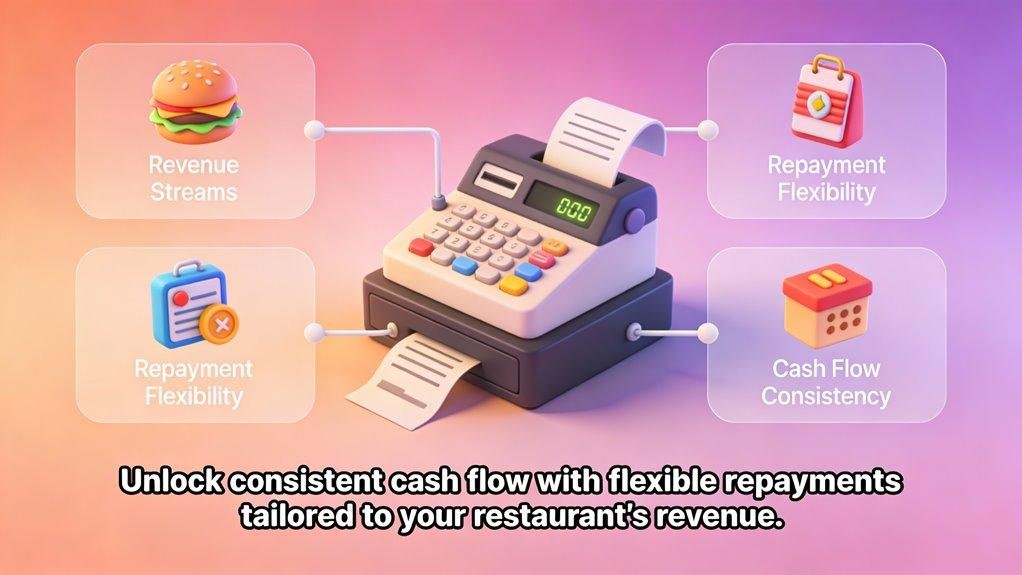
Let’s investigate how monthly revenue-based financing aligns with your profit and loss statement and payroll schedules, creating a smoother cash flow cycle. Such method uses your POS system to calculate fair, accurate payments tied directly to actual sales, avoiding guesswork. This approach offers a flexible repayment structure that adjusts based on your daily sales volume, helping you manage lean periods more effectively. Furthermore, this system is similar to revenue-based loans designed for healthcare providers, enabling businesses to secure funding that is responsive to their income fluctuations.
How Monthly Alignment Synchronizes With Your P&L And Payroll
When we align loan repayments with monthly revenue, we create a natural rhythm that simplifies managing both your profit and loss statement and your payroll cycle.
Monthly business advances tie repayments directly to your actual earnings, making payments flexible and responsive. Such a model prevents cash flow strain during slow months and matches your payroll schedule, so employee costs remain manageable. That turns unpredictable loan payments into a variable, predictable expense that scales with your business performance.
- Repayments adjust automatically with monthly revenue fluctuations
- Payments scale down during slow periods, easing profit and loss pressure
- Alignments sync with payroll timing to preserve labor costs
- Variable payments reduce financial volatility compared to fixed loans
- No collateral, allowing focus on gross revenue for smooth cash flow control
Because revenue-based financing requires less stringent documentation, the approval process is generally faster, enabling quicker access to funds.
This approach lets us innovate confidently while keeping finances stable.
The Role Of POS Integration In Calculating Fair Remittance
Integrating your POS system directly with your financing platform changes how we calculate fair remittance for monthly revenue-based financing. By linking real-time sales data, we can mechanize pos-linked monthly payments that reflect your restaurant’s actual performance. This real-time sales data integration allows payments to scale proportionally with daily revenue, adjusting spontaneously with busy or slow periods. We set payment terms based on your cash flow capacity, ensuring withdrawals align with what your business can handle without strain.
POS integration also enables smooth monitoring through dashboards, reduces errors from manual calculations, and pulls precise data for accurate recipe costs and menu profits. Overall, this technology powers fair, transparent payments that protect your cash flow and support growth, advancing the monthly revenue-based financing model beyond traditional cash advances. Moreover, this approach helps maintain liquidity for essential expenses like inventory and payroll, which is crucial for fast food restaurants dealing with fluctuating sales patterns.
Protecting Your Bank Balance From Predatory NSF Cycles
Having POS integration finely tune payment calculations, we now face a bigger challenge that monthly revenue-based financing solves: protecting your bank balance from predatory NSF cycles.
Traditional daily cash advances create repeated NSF fees, draining 10-20% of monthly cash flow and trapping restaurants in costly cycles. Revenue based financing for restaurants aligns payments with actual sales, reducing overdraft risk and preserving working capital.
This approach not only prevents constant balance depletion but also offers predictable cost control. Consider these key protections:
- Payments scale with monthly gross revenue, easing slow periods
- Single monthly withdrawal cuts fee frequency dramatically
- Caps on total repayment end debt cycles early
- Real-time adjustments prevent overnight overdrafts
- No personal guarantees, safeguarding your equity
Strategic Benefits Of Non-Daily Funding Models
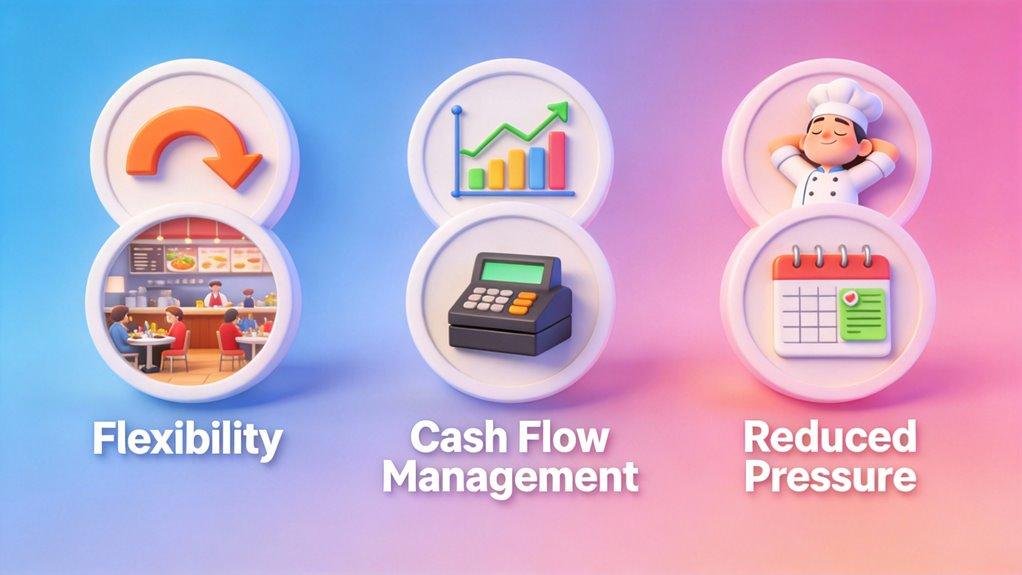
When we consolidate multiple daily MCAs into one monthly payment, we simplify cash flow and reduce the constant pressure from daily withdrawals. This enhances liquidity, giving us room for negotiating better terms with our suppliers.
Consolidating Multiple MCAs Into A Single Monthly Payment
Even if you’ve been juggling multiple daily MCAs, consolidating them into a single monthly payment can change how you manage your restaurant’s finances. Embracing a mca alternative 2026 means simplifying repayment, cutting costs, and gaining financial clarity.
Here’s how consolidation boosts your strategy:
- Simplifies debt management with one predictable monthly payment
- Lowers interest rates and total repayment costs
- Frees cash flow by replacing daily draws with monthly scheduling
- Improves budgeting by providing a clear repayment outlook
- Builds credit and opens doors to future financing
Moving away from daily draws relieves operational strain. This shift isn’t just about fewer payments—it’s about gaining breathing room to plan, grow, and invest confidently in your restaurant’s future.
Negotiating Better Supplier Terms With Improved Liquidity
Since reliable liquidity sets the foundation for stronger supplier relationships, switching towards a monthly payment model can reshape how we negotiate with vendors. With improved cash flow stability, we gain the flexibility to request extended payment terms, signaling financial strength.
This improves our bargaining power, enabling bulk purchases that lower costs through volume discounts. By shifting from reactive to proactive dealings, we cultivate supplier loyalty and may secure exclusive deals or priority service.
In addition, monthly revenue-based payments reduce reliance on daily draws, freeing working capital to support timely payments and operational needs. Embracing restaurant debt refinancing with that approach simplifies our finances and supports growth.
Ultimately, improved liquidity through non-daily funding models allows us to negotiate better supplier terms while stabilizing cash flow in the competitive 2026 environment.
Navigating The 24-Hour Approval Landscape
We’ve entered a fresh period where connecting your restaurant’s digital finance systems allows lenders to assess your business instantly without digging through piles of paperwork.
This mechanized underwriting process cuts out banks and speeds up approvals, making private credit the preferred option in 2026.
Let’s investigate how linking your POS, payroll, and bank data creates a smooth path for quick funding with fewer obstacles. This innovation not only enhances the speed of securing funds but also aligns with smart financing solutions that cater directly to the needs of bootstrapped businesses.
Connecting Your Digital Stack For Automated Underwriting
When we connect your digital finance stack through APIs, underwriting moves from a slow, paperwork-heavy process to a quick and mechanized one. Such integration powers hospitality cash flow solutions that align with your actual performance, offering precision and speed.
Instead of hunting down bank statements, real-time data feeds let us analyze your financial health instantly. Machine learning models then assess your risk accurately and swiftly, supporting a smooth approval process.
- APIs link POS, payroll, and banking systems for instant data retrieval
- Mechanized decision engines generate risk scores with algorithmic accuracy
- Verification tools validate identity and financial data without manual checks
- RPA handles repetitive underwriting tasks, freeing up time for critical steps
- 24-hour approvals become routine, reflecting your current revenue situation
This digital collaboration is the backbone of modern underwriting.
Bypassing The Bank: Why Private Credit Is The 2026 Standard
Connecting your digital finance stack simplifies underwriting, but the next step is understanding where your best funding source originates from.
Banks hesitate to lend for restaurants due to perceived risks and strict documentation. That’s why private credit has become the 2026 standard. It offers quick approvals and flexible structures like non-daily cash advances, enabling us to move away from daily drains.
Here’s how private credit stacks up:
| Feature | Private Credit |
|---|---|
| Approval Time | 24 hours or less |
| Funding Flexibility | Monthly revenue-based payments |
| Qualification Criteria | Revenue-focused, less rigid |
Bypassing banks lets us secure capital promptly and manage payments aligned with revenue. This shift gives us the breathing room to scale confidently and avoid overdraft traps.
Frequently Asked Questions
How Does Monthly RBF Impact My Credit Score?
We don’t worry about monthly RBF hurting our credit because this doesn’t impact personal scores. Soft credit checks don’t affect us, so we can innovate confidently, focusing upon our revenue growth without credit stress holding us back.
Are There Minimum Revenue Requirements for Monthly RBF Eligibility?
Yes, we do need minimum revenue thresholds to qualify. Most lenders ask for monthly revenues between $7,500 and $30,000, ensuring steady cash flow so we can confidently manage variable, monthly-aligned payments without hindering growth.
Can Monthly RBF Coexist With Traditional Bank Loans?
Yes, we can use monthly RBF alongside traditional bank loans. Their flexible repayments align with revenue, easing cash flow while banks offer stability. Together, they create an adaptable, innovative funding strategy that scales with our restaurant’s growth.
What Happens if My Monthly Revenue Declines Significantly?
If our monthly revenue dips considerably, the payment adjusts downward automatically, giving us breathing room. There’s built-in protection, so repayments scale with actual performance, helping us manage downturns without added pressure or risking overdraft traps.
Is Monthly RBF Suitable for New Restaurant Startups?
We get it—monthly RBF suits startups with steady early income and at least two months operating. For unpredictable or seasonal cash flows, the situation is trickier, but with smart forecasting, we can still tap growth without sacrificing flexibility.
