

Short-term funding before peak season helps us build inventory, hire staff, and enhance marketing without cash flow stress.
By securing capital during the off-season, we get better lending terms and avoid last-minute credit shortages.
You may be interested


Using data-driven forecasts, we can budget precisely and align funding draws with supplier lead times to maximize liquidity.
This approach guarantees we’re ready for increased demand and operational challenges.
Investigate how innovative funding structures can change your seasonal business growth.
Key Takeaways
- Secure off-season growth debt to access better lending terms and build inventory, staff, and technology before peak demand.
- Use short-term seasonal credit to cover pre-season hiring and training costs, bridging cash flow gaps without long-term debt.
- Align funding draws with supplier lead times to ensure liquidity matches inventory purchase schedules and prevent supply delays.
- Leverage predictive AI underwriting for fast approvals by analyzing historical peak data and real-time revenue trends.
- Base repayment schedules on revenue cycles, increasing during peak months and easing off-season burdens for better cash flow management.
The Evolution Of Seasonal Capital Management
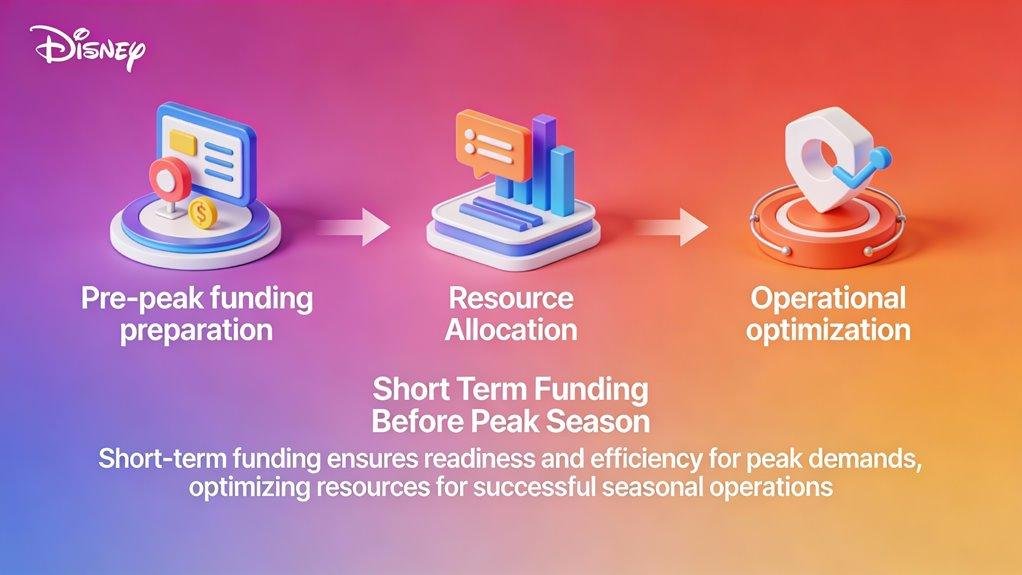
We know that the off-season isn’t just downtime; it’s the prime moment to lock in growth debt. Instead of scrambling to survive peak demand, we can use this period to build capacity aggressively and position ourselves for success. Understanding seasonal cycles allows us to forecast capital needs more accurately and manage resources effectively. By leveraging temporary funding solutions, skilled tradesmen can efficiently cover the gaps between project phases and sustain growth throughout the off-season.
Let’s investigate how shifting our funding strategy from reactionary to proactive alters seasonal capital management.
Why The “Off-Season” Is The Best Time To Secure Growth Debt
Although the off-season is marked by lower cash flow, this presents the best opportunity for securing growth debt for seasonal businesses.
By tapping into offseason funding advantages, we can proactively manage capital when competition for credit is lower and lenders offer better terms based upon data-backed cash flow forecasts. Securing debt during slow periods allows us to avoid peak-season liquidity crunches. This approach reflects the essential importance of cash flow management to navigate seasonal financial challenges.
Such timing helps build capacity rather than just cover bills. Taking a strategic approach means we can invest in inventory, technology, and staffing before demand spikes.
In 2026’s rapid economy, waiting until peak season means missing the chance to enhance working capital and capture maximum growth. The off-season is not a hurdle, it’s a strategic launchpad for scaling efficiently and confidently.
Moving From Survival To Aggressive Capacity Building
Many seasonal businesses still treat capital management as a way for surviving peak periods rather than for building lasting capacity.
In 2026, that mindset limits growth. We need to shift our approach and use seasonal working capital strategically to expand capacity aggressively.
Instead of patching cash flow gaps, we invest in workforce training, equipment upgrades, and inventory stockpiling before the surge. Leveraging advanced forecasting and peak-to-peak underwriting, we can secure funding that’s aligned with true seasonal demand, not just recent low revenue. By recognizing seasonality as a predictable rhythm, businesses can better anticipate needs and optimize their capital deployment.
This proactive capital use allows us to capture market share and scale operations efficiently. Moving from survival to aggressive capacity building changes seasonal funding into a powerful growth lever, not just a safety net, ensuring we lead our markets rather than follow them.
High-Impact Use Cases For Pre-Season Capital

Let’s look at how pre-season capital releases real advantages in 2026. By stockpiling inventory, we reduce risk from supply swings and cost spikes. Additionally, ensuring production efficiency allows us to meet the heightened demand effectively during peak season. At the same time, funding early hiring and training closes operational gaps before revenue hits, while launching marketing campaigns gains us market share ahead of the rush. Taking action in the quieter Q1 period can also secure premium valuations, positioning startups strongly for later fundraising rounds.
Inventory Stockpiling To Hedge Against Supply Volatility
When we face supply volatility, inventory stockpiling becomes a crucial strategy to guarantee business growth during peak seasons. With inventory stockpiling loans, we secure the capital needed to build a safety buffer that protects us from unexpected supply chain interruptions.
To enhance this approach, we focus upon:
- Targeting high-margin, high-turnover products affected by tariffs or delays, confirming stockpiling capital drives maximum impact. This approach helps balance the need for sufficient inventory without overstocking, effectively managing safety stock.
- Using AI demand forecasting to fine-tune stock levels, preventing excess inventory and avoiding missed sales.
- Distributing stock across multiple locations, enhancing last-mile efficiency and meeting local demand surges promptly.
This proactive strategy turns supply volatility from a threat into an opportunity, positioning us to capitalize aggressively during peak windows in 2026.
Funding The “Hiring And Training” Gap Before Revenue Starts
Because staffing requirements ramp up before revenue hits its peak, securing capital early for covering hiring and training is essential. Seasonal businesses often face fluctuating cash flows that make timing payroll and training expenses particularly challenging, so planning for this seasonal cash flow challenge is crucial.
Short term seasonal credit is an innovative solution that lets us bridge this timing gap without long-term debt. By using data-driven knowledge, we can forecast payroll and training costs precisely and act before competitors compete for talent.
Here’s how short term seasonal credit supports staffing:
| Use Case | Capital Needed | Benefits |
|---|---|---|
| Pre-season Hiring | $20k – $50k | Early talent lock-in |
| Training Programs | $30k – $75k | Efficient ramp-up |
| Payroll Bridge | $10k – $40k | Maintains staff motivation |
| Contingency Funds | $5k – $15k | Covers unforeseen expenses |
Smart capital utilization here isn’t just covering costs; it’s enabling growth.
Launching Pre-Season Marketing Blitzes For Maximum Market Share
Although capital constraints often force businesses into delaying marketing efforts, launching pre-season marketing blitzes early lets us seize market share before competitors react. With pre-season funding 2026 available, we can engineer campaigns that maximize impact in a crowded market.
Here’s how we utilize it:
- Customize communications using data-driven segmentation to enhance engagement and conversion rates through SMS and email.
- Distribute omnichannel content that generates increased impressions and social engagement, reinforcing our message daily. Utilizing real-time content and engagement during campaigns enables us to connect instantly with fans, boosting interaction and visibility.
- Start campaigns months in advance to reduce competitor demand, lower advertising costs, and scale efficiently before peak season.
Innovative 2026 Funding Structures For Cyclical Businesses
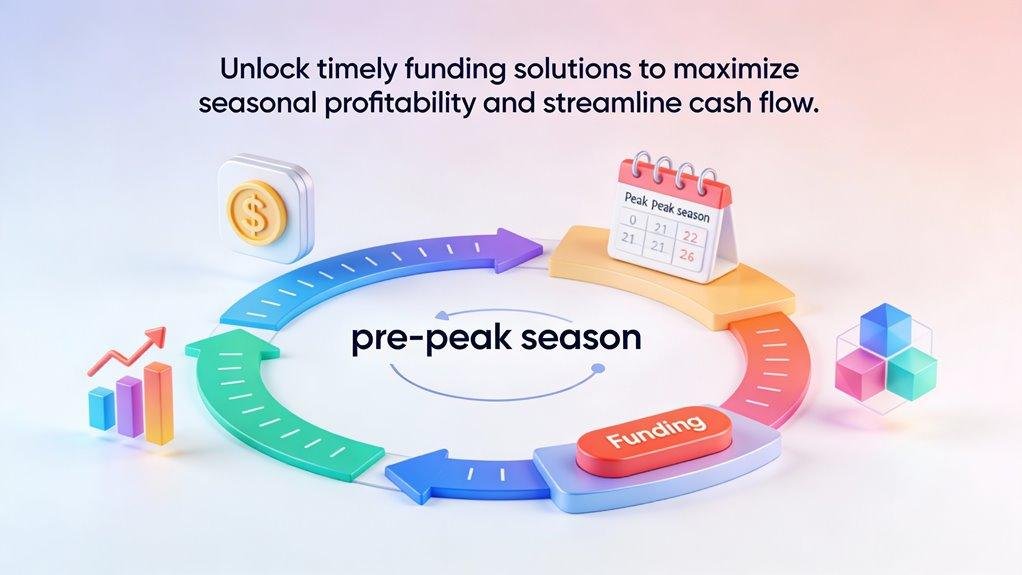
Let’s look at revenue-based advances that adjust for seasonal swings, giving cyclical businesses a funding option that fits their cash flow patterns.
Predictive AI underwriting now helps lenders see beyond slow periods by analyzing multi-year peak data, so we’re not rejected for low-season revenue. This approach releases capital precisely when we require it most, supporting growth without waiting for traditional cycles. Additionally, revenue loan options provide flexible financing solutions that align with the unique needs of first-time entrepreneurs.
Exploring Revenue-Based Advances With Seasonal Adjustments
When we investigate revenue-based advances with seasonal adjustments, we see a powerful new funding solution designed specifically for cyclical businesses in 2026. This approach aligns repayment schedules with your cash flows, making it ideal for managing peak season inventory loans.
Here’s how it stands out:
- Repayments flex fluidly, dropping during slower months and accelerating when sales peak to preserve liquidity.
- Seasonal multipliers enable pre-peak advances that support inventory buildup just before demand surges.
- Automated accounting integration guarantees real-time adjustments, keeping your funding aligned with actual revenue.
Using Predictive AI Underwriting To Bypass Low-Season Rejections
In 2026, three key advancements in predictive AI underwriting are changing how cyclical businesses secure funding during slow seasons.
Initially, these systems analyze multi-year peak performance, not just recent low-season cash flow. Secondly, independent AI agents monitor real-time inventory and revenue trends to flag timely funding needs. Third, mechanized data processing replaces manual reviews, enabling near-instant approvals.
By embracing predictive underwriting, we bypass traditional low-season rejections and align loans with future peak demand. This approach not only accelerates access to capital but also reduces default risks through performance-based terms.
For cyclical businesses, predictive AI underwriting alters seasonal funding from a hurdle into a strategic lever, allowing us to engineer growth instead of reacting to constraints. It is the innovation that turns slow seasons into launchpads for market capture.
The 24-Hour Checklist For Pre-Season Liquidity
To secure funding quickly, we need to have our historical peak data organized and ready for instant approval. This means aligning our draw schedules with supplier lead times to guarantee the right cash hits when it’s needed most. Let’s focus around synchronizing these elements to avoid delays and maximize our pre-season liquidity. Additionally, it’s crucial to optimize cash flow by efficiently managing outstanding billing to ensure seamless business operations.
Preparing Historical Peak Data For Instant Approvals
Since securing pre-season funding depends heavily regarding speed and accuracy, we need to gather and prepare your historical peak data with utmost care. This data fuels instant approvals by showcasing your ability to manage temporary labor capital and scale effectively.
To get there, focus on three fundamentals:
- Collect 3-5 years of peak season revenue, sales, expenses, and customer metrics like CAC and LTV.
- Identify and explain outliers such as spikes caused by one-time deals or economic shifts, ensuring lenders see the full image.
- Analyze trends using year-over-year growth and smoothing techniques to forecast realistic scenarios.
Aligning Your Funding Draw With Supplier Lead Times
When we align our funding draw closely with supplier lead times, we reduce the risk from cash flow gaps that can stall our pre-season preparations.
Demand-driven funding means matching our short-term capital injections to the exact timing suppliers need. This alignment accounts for variability and peak season extensions, ensuring liquidity when inventory investments are required.
Here’s a 24-hour checklist to guide us:
| Task | Timing Recommendation |
|---|---|
| Verify supplier lead times | Compare historical peak data |
| Schedule purchase orders | Add buffer intervals for delays |
| Adjust funding draw timing | Match lead times and buffers |
Frequently Asked Questions
How Does Seasonal Look-Back Underwriting Differ From Traditional Credit Assessments?
We see seasonal look-back underwriting focusing on real-time, peak-period cash flows and future capacity, unlike traditional credit’s backward-looking fixed scores. It allows us capture vibrant cycles and release capital trapped by outdated historic credit models.
What Risks Are Involved in Relying on Short-Term Funding Pre-Season?
We risk high interest costs, rigid repayment mismatches, and cash flow volatility that can strain our operations. If we don’t align funding terms with our seasonality, short-term debt might throttle growth instead of fueling growth.
Can Short-Term Funding Improve Relationships With Suppliers and Vendors?
Yes, we can use short-term financing to pay suppliers early, strengthening trust and collaboration. This enhances supplier stability and innovation, ensuring smoother operations and better pricing. Let’s utilize funding to build resilient, mutually beneficial partnerships.
How Do Autonomous Assets Impact Funding Approval Chances?
Autonomous assets enhance our funding approval chances by showcasing advanced efficiency and predictable performance. Lenders trust these tech-driven resources, making us standout borrowers who adopt innovation, reducing risk and expediting capital access for rapid growth.
What Metrics Do Underwriters Prioritize in Peak-To-Peak Performance Reviews?
We prioritize loss ratio trends, underwriting cycle times, and quality accuracy for gauge peak-to-peak performance. These metrics reveal true risk and capacity, letting us fund businesses ready for scale aggressively during their highest-demand seasons.
