

We offer swift ecommerce funding that delivers immediate capital for your holiday inventory, helping you avoid stockouts and lost sales.
Our solution uses AI-driven demand forecasting and real-time sales data to predict inventory needs accurately. Such an approach guarantees your cash flow stays strong by aligning repayments with your peak sales cycle.
You may be interested


Additionally, you gain quick access to funds without diluting ownership.
Keep exploring in order to see how we prepare your business for smooth, profitable peak seasons.
Key Takeaways
- AI-driven demand forecasting enables quick, accurate holiday inventory funding decisions for ecommerce businesses.
- Instant inventory advances use real-time sales data to expedite funding without traditional credit checks.
- Revenue-based financing aligns loan repayments with holiday sales surges, improving cash flow management.
- Same-day fund transfers via FedNow ensure rapid availability of capital for inventory procurement.
- Automated underwriting leverages sales velocity and API integration to fast-track approval and stock replenishment.
The Evolution Of Peak Season Capital Management
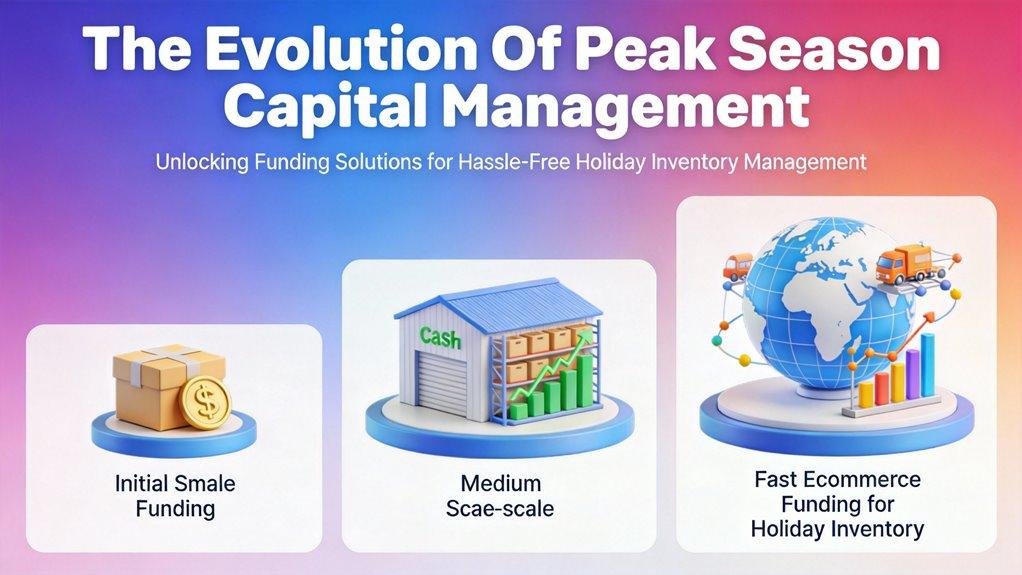
We’re seeing the cost associated with running out of stock rise sharply in today’s digital economy, where lost sales mean lost market share for good. Instead of reacting to demand, we have to anticipate the demand by securing rapid capital to keep inventory flowing smoothly. The transition towards predictive inventory liquidity is changing how we manage peak season funding and protect our growth. Embracing the Barbell Effect in inventory management—with a focus on full price and deep discount extremes—ensures efficient capital allocation and reduces costly mid-tier stock holdings. Utilizing revenue-based financing allows e-commerce businesses to access capital aligned with their sales performance, which can further enhance inventory strategies during peak seasons.
Why The “OOS” Penalty Is Higher In The Modern Digital Economy
Out-of-stock (OOS) events now carry a much steeper expense in the 2026 digital economy because they directly impact revenue and customer loyalty with unmatched force.
Nearly half of intended purchases disappear when items are unavailable, and 20% of online cart abandons relate to stockouts. This signifies wasted marketing spend as ads drive traffic to empty shelves, reducing ROI and increasing support costs.
Additionally, SEO penalties lower search rankings, shrinking organic visibility and making recovery harder. The risk intensifies as consumers quickly switch to alternatives, multiplying lost revenue.
Retailers also face higher operational costs due to the additional burden on customer support caused by stockouts.
That’s why innovative brands use holiday inventory loans to preempt stock gaps. Accessing capital rapidly allows us to stock smarter, keep customers, and secure digital shelf dominance—turning peak season challenges into growth opportunities with confidence.
Moving From Reactive Stocking To Predictive Inventory Liquidity
When ecommerce brands continue relying against reactive stocking methods, they often miss the mark in meeting customer demand during peak seasons.
Traditional practices depend against past averages and fixed reorder points, leaving brands vulnerable to stockouts or excess inventory. Instead, we must accept predictive stock funding, which uses AI-driven demand forecasting and real-time data to anticipate inventory needs before they arise. Leveraging AI-Powered Demand Forecasting enables brands to analyze complex customer behavior and market trends to refine inventory accuracy continuously.
This shift replaces guesswork with precise analytics, combining sales history, customer behavior, and market trends, to enhance capital allocation. By integrating predictive stock funding, we improve cash flow, reduce costs, and guarantee the right products are ready exactly when needed.
Moving forward, adopting this proactive approach positions us to capitalize against peak season opportunities without the costly pitfalls of reactive stocking.
Mechanics Of Instant Inventory Advances
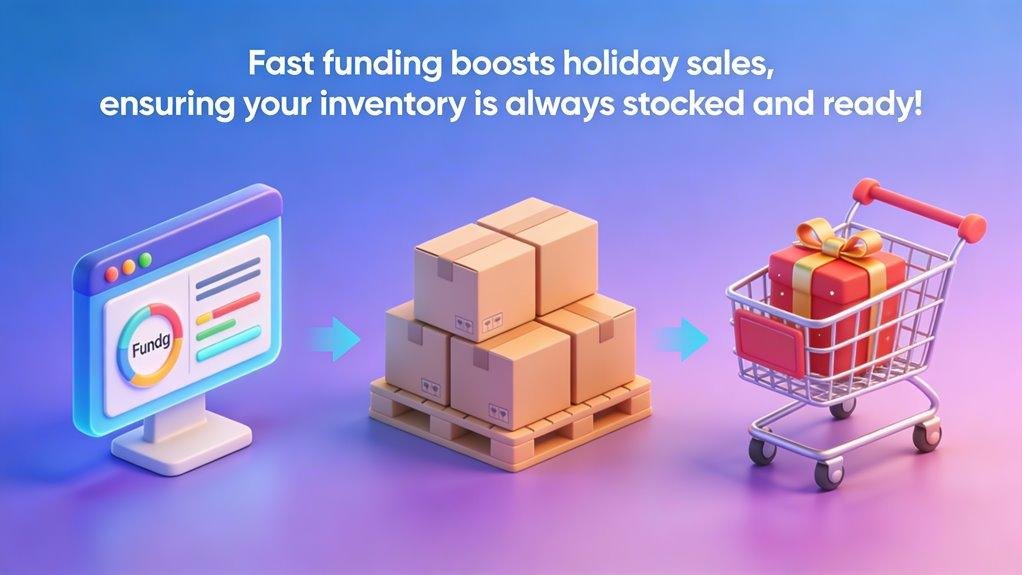
We utilize real-time demand signals to power algorithmic underwriting that approves inventory advances swiftly and accurately. With FedNow Settlement, funds reach manufacturers the same day, bypassing traditional bank delays so you can secure critical production slots promptly. This smooth process guarantees your inventory arrives in time, ready for peak season sales. By integrating with automated inventory management systems, we ensure your stock levels are updated instantly across all sales channels, reducing risks of stockouts during busy periods. This approach helps in optimizing cash flow to keep your business operations seamless and efficient.
Leveraging Demand Signals For Algorithmic Underwriting
Data is the engine behind algorithmic underwriting for instant inventory advances. By tapping into demand signals, we gain a real-time view of market activity that powers funding decisions.
Here’s how we utilize these observations:
- Extract diverse data, from historical sales to live inventory levels, across platforms.
- Use AI to identify demand patterns predicting inventory needs and risk.
- Integrate external inputs like news sentiment to improve predictive models.
- Accelerate approvals by automating risk scoring based on detailed demand trends.
This approach replaces slow, manual reviews with instant, accurate underwriting. It lets brands secure capital quickly to stock up before holiday surges. As industries move towards agentic commerce, leveraging autonomous AI agents to handle complex transactions, fast, data-driven funding decisions become even more critical.
Ultimately, understanding and responding to demand signals helps us finance inventory with confidence, capitalizing on every sales opportunity before others even recognize the necessity.
How FedNow Settlement Bypasses Traditional Bank Latency
Because instant inventory funding requires rapid cash flow movement, FedNow settlement completely changes the game by eliminating the delays built into traditional banking systems.
Unlike ACH’s batch processing, FedNow settles each transaction individually and in under 20 seconds. This real-time gross settlement moves funds directly between bank controller accounts, providing finality without waiting periods. Available 365 days, FedNow operates continuously including weekends and holidays, which is crucial during peak inventory purchasing times.
For us, that means we can secure same-event inventory advances with guaranteed liquidity at any hour. There’s no longer a need for enduring the uncertainty of deferred net settlements or reversal risks.
FedNow works 24/7, enabling instant cash transfers that keep inventory flowing smoothly. By cutting out traditional latency, we gain a powerful edge in funding holiday stock quickly and confidently, ensuring our supply matches demand without delay.
Securing Production Slots With Same-Day Manufacturer Payments
Instant payments for manufacturers give us the advantage in locking in priority production slots during the busiest holiday periods. Same-day advances enable immediate cash flow directly to suppliers, eliminating traditional wire delays and preventing costly production hold-ups. This capability is essential as demand surges.
Here’s how we utilize these mechanics for instant inventory advances:
- Automated funding APIs release payments the moment an order confirms.
- Real-time risk models approve inventory advances within minutes.
- ERP and warehouse systems sync to trigger payments following stock alerts, ensuring real-time inventory synchronization.
- Direct same-day ACH or RTP transfers secure prioritized manufacturer capacity.
Strategic Benefits Of Non-Dilutive Holiday Funding

We can scale for Q4 without giving up any brand equity by choosing non-dilutive funding options that keep us fully in control. This strategy helps us hedge against shipping volatility by securing inventory early and guarantees our repayments align with the holiday sales surge. Additionally, utilizing non-dilutive funding alternatives can provide businesses with a viable means of financing without sacrificing ownership stakes.
Scaling For Q4 Without Giving Up Brand Equity
As we prepare for scaling in Q4, maintaining brand equity remains a top priority that non-dilutive holiday funding uniquely supports.
With q4 ecommerce funding, we avoid equity dilution, keeping full ownership and control over brand strategy. This confirms decisions align with our long-term vision without investor interference.
Non-dilutive capital also raises cash flow flexibility, allowing us to respond rapidly to demand spikes and market shifts. By funding targeted marketing early, we maximize ROI and extend our holiday sales window.
Significantly, this enables investments in customer loyalty through customized offers and VIP programs, solidifying emotional brand connections.
In conclusion, non-dilutive funding helps us:
- Retain ownership and brand autonomy
- Improve cash flow for agile operations
- Amplify marketing impact
- Strengthen customer loyalty for lasting growth
Hedging Against Shipping Volatility Through Early Stockpiling
How can early stockpiling shield us from the holiday shipping chaos that so often interrupts peak season sales? By securing inventory well before the rush, we avoid bottlenecks caused by congested shipping lanes and last-minute premium fees.
Early stockpiling lets us utilize rapid stock financing 2026, releasing capital quickly to purchase the right products at stable prices. This approach also benefits from real-time tracking and predictive analytics, allowing us to balance stock across locations proactively.
Optimizing safety stock reduces carrying costs while maintaining availability even during shipping volatility. In the end, early inventory acquisition minimizes risk, lowers transportation expenses, and guarantees quicker fulfillment.
Aligning Your Repayment With The Holiday Sales Surge
Why should repayment schedules match the rhythm from your holiday sales surge?
Aligning repayments with actual sales cycles lets us enhance cash flow during peak months. Using inventory bridge loans with flexible terms means we only pay when revenue peaks, preserving liquidity early in the season.
This approach delivers strategic benefits:
- Non-dilutive funding maintains full ownership while enabling swift capital access.
- Early payment options cut total fees by using stronger cash flow months.
- Flexible repayment prevents cash crunches during slower post-holiday periods.
- Funding converts Q4 revenue into working capital for Q1 growth.
The 24-Hour Blueprint For Q4 Readiness
In order to get Q4-ready in 24 hours, we need to connect our store API for immediate performance audits. This method skips traditional credit checks because our sales velocity now serves as our FICO score. With these lending solutions designed for ecommerce growth, businesses can capitalize on the holiday season without delay.
Integrating Your Store API For Instant Performance Audits
A handful from key API integrations can alter how we assess store performance ahead in the critical Q4 rush. By connecting our store API endpoints securely, we reveal real-time data crucial for automated inventory underwriting.
This process lets us prove demand signals swiftly and qualify for quick ecommerce funding. To maximize impact, we focus on these steps:
- Authenticate every endpoint with strict authorization, ensuring data integrity.
- Implement structured JSON logging to improve auditability and traceability.
- Run instant performance audits using integrated tools like Google PageSpeed Metrics.
- Monitor and analyze metrics to identify bottlenecks in page speed and checkout flows.
This integration fuels rapid, data-driven decisions, setting us up to seize the holiday inventory opportunity with confidence.
Bypassing The Credit Check: Why Your Sales Velocity Is Your FICO
Connecting your store API helped us access real-time demand signals, but funding your Q4 inventory requires us in order to look beyond traditional credit checks.
Instead, we rely on sales velocity as a fluid credit alternative. Sales velocity measures how quickly your revenue moves, from website visitors to closed sales, showing lenders your cash flow health instantly.
This approach bypasses FICO’s static criteria, focusing on daily pipeline movement like deal volume, average order value, and conversion rates. For Q4 readiness, tracking sales velocity allows us to predict your payback period and approve funding in minutes.
Frequently Asked Questions
How Does Agentic Underwriting Protect My Financial Data Privacy?
We guarantee agentic underwriting protects your financial data privacy by using zero-trust designs, fluctuating consent protocols, and cryptographically secured credentialing. Such means only authorized AI agents access minimal data, keeping everything safe, private, and compliant.
What if My September Sales Forecast Changes Dramatically by November?
We adjust swiftly when forecasts shift—we utilize real-time demand data and predictive payback models to modify funding fluidly. Such flexibility guarantees your inventory aligns with actual sales, minimizing risk and maximizing your holiday season agility and growth potential.
Are There Penalties for Early Repayment on Instant Inventory Advances?
We know early repayment can save costs, and many instant inventory advances now waive penalties or reduce fees if you pay off early. Let’s utilize that flexibility to enhance your cash flow and scale more quickly without extra charges.
Can International Brands Access Fednow Settlement Benefits for Holiday Funding?
We can’t directly access FedNow since it’s limited to U.S. banks, but by partnering with eligible U.S. depository institutions or fintechs, we can release FedNow benefits and fuel our holiday funding with near-instant settlements.
How Do Lenders Evaluate New Brands Without Extensive Sales History?
We evaluate new brands by tapping into alternative data—real-time sales, marketplace payouts, and transaction histories. That lets us jump beyond traditional credit, gauging true momentum and growth potential in order to approve funding even with limited sales history.
