
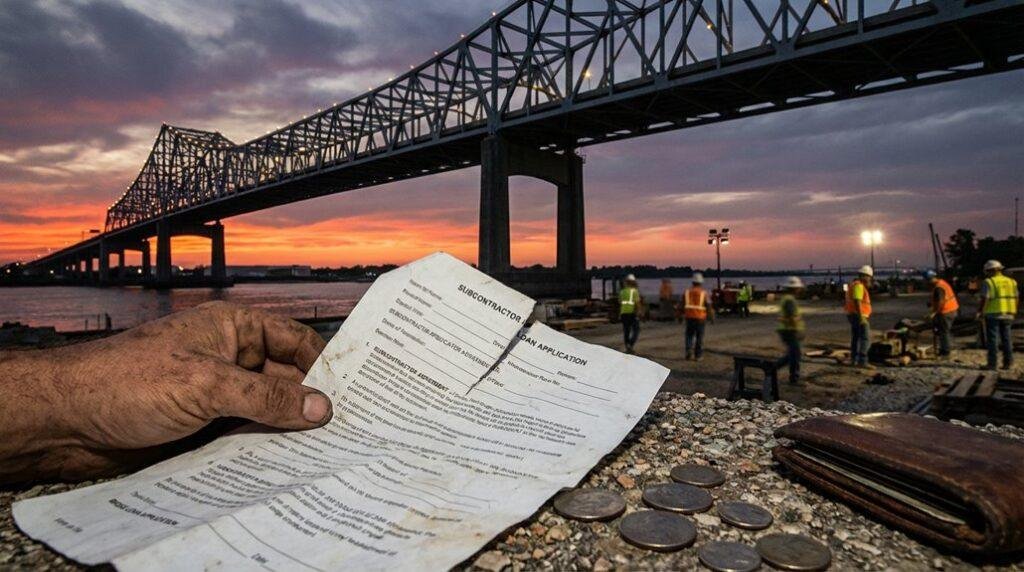
Subcontractors with poor credit can access critical project financing through bridge loans that prioritize contract performance over traditional credit scoring.
We utilize AI-driven underwriting to evaluate your work-in-progress and contract potential, not just credit history.
You may be interested


These innovative financing tools provide rapid, unsecured funding within 48 hours, altering liquidity challenges into strategic growth opportunities.
Our approach turns financial barriers into pathways for success.
Want to reveal your project’s full potential?
Key Takeaways
- Bridge loans prioritize project performance and verified work-in-progress over traditional credit scores, enabling subcontractors with challenging credit histories to access capital.
- AI-driven underwriting platforms evaluate lending risk through operational momentum, contract quality, and project potential rather than relying solely on personal credit ratings.
- Unsecured bridge financing protects personal assets and provides rapid funding within 48 hours, addressing immediate liquidity needs for subcontractors with limited credit options.
- Performance-linked capital strategies focus on contract execution and work-in-progress, offering flexible funding alternatives that transcend traditional credit barriers for subcontractors.
- Revenue-based lending models allow subcontractors to leverage project potential and future earnings, providing a pathway to financial support beyond conventional credit constraints.
The Liquidity Paradox of Modern Construction

We’ve seen firsthand how high-growth subcontractors are caught in a frustrating liquidity trap, where abundant work doesn’t translate to immediate cash flow. According to industry benchmarks, the current ratio liquidity challenge means contractors often struggle to convert project potential into operational capital. The 2026 Infrastructure Surge has created historic project opportunities, but traditional credit models fail to recognize the true financial potential of a strong backlog. Our analysis reveals that the real cost of the “Pay-App Gap” isn’t just delayed payments, it’s lost momentum, missed opportunities, and the gradual erosion of a contractor’s competitive edge. This is why accessing growth capital using monthly receipts as collateral can be a game-changer for subcontractors in need of liquidity.
Why High-Growth Subcontractors Struggle with Legacy Credit Scores
Though construction remains a high-demand sector, subcontractors frequently find themselves trapped in a financial paradox where strong operational performance fails to translate into favorable credit environments.
The bridge loan for subcontractor bad credit emerges as a critical solution to address the subcontractor liquidity gap. Traditional credit scoring models can’t capture the fluid reality of growing construction businesses, where rapid revenue expansion often coincides with temporarily heightened debt levels.
The Contractor Score metrics demonstrate that comprehensive financial evaluations beyond traditional credit models can more accurately assess a subcontractor’s true financial potential.
Bad credit construction working capital solutions now recognize that operational momentum matters more than historical financial snapshots. We’re seeing a fundamental shift where lenders understand that a sturdy project backlog and proven execution capabilities represent true financial strength.
The old credit metrics are becoming obsolete, replaced by more intricate assessments of a contractor’s real-world performance and potential.
The Impact of the 2026 Infrastructure Surge on Cash Flow
As the 2026 infrastructure surge drives construction markets into unmatched territories, subcontractors find themselves steering a complex liquidity environment where booming project pipelines paradoxically create more financial stress than stability. Public funding dominance in infrastructure investments is creating unprecedented financial ecosystems that demand innovative capital strategies.
Performance-linked bridge loans have emerged as critical tools for managing cash flow and liquidity challenges. We’re seeing construction loans for poor credit evolve from last-resort options into strategic financial instruments.
The $64.1 billion FHWA budget and massive infrastructure investments create extraordinary opportunities, but also demand rapid financial flexibility. Contractors must utilize AI-driven underwriting and real-time ledger verification to turn project backlogs into immediate operational capital.
Analyzing the Real Cost of the “Pay-App Gap”
The infrastructure surge has changed construction financing from a predictable cash flow model into a high-stakes liquidity chess match. Pay-app bridge loans have emerged as a critical non-FICO subcontractor funding strategy, altering revenue-based construction finance. Technological advancements in payment processing have transformed how subcontractors can leverage their verified work as immediate financial capital.
We’re witnessing a radical shift where verified work becomes immediate capital.
| Pay-App Timeline | Cash Impact | Strategic Response |
|---|---|---|
| 0-30 Days | High Friction | Bridge Loan Trigger |
| 31-45 Days | Cash Flow Strain | Interim Financing |
| 46-60 Days | Potential Default | Aggressive Funding |
| 61+ Days | Business Risk | Restructure Required |
The true cost isn’t just delayed payments. It’s lost opportunities, strained vendor relationships, and potential project derailment.
Modern subcontractors must utilize innovative financing tools that change verified backlog into immediate operational fuel, converting financial constraints into competitive advantages.
Mechanics of Non-FICO Bridge Financing

We’re revolutionizing construction finance by leveraging AI-driven underwriting that alters how subcontractors access capital. Contract velocity now trumps personal credit scores, allowing us to evaluate your business potential through real-time project performance metrics. Our innovative financing model addresses the traditional bridge loan challenges by recognizing that subcontractors with strong project portfolios can secure funding beyond traditional credit constraints.
Our approach links financing directly to your operational strengths, converting your verified work-in-progress into immediate operational fuel.
Understanding AI-Driven Underwriting and Ledger Integration
When traditional credit scoring falls short, AI-driven underwriting emerges as a groundbreaking approach for financial assessment of subcontractors. Automated data processing enables rapid analysis of comprehensive datasets beyond conventional credit metrics.
We utilize advanced algorithms that reshape how MEP contractors with bad credit access 24-hour construction bridge financing. Our system processes complex data streams instantly, converting project backlog, invoice histories, and performance metrics into flexible financial profiles.
By integrating ledger information directly from project management platforms, we bypass traditional credit limitations. Advanced machine learning models evaluate risk with unmatched precision, enabling rapid capital allocation for contractors previously locked out of conventional funding channels.
We’re not just providing loans, we’re redefining financial accessibility for trade professionals. Our approach turns verified work potential into immediate operational capital, altering how subcontractors maneuver financial challenges in a swiftly changing market environment.
Why Contract Velocity is More Valuable Than Personal Credit
Shifting from AI-driven ledger integration, contract velocity emerges as the new financial heartbeat for subcontractors maneuvering 2026’s complex funding terrain. Public construction frameworks provide a sophisticated backdrop for understanding how performance metrics transcend traditional credit evaluation.
Personal credit scores are becoming obsolete as performance metrics take center stage. We’re witnessing a fundamental conversion where project execution trumps traditional lending standards.
| Metric | Personal Credit | Contract Velocity |
|---|---|---|
| Evaluation | Static History | Changeable Performance |
| Risk Assessment | Limited Scope | Thorough View |
| Funding Speed | Slow | Rapid |
| Future Potential | Restricted | Expansive |
Contract velocity reveals a contractor’s true operational DNA, measuring milestone completion, invoice approvals, and real-time financial health.
The Shift to Performance-Linked Capital in Trade Finance
The construction finance revolution has changed non-FICO bridge financing into a precision instrument for capital utilization. We’ve shifted from traditional credit scoring to performance-linked capital that directly ties financing to contract execution.
By focusing on transaction structures rather than personal credit history, we’ve created financing mechanisms that prioritize project momentum over past financial stumbles. Our approach links capital directly to verified work-in-progress, allowing subcontractors to release immediate liquidity based on contract velocity.
Risk mitigation now happens through sophisticated performance triggers, documentary proof, and real-time contract monitoring. We’ve converted bridge loans from last-resort financing into strategic scaling tools that reward operational excellence.
This new framework means subcontractors can access capital more swiftly, more efficiently, and with greater alignment to their actual business potential.
Strategic Benefits of Construction Bridge Loans

We know that construction bridge loans aren’t just financial products, they’re strategic weapons for subcontractors looking to win in a high-velocity market.
By securing immediate funding for critical project needs like payroll and bulk material procurement, we can hedge against seasonal price spikes and maintain our competitive edge.
These loans aren’t just about cash flow, they’re about preserving our reputation, keeping top talent engaged, and ensuring we can execute large-scale projects without financial friction. Additionally, they allow subcontractors to gain funding based on performance rather than credit scores, which can be crucial for those with less-than-ideal credit histories.
Funding Immediate Payroll for Large-Scale Project Milestones
When construction projects demand swift financial maneuverability, bridge loans emerge as the critical lifeline for subcontractors managing complex payroll requirements during milestone-driven developments. We recognize that timing is everything in large-scale projects, where keeping skilled labor motivated and paid determines project success.
Bridge loans provide immediate funds to cover payroll gaps, ensuring workers remain committed and project momentum stays uninterrupted. By accessing rapid financing aligned with project milestones, subcontractors can strategically manage cash flow challenges without compromising operational integrity.
This financial approach changes potential interruptions into smooth progression, allowing teams to maintain productivity and meet stringent project timelines. The result is a more resilient, agile approach to construction finance that prioritizes workforce stability and project continuity.
Bulk Material Procurement: Hedging Against Seasonal Price Spikes
In 2026, savvy subcontractors recognize that three strategic material procurement advantages can convert bridge loans from a financial tool into a competitive weapon.
We utilize rapid funding to secure bulk material discounts before market prices escalate, protecting our project margins. By accessing capital quickly, we can lock in lower prices and prevent costly delays from material shortages.
Our ability to make immediate purchases gives us an edge over competitors still waiting for traditional bank approvals. Bridge loans enable us to hedge against seasonal price spikes, maintain project timelines, and build stronger supplier relationships.
This approach changes short-term financing from a last resort into a proactive growth strategy for modern construction firms.
Preserving Your Reputation and Retention in a Competitive Labor Market
Because labor shortages continue troubling the construction industry in 2026, strategic bridge loans have become a critical lifeline for subcontractors seeking to maintain workforce stability and project momentum. We understand that consistent payroll directly impacts employee retention, especially in a competitive market where skilled workers have multiple opportunities.
Bridge loans enable us to cover overhead during payment cycle gaps, ensuring our team remains financially secure and motivated. By providing predictable income streams, we can attract and retain top talent who value financial reliability.
These innovative funding solutions convert potential workforce interruptions into strategic advantages, allowing subcontractors to maintain project timelines and competitive positioning. Our ability to maneuver financial challenges without compromising employee commitment sets us apart in a rapidly changing construction terrain.
Comparing Bridge Loans vs. Traditional Bank Lending
We’ve seen directly how traditional bank lending can strangle a subcontractor’s growth potential, especially when speed matters most in our competitive 2026 construction market. Bridge loans offer us a strategic alternative that frees up capital in 48 hours, protecting our personal assets while providing unsecured funding that acts as a non-dilutive growth tool. Additionally, revenue royalty financing can also be a viable option for contractors looking to secure funding based on future revenues without taking on debt.
Speed of Execution: 48 Hours vs. 45 Days
How quickly can cash change your construction business? The speed of funding can make or break your project’s success. Bridge loans revolutionize capital access for subcontractors, providing cash in moments instead of months.
| Funding Method | Typical Timeline | Business Impact |
|---|---|---|
| Traditional Loan | 45-60 Hours | Missed Opportunities |
| Bridge Loan | 48 Hours | Immediate Execution |
| Project Momentum | Sustained | Accelerated Growth |
We understand the critical nature of swift capital. Traditional banks drag their feet with extensive paperwork and rigid credit requirements.
Bridge loans cut through bureaucracy, focusing on your project’s potential rather than past financial missteps. By prioritizing speed and flexibility, we’re changing how subcontractors secure funding, turning time from an obstacle into a strategic advantage.
Unsecured Funding: Protecting Your Personal Assets and Real Estate
Speed in capital alters construction businesses, but protecting personal assets matters equally. In 2026’s lending environment, bridge loans offer subcontractors innovative asset protection strategies that traditional banks can’t match:
- Unsecured funding shields personal real estate from credit scrutiny
- Non-recourse options limit liability to specific project assets
- Flexible underwriting prioritizes contract potential over personal financial history
We’ve seen how bridge lending reshapes risk management for trade professionals. Instead of pledging additional properties or enduring invasive credit checks, subcontractors can now access capital based upon their project backlog.
This approach doesn’t just provide liquidity—it preserves your hard-earned assets while accelerating business growth. By selecting asset-based lending, you’re not just securing funds; you’re strategically protecting your financial future.
How Bridge Capital Functions as a “Non-Dilutive” Growth Tool
Capital velocity isn’t just a buzzword—it’s the lifeblood from modern construction enterprises. Bridge capital alters how subcontractors access funding, providing non-dilutive growth without traditional bank constraints.
We’ve seen revenue-based loans adjust repayments fluidly, preserving equity while meeting urgent cash flow needs. Unlike rigid bank models, these innovative financing tools link directly to project performance, enabling quicker capital utilization.
Venture debt bridges funding gaps with minimal ownership sacrifice, typically ranging from 3.3% to 10.4% dilution across investment stages. For subcontractors maneuvering complex market trends, this signifies maintaining full control while accessing immediate working capital.
Our approach prioritizes strategic financial flexibility, turning potential cash flow challenges into opportunities for sustainable business expansion.
Qualifying for Bridge Capital with Poor Credit
We understand that poor credit can feel like a roadblock in securing bridge capital for your construction projects.
Our approach connects your project management software directly with lenders, instantly verifying your backlog and retainage as powerful secondary collateral beyond traditional credit scores. By negotiating performance-linked repayment terms, we help subcontractors change their project potential into immediate working capital, regardless of past credit challenges. Additionally, funding solutions for projects enable subcontractors to access capital that can kickstart their initiatives without delay.
Connecting Your Project Management Software for Instant Verification
While traditional lenders might still cling to outdated credit scoring models, modern bridge loan providers now employ advanced project management software integrations to verify a subcontractor’s true financial health.
We’re reshaping how financial qualifications work by connecting directly to your digital workflow. Our innovative approach means instant verification through real-time data tracking:
- Procore, Autodesk, and Sage dashboards become live financial statements
- API links pull verified contract values, payment histories, and project backlogs
- Automated systems evaluate your actual business performance beyond static credit scores
Leveraging Your Retainage and Backlog as Secondary Collateral
As project management software integrations reveal real-time financial observations, subcontractors can now convert their often-overlooked contractual assets into powerful lending advantages. Retainage and backlog represent untapped capital reserves that modern bridge loan providers are increasingly recognizing as significant collateral.
By demonstrating consistent project completion rates and verifiable contract pipelines, contractors can offset traditional credit barriers. Our approach reshapes what banks once considered risky into strategic financial instruments.
Advanced lenders now evaluate project speed, contract quality, and potential earnings rather than solely relying on credit scores. This means your confirmed workload becomes a fluid financial asset, enabling quicker capital access and more flexible financing options.
The result? Subcontractors can access liquidity based upon future performance, not past financial limitations.
Negotiating Favorable Terms with Performance-Linked Repayment
Bridge loan qualification in 2026 demands a strategic approach that surpasses traditional credit obstacles. We recognize that performance-linked repayment structures release capital for subcontractors beyond credit scores. Our approach focuses on innovative financing strategies that prioritize project potential over historical financial challenges.
Key negotiation tactics include:
- Proposing milestone-based repayment terms that align with project completion
- Demonstrating strong project experience and clear execution strategy
- Highlighting potential value creation and reliable exit mechanisms
Lenders now evaluate projects through a forward-looking lens, emphasizing future revenue generation and technological maturity.
Scaling Your Subcontracting Business to Megaproject Status
We’ve watched countless subcontractors struggle by breaking into megaproject territory, bridge capital changes everything by converting cash flow constraints into strategic growth opportunities.
By using AI-verified lending platforms that assess your work-in-progress and contract velocity, you can now secure the immediate funding needed to bid for and execute multi-year infrastructure projects that were previously out of reach.
Strategic project liquidity isn’t just about surviving. It’s about positioning your trade firm to become a critical player in the massive infrastructure revolution unfolding across the United States.
Transitioning from “Cash-Constrained” to “Execution-Focused”
While megaproject opportunities in construction surge, subcontractors can’t simply dream big, they must build strategic infrastructure for handling exponential growth.
Our approach alters cash-constrained operations into execution-focused powerhouses by addressing critical scaling challenges:
- Implement digital control towers that aggregate project data and reveal hidden cost-saving opportunities
- Standardize performance tracking to reduce schedule slippage and improve project predictability
- Treat project phasing as a strategic risk management tool with clear financing gates
We recognize that shifting to megaprojects requires more than ambition, it demands a calculated, data-driven strategy.
Using Bridge Capital to Secure Multi-Year Infrastructure Contracts
Because megaproject opportunities demand strategic financial positioning, subcontractors must change their capital access from reactive to proactive. Bridge capital alters how firms approach multi-year infrastructure contracts by providing immediate liquidity against verified project backlogs.
We’re seeing a shift in perspective where contract velocity matters more than traditional credit metrics. Smart subcontractors now utilize AI-driven underwriting platforms that evaluate project potential instead of past financial history.
These innovative financing solutions allow trade professionals to bid for larger contracts, secure critical materials more quickly, and maintain workforce stability during extended project timelines. By treating verified work-in-progress as collateral, subcontractors can scale beyond immediate cash constraints and position themselves as reliable execution partners in the infrastructure development ecosystem.
The Long-Term ROI of Strategic Project Liquidity
Strategic project liquidity converts subcontractor operations from survival mode into systematic scaling, changing verified work-in-progress into a powerful financial engine. We recognize that bridge capital isn’t just about short-term cash, it’s a strategic growth mechanism for ambitious trade firms.
Our approach focuses on revolutionary financial strategies:
- Leveraging verified backlog as energetic collateral
- Accelerating project velocity through immediate capital access
- Enabling rapid workforce and equipment scaling without traditional credit constraints
Frequently Asked Questions
Can I Use Bridge Loans With Ongoing Bankruptcies or Legal Judgments?
We’ll steer through complex financing strategically. Active bankruptcies complicate bridge loan access, but targeted legal counsel and specialized lenders can help structure alternative financing pathways for your business recovery.
How Quickly Can I Access Funds After Initial Application?
We’ll get your funds within 24-72 hours after a clean application. Our AI-driven underwriting means you’re not waiting weeks—you’re accessing capital at market speed.
Will Bridge Loans Impact My Ability to Secure Future Financing?
Bridge loans can impact future financing, but we’ll strategically utilize them to showcase project momentum and financial agility, turning temporary credit challenges into long-term growth opportunities for our business.
Do Bridge Loans Require Personal Guarantees From Company Owners?
Yes, we’ll need personal guarantees from our key owners. It’s standard practice for securing bridge loans, ensuring lenders have recourse beyond corporate assets when financing high-velocity construction projects.
Can Subcontractors With Zero Credit History Qualify for Bridge Loans?
We’ve altered bridge lending—zero credit history isn’t a barrier anymore. Our AI-driven underwriting now evaluates your project backlog, contract velocity, and proven execution capability, not just traditional credit metrics.
