

Merchant cash advances (MCAs) for restaurants offer rapid access to funds by advancing a lump sum repaid through a portion of daily credit card sales. They’re ideal for swift cash needs and flexible repayments that adjust with revenue.
Nonetheless, MCAs can be costly with high repayment amounts and daily deductions that may strain cash flow. Understanding approval criteria and risks helps avoid pitfalls.
You may be interested


If you want to make smart financing choices, there’s more to investigate regarding how MCAs compare with other options and how to manage them effectively.
Key Takeaways
- Restaurant owners appreciate MCA for quick funding but often note high repayment costs and daily deductions affecting cash flow.
- Flexible repayment tied to credit card sales suits unpredictable restaurant revenue but can strain slower business periods.
- Many reviews highlight MCA approval ease without collateral or strict credit score requirements, ideal for startups or financially challenged restaurants.
- Concerns about hidden fees and vague terms suggest careful contract review is essential before accepting MCA offers.
- Positive feedback often comes from providers offering fast approvals, integrated POS payment systems, and tailored advances for restaurant needs.
What Is a Merchant Cash Advance (MCA) for Restaurants?
While traditional loans can be hard to secure, especially for restaurants facing fluctuating cash flow, a Merchant Cash Advance (MCA) offers a practical alternative. An MCA provides a lump sum upfront in exchange for a portion of future credit card sales. It functions as a purchase and sale transaction rather than a loan.
Repayment is tied to daily or weekly revenue, adjusting with sales volume, which fits well with the unpredictable income for restaurants. Typically, businesses receive 1-2 months of average credit card sales quickly, often within 24 to 48 hours. Because payments are automatically deducted as a percentage of sales, there’s no fixed term or monthly bill. This makes MCAs a flexible funding option that supports growth and covers short-term cash needs without relying on credit scores or collateral. MCAs are especially beneficial for small businesses like restaurants because they allow tailored payments according to sales fluctuations and provide emergency liquidity during appliance failures or unexpected expenses.
Pros and Cons of MCAs for Restaurant Owners
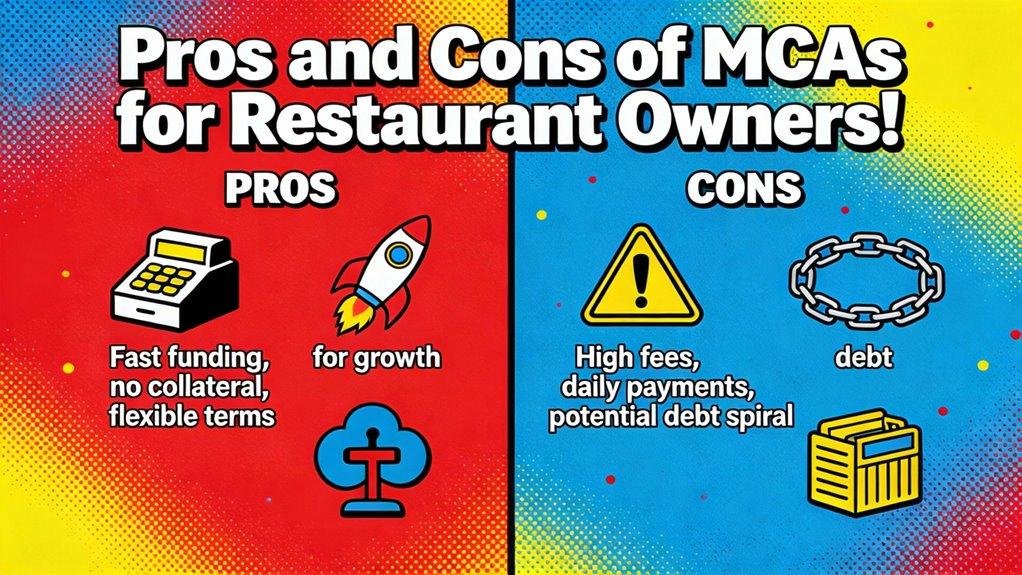
Because MCAs offer rapid access to capital with flexible repayment linked with sales, they can be appealing for restaurant owners needing swift cash. We appreciate how MCAs provide funds within 48 hours, no collateral, and repayments that adjust to daily sales. This flexibility can help manage seasonal revenue swings and avoid fixed monthly obligations. Fewer than 50% of small businesses in the UK approved for traditional bank loans in 2024, making MCAs a valuable alternative for many restaurateurs. Additionally, coffee shops are increasingly exploring performance-linked funding as a viable financial solution amidst traditional banking challenges.
Nevertheless, we must also recognize the significant downsides. MCAs carry high factor rates that translate into costly APRs, far exceeding traditional loans. Daily deductions can strain cash flow, especially during slow periods, risking a cycle of dependency. Furthermore, the largely unregulated MCA industry may involve hidden fees and restrictive terms. For restaurant innovators, MCAs present both an opportunity and a challenge. Careful evaluation of financial impact is necessary before committing.
Key Approval Criteria Restaurants Must Meet for MCAs
When considering merchant cash advances, restaurants must meet specific approval conditions that focus largely upon financial stability. Consistent credit card sales and a solid sales history are key factors lenders examine in order to assess repayment ability. The evaluation process typically includes a review of the restaurant’s credit card sales history and overall financial health to determine eligibility.
LET’S LOOK CLOSELY AT THE MAIN CRITERIA THAT DETERMINE IF YOUR RESTAURANT QUALIFIES FOR AN MCA.
Approval Conditions Overview
Understanding the key approval criteria for merchant cash advances is vital if we want to secure funding for our restaurant. Most providers require at least six months of operating history, while some expect up to a year. This history helps lenders assess our sales patterns and revenue stability. Repayment is flexible, using a fixed percentage known as a holdback from each sale, secured by revenue stream rather than personal assets.
Monthly credit card sales usually need to meet a minimum threshold of $5,000 to $10,000, with many setting that at $7,500 or higher. While credit scores matter less, a minimum around 550 is typical. We will also need to provide recent bank and credit card processing statements, along with basic identification documents. Importantly, active bankruptcies or recent defaults can block approval. Meeting these conditions gives us a solid foundation for pursuing innovative funding through merchant cash advances.
Financial Stability Indicators
What financial indicators do lenders concentrate on when considering a merchant cash advance for our restaurant? They prioritize steady monthly credit card sales because repayment relies on a percentage of daily card transactions. Consistent sales volume shows dependable cash flow and lowers risk.
Lenders also review recent bank statements to validate revenue patterns and guarantee daily repayments won’t hinder operations. Positive cash flow is critical, signaling we can cover expenses while repaying advances smoothly. Revenue consistency, even with some fluctuation, matters too. Declining sales reduce approval chances.
Debt and profit ratios play a role. Maintaining a debt-to-equity ratio below 1 and positive operating margins indicates financial health. Focusing on these indicators permits us to innovate confidently, knowing our financial foundation supports sustainable funding through MCAs.
Understanding Flexible Repayment Options for Restaurant MCAs
When considering merchant cash advances for restaurants, one must understand how fluctuating payment structures work. Payments adjust based upon your daily credit or debit card sales, which can protect your cash flow during slower periods. Integrating repayment with your point-of-sale system simplifies the process, making it easier to manage and more responsive to your actual revenue. Additionally, leveraging monthly cash flow cycles can enhance the effectiveness of your funding strategy, ensuring that you are better equipped to handle operational fluctuations.
Fluctuating Payment Structures
Although restaurant revenues can vary widely from time period to time period, merchant cash advances (MCAs) offer repayment plans that adjust for those fluctuations. Payments are deducted as a fixed percentage of daily card sales, scaling down during slow periods and up during strong ones.
This flexible structure eases cash flow stress and matches your revenue cycle without a fixed end point. Understanding the holdback percentage and factor rate helps you see the total repayment and daily deductions clearly.
| Feature | Explanation |
|---|---|
| Holdback Rate | % of daily sales withheld |
| Factor Rate | Multiplier for total repayment |
| Payment Duration | Varies 3-18 months |
| Repayment Method | Split withholding or ACH |
| Cash Flow Impact | Payments flex with revenues |
This model keeps your business agile and financially stable.
POS Integration Benefits
Merchant cash advances that adjust for your cash flow become even more effective when paired with point-of-sale (POS) system integration. This pairing allows funding offers to appear directly in your dashboard, accelerating approval and disbursement. Additionally, payments automatically align with your sales, easing cash flow challenges.
With POS integration, here’s what we gain:
- Real-time sales data automates reporting and enhances decision-making.
- Flexible payments rise and fall with daily card receipts, matching revenue cycles.
- Quicker funding approvals and disbursements with optimized online processes.
Together, these innovations create a responsive financing solution that matches how restaurants operate. This solution preserves cash during slow times without penalties and supports rapid access to capital when needed. It’s a smarter way to fund growth.
Long-Term Financial Risks of Relying on MCAs in Restaurants
Since restaurant owners often face unpredictable sales and tight margins, relying heavily on merchant cash advances (MCAs) can create serious long-term financial challenges. The high repayment costs, with factor rates often between 1.1 and 1.5, can turn a $50,000 advance into a $70,000 repayment.
Daily deductions from 10 to 20 percent of sales strain profitability and leave little cash for payroll or vendors. Seasonal fluctuations make this even harder, causing shortfalls in slower periods. This pressure often leads restaurants into a debt trap, stacking multiple MCAs just to stay afloat.
Over time, this cycle damages creditworthiness, limiting access to traditional loans and risking legal action. Understanding these risks helps us develop smarter financial strategies that support sustainable growth. Implementing flexible loan options with pay-as-you-earn plans might offer a more manageable alternative to combat cash flow uncertainty.
How to Avoid Cash Flow Problems When Using MCAs
Cash flow management plays a crucial role when utilizing merchant cash advances (MCAs) for funding your business. To avoid cash flow problems, we need to focus on tracking financial health, forecasting accurately, and managing expenses strategically.
Initially, integrating our POS with accounting software gives precise sales data and cash flow statements. Next, forecasting helps us anticipate shortfalls caused by MCA daily remittances using past revenue and expense trends.
Integrating POS with accounting software enables accurate sales tracking and forecasting to manage MCA daily remittances effectively.
Ultimately, managing expenses involves negotiating vendor terms and optimizing receivables to keep cash flowing smoothly. Here’s how we can stay atop:
- Use real-time sales data to monitor MCA repayments and cash flow coverage ratios.
- Build financial reserves to cushion seasonal dips and unexpected costs.
- Communicate proactively with MCA providers if sales volumes drop noticeably.
These steps keep our cash flow stable and flexible.
Comparing MCAs to Other Restaurant Financing Options
How do merchant cash advances stack up against other restaurant financing options? MCAs provide rapid lump sums repaid through a percentage of future sales, making them ideal for restaurants with high credit card volume needing quick access to cash.
Unlike term loans or SBA loans, MCAs don’t require collateral or lengthy approval processes, which can delay funding for weeks or months. Nevertheless, their factor rates tend to be higher, reflecting greater cost and flexibility.
Lines of credit offer revolving access and lower ongoing costs but require steady income and credit. Equipment financing suits specific purchases with monthly payments and lower rates.
Ultimately, MCAs shine for urgent, flexible funding without strict credit demands. Traditional loans benefit established businesses planning for long-term growth.
Choosing the Right MCA Provider for Your Restaurant
What should we consider when selecting the right merchant cash advance provider for our restaurant? It’s essential to evaluate providers based on speed, flexibility, and fit with our business model.
Rapid funding means cash when we need those resources, while repayment terms must match our revenue flow. Additionally, the provider’s understanding of restaurant challenges matters.
Let’s focus on three key points:
- Funding Speed and Approval: Same-day approvals and swift transfers, like those from Redline Capital or Credibly, keep operations smooth.
- Repayment Flexibility: Options such as daily or weekly payments adjusting to sales help manage seasonal shifts.
- Specialization for Restaurants: Providers like Lightspeed Capital, who tailor advances around point-of-sale data, offer an innovative edge.
These factors help us pick a partner aligned with our restaurant’s financial rhythm and growth goals.
Real Stories: Restaurant Successes and Warnings About MCAs
While merchant cash advances (MCAs) can offer rapid and flexible funding for restaurants, we must learn from real experiences to steer through their pros and cons effectively. Family-run pubs improved cash flow and credit scores using MCAs with repayments tied to daily sales.
Meanwhile, some restaurants secured capital beyond expectations to fund renovations and technology upgrades. This enabled growth without fixed terms. Platform-based advances by companies like DoorDash provide essential options for businesses lacking traditional loans, offering flexible repayment aligned with sales.
Yet, it’s important to choose providers wisely, as some MCA terms can strain finances if daily sales drop. Success depends upon understanding repayment structures and leveraging the advances strategically. By learning from genuine stories, we can innovate funding approaches that support sustainable restaurant growth.
Frequently Asked Questions
How Do Seasonal Sales Fluctuations Impact MCA Repayment Terms for Restaurants?
Seasonal sales fluctuations directly influence MCA repayment since payments adjust as a percentage of daily or weekly sales. During slow seasons, repayments decrease, easing cash flow strain, while peak periods speed up repayment. This flexibility helps us match payments with revenue cycles. Nevertheless, we must monitor sales carefully in order to avoid shortfalls and consider negotiating terms that better fit our seasonal patterns, ensuring we maintain operations without damaging our financial stability.
Can MCAS Be Integrated With Restaurant POS and Accounting Systems?
Yes, MCAs can integrate with restaurant POS and accounting systems. This connection enhances repayment by automatically deducting a percentage of daily credit card sales directly from transactions, adjusting with sales volume. It also simplifies monitoring for both merchants and providers. Integration increases operational efficiency, allowing restaurants to track sales, payments, and repayment progress in real-time. Overall, connected systems help maintain cash flow while managing debt more effectively and transparently.
What Industries Besides Restaurants Have High MCA Approval Rates?
Besides restaurants, retail and e-commerce businesses boast high MCA approval rates. These sectors benefit from focusing on credit card sales rather than credit scores, which improves their chances. MCA lenders look at daily sales performance, making it easier for businesses with variable cash flow or limited credit history to qualify. This flexibility attracts innovative companies enthusiastic to respond quickly to market shifts and invest in growth without the delays associated with traditional loans.
How Does Leasing Equipment Compare Fiscally to Using MCAS?
Leasing equipment often costs more over time but offers fixed monthly payments and tax-deductible expenses, helping us plan and preserve cash flow. Merchant cash advances hit us with daily sales holdbacks, making cash flow unpredictable and generally more expensive. Leasing doesn’t build ownership, though it provides maintenance and upgrade options. Overall, leasing suits us when steady budgeting and equipment control matter, while MCAs might seem easier but come with higher financial risks.
What Regional Trends Affect MCA Availability for Restaurants Globally?
Regional trends shaping MCA availability include economic stability, local tax laws, and digital payment adoption. In North America, expanded tax benefits and diverse industries enhance MCA access. Asia-Pacific’s urban areas enjoy quicker approvals thanks to e-commerce integrations. Seasonal tourist regions demand flexible repayment plans reflecting varying revenue. As markets grow, providers tailor advances to local sales patterns and regulations, ensuring restaurants worldwide can secure funding that matches their unique operational rhythms.
