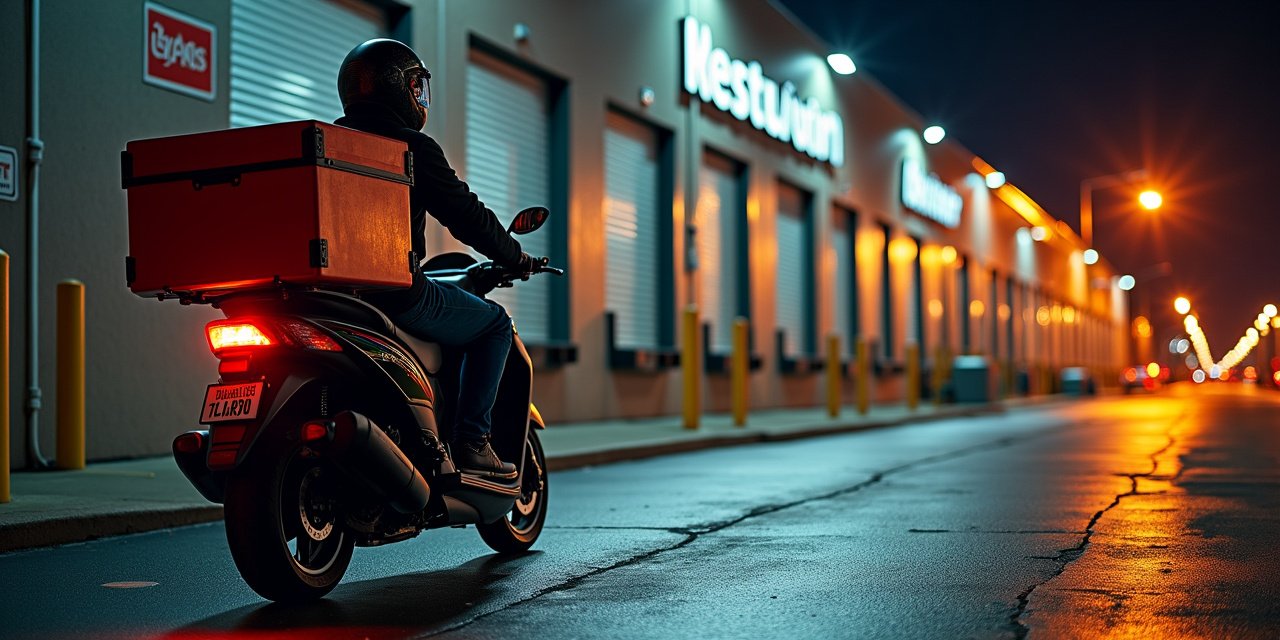
Restaurants paying 20%+ in delivery commissions can finance their own channel in months and recover infrastructure cost within a year.
The Commission Math That's Killing Restaurant Margins
A restaurant doing $30,000 per month in delivery through third-party apps at a 25% commission rate loses $7,500 every month. That's $90,000 per year in pure extraction.
Magic Valley operators are not immune. Twin Falls restaurants compete on thin margins already compressed by rising food costs and labor.
Building an owned delivery channel is an infrastructure investment — and it can be financed the same way any capital project can be.
Already running meaningful volume through delivery apps? See how delivery app revenue factors into MCA and RBF underwriting before you finance the move away from them.
In-House Delivery Infrastructure: Cost Breakdown
Understanding total buildout cost is the first step in sizing the right capital advance. Most operators underestimate software and training costs.
| Infrastructure Component | Typical Cost | Notes |
|---|---|---|
| Online ordering platform | $3,000–$8,000 | White-label setup + annual SaaS |
| Driver management software | $1,500–$4,000 | Routing, dispatch, tracking |
| Insulated delivery bags/equipment | $800–$2,500 | Per driver kit |
| Marketing to own customers | $2,000–$6,000 | Initial migration campaign |
| Staff training + ops manual | $500–$1,500 | One-time setup cost |
Revenue-Based Capital for Delivery Infrastructure
Revenue-based advances are well-suited for delivery infrastructure because repayment flexes with daily card volume. As your delivery channel grows, repayment scales proportionally.
This matters because the ramp-up period for an owned channel takes 60–90 days before customer adoption stabilizes. Fixed monthly loan payments during that window create unnecessary pressure.
A delivery infrastructure buildout is a planned capital decision. An equipment failure mid-service is not. See our 24-hour breakdown playbook for the emergency version of this financing question.
- Request capital sized to 1.5–2x your estimated infrastructure cost to cover contingencies
- Negotiate holdback percentage based on projected post-launch revenue, not current volume
- Keep third-party apps active during the transition — do not cut them off before owned-channel volume is proven
- Track delivery revenue separately from dine-in to measure margin recovery accurately
- Plan for a 6-month customer re-education campaign to drive direct ordering behavior
For the underlying repayment mechanics and a full RBF-vs-term-loan comparison, see how restaurant revenue-based financing works.
Quick Check
See what you qualify for in under 3 minutes.
No personal guarantee required. No hard credit pull. Revenue history is what qualifies you.
Check Capital Eligibility →The Data Behind the Shift Away From Delivery Apps
Restaurant operators nationwide aren't reducing delivery-app dependence on instinct alone. A Market Leader survey of roughly 450 operators found 53% are actively cutting third-party delivery reliance. Only 32% plan to keep using platforms as they currently operate.
Commission structure explains the shift. DoorDash's published pricing runs 15% on Basic, 25% on Plus, and 30% on Premier. Uber Eats raised its Lite-tier rate from 15% to 20% in March 2026 alone.
That hike triggered a real-world break. Rave Restaurant Group — owner of Pizza Inn and Pie Five — dropped Uber Eats entirely in April 2026. Franchisees said the fee hike left near-zero profit per delivery order.
Even DoorDash's own pricing hints at the incentive. Its native online-ordering tool carries zero commission — a tacit admission direct channels cost less.
The lesson for Magic Valley operators: commission tiers move up, not down. Non-dilutive working capital financed now locks in today's capital cost before the next hike.
Frequently Asked Questions
A basic in-house ordering platform and delivery management system typically costs $8,000–$25,000 to launch. Ongoing costs are significantly lower than third-party commission fees.
Yes. Revenue-based capital can cover vehicle acquisition, driver management software, and insulated delivery equipment as a single working capital advance.
Most operators recoup infrastructure costs within 8–14 months when delivery volume exceeds 200 orders per month at an average ticket of $35 or more.
External Resource
SBA.gov Small Business Financing — U.S. Small Business Administration — Restaurant Funding
Ready to check your options?
Rev Boost Funding connects operators with independent financing partners. Not a lender.
Affiliate partnerships present.
Check Capital Eligibility → You Finished This — Add as Preferred SourceOperator Decision Matrix
Which Capital Instrument Fits Your Situation?
Match your equipment status and revenue profile to the right financing structure.
$25K+/mo
$10K–$25K/mo
Instrument recommendations are illustrative. Actual eligibility depends on lender underwriting criteria and business profile.
Revenue Financing Estimator
How Much Capital Can You Access?
Adjust the inputs to estimate your funding range. Illustrative only — no credit pull.
Illustrative estimate only. Not a lending commitment. Actual terms depend on lender underwriting and business profile. Results vary.
Verify Actual Eligibility →