
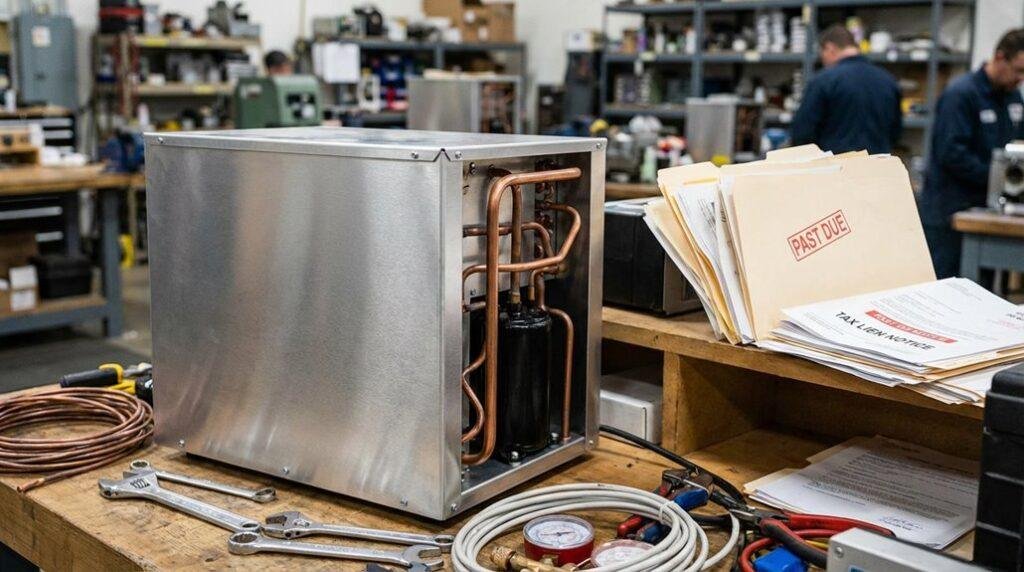
HVAC companies facing tax liens can still secure working capital through strategic financing solutions.
We’ll help you guide performance-based lending, revenue-based financing, and tax lien subordination options.
You may be interested


By targeting flexible capital strategies that consider your current cash flow, you can protect your assets, manage IRS obligations, and maintain operational momentum.
Our approach alters financial challenges into growth opportunities. Want to learn how we can release your company’s potential?
Key Takeaways
- Tax lien subordination allows HVAC companies to access working capital by enabling financing despite existing IRS debt and maintaining creditor relationships.
- Revenue-based financing offers flexible repayment structures aligned with cash flow, helping HVAC businesses manage working capital during periods of financial stress.
- Performance-based lending models focus on current cash flow, providing capital solutions for HVAC contractors struggling with tax liens and operational challenges.
- Strategic debt management through structured installment agreements can resolve tax obligations while preserving working capital and protecting critical business assets.
- Proactive financial planning, including automated tax set-asides and regular revenue reviews, can help HVAC companies mitigate working capital constraints associated with tax liens.
The State of the HVAC Economy in 2026

We’re witnessing an extraordinary change in the HVAC industry, where stringent SEER3 efficiency standards and A2L refrigerant shifts are creating massive economic pressure on firms already struggling with razor-thin margins. Asia Pacific market growth is projected to reach 47% of global revenue, further intensifying competitive dynamics for smaller regional contractors.
Labor costs are skyrocketing as skilled technicians demand higher wages, while new equipment compliance requirements are driving up capital investments at a pace many smaller contractors can’t sustain. As a result, managing liquidity becomes vital for these firms, particularly when facing unexpected maintenance costs.
The result is a perfect storm where distressed firms find themselves caught between regulatory mandates, technological upgrades, and the persistent shadow of tax liabilities that threaten to derail their potential for growth.
Navigating the SEER3 Efficiency and A2L Refrigerant Shift
Although the HVAC environment has always been fluid, the convergence of SEER3 efficiency standards and A2L refrigerant changes in 2026 represents a crucial moment for contractors nationwide.
Contractors seeking working capital for HVAC companies with tax liens now face a complex terrain of technological and regulatory shifts. Financing for A2L refrigerant alterations demands strategic capital implementation that aligns with emerging industry standards.
Revenue-based financing for tax liens enables businesses to traverse these groundbreaking market conditions without traditional banking constraints. Smart operators understand that the A2L alteration isn’t just a compliance challenge—it’s an opportunity to modernize fleets, improve service capabilities, and position themselves as state-of-the-art providers in a rapidly changing market. Regulatory performance metrics like SEER2 and EER2 will drive critical investment decisions for forward-thinking HVAC businesses.
The most flexible firms will utilize innovative financing to turn regulatory pressure into competitive advantage.
Why Labor Wages and Equipment Costs are Squeezing Distressed Firms
While the HVAC industry has always maneuvered complex economic environments, 2026 presents an extraordinary squeeze that’s pushing distressed firms to their operational limits. Nationwide employment growth of 6% from 2022 to 2032 suggests potential workforce expansion opportunities amid current challenges.
Labor wage pressures and equipment cost spikes are decimating profit margins more rapidly than ever before. Technician shortages mean higher wages, with median hourly rates climbing over $27, while A2L refrigerant shifts demand expensive inventory investments.
For firms struggling with IRS tax debt financing 2026, non-bank HVAC loans with IRS debt become critical survival tools. SBA loans for distressed HVAC firms offer potential lifelines, allowing companies to bridge critical capital gaps.
Smart operators recognize that strategic financing isn’t just about surviving—it’s about positioning themselves to capitalize on emerging market opportunities during this revolutionary industry moment.
The Reality of the IRS “Distress Trap” in a Boom Market
If the 2026 HVAC market represents a paradoxical terrain of unparalleled opportunity and hidden financial peril, the IRS “Distress Trap” emerges as the critical inflection point separating thriving contractors from those facing imminent operational collapse.
We’re seeing heat pump installers increasingly desperate for capital, searching for innovative hvac business loans with tax liens that can break through traditional financing barriers. Tax lien subordination for contractors has become a strategic lifeline, allowing businesses to secure working capital despite historical tax challenges.
The most versatile firms are leveraging performance-based lending models that evaluate current cash flow over past tax complications. With regulatory pressures mounting and technology evolution accelerating, contractors can’t afford to be sidelined by outdated financial constraints. Heat pump electrification is driving technological investments that require sophisticated financial strategies beyond traditional lending models.
Understanding Your Capital Options with a Tax Lien

We’ve seen how tax liens can derail traditional financing, but alternative capital strategies exist that can help HVAC companies move forward. Simple Installment Agreements (SIA) provide a pathway for resolving tax debt while keeping funding options open, allowing lenders to take a second position behind your tax obligation. Additionally, flexible loans can offer a versatile solution through innovative repayment options that adapt to your business’s cash flow. PACE financing offers another strategic approach, specifically designed for businesses with property-linked financial challenges, enabling companies to leverage home equity and alternative credit assessments despite existing tax constraints.
Revenue-based financing offers a flexible alternative for rigid bank lines, letting trade partners assess your current business performance rather than past tax challenges.
Simple Installment Agreements (SIA) and Your Path to Funding
Tax liens: nightmares are becoming a thing of the past for HVAC companies navigating 2026’s complex financing terrain. We’re seeing a revolution in how businesses manage tax debt through Simple Installment Agreements (SIA).
These innovative financing pathways let HVAC companies with up to $50,000 in tax liability secure structured payment plans without traditional lending roadblocks. Our HVAC service-velocity capital approach means you’re no longer penalized by past financial challenges. Extended payment terms to the collection statute expiration date (CSED) provide businesses with unprecedented flexibility in managing tax obligations.
By qualifying for SIAs, companies can avoid federal tax liens, maintain clean credit profiles, and access working capital. The key is early intervention: applying online, demonstrating consistent payment capability, and staying current with tax return filings.
This strategic approach alters tax debt from a business obstacle into a manageable financial hurdle.
Tax Lien Subordination: How Lenders Take a Second Position
Simple Installment Agreements opened a window, but lien subordination blows the doors wide open for HVAC companies seeking working capital. This strategic financial approach allows lenders to take a second position behind the IRS, freeing critical funding streams for businesses with existing tax challenges. Smaller tax liens typically facilitate smoother negotiations and create more flexible pathways for financial resolution.
Subordination Permits Factoring Companies to Secure Initial Position Regarding Receivables
Enables Inventory Financing Without Removing the Existing Tax Lien
Improves Credibility with IRS Through Structured Payment Mechanisms
Provides Access to Working Capital Based on Current Business Performance
Revenue Based Financing vs. Traditional Bank Lines for Trade Partners
While traditional bank lines for credit have long been the standard financing mechanism for HVAC contractors, revenue-based financing represents a game-changing alternative that can release critical working capital for companies wrestling with tax liens or seasonal cash flow challenges.
Unlike rigid bank loans, these innovative financing structures align repayment directly with your company’s revenue streams, creating flexible payment schedules that adjust to seasonal demand fluctuations.
We’ve seen firsthand how revenue-based options provide quicker approvals, more accessible funding, and performance-focused underwriting that traditional banks can’t match. By prioritizing cash flow stability over credit scores, these financing models enable HVAC companies to overcome financial barriers, invest in growth, and maintain operational momentum during challenging economic periods.
Agentic Underwriting: Beyond the FICO Score

We’ve unearthed how AI-powered lending systems now analyze your ServiceTitan and field service management data to provide unparalleled capital access, revolutionizing how HVAC companies secure working capital.
Modern performance-linked lending platforms can now evaluate your operational backlog as real collateral, effectively converting your future service contracts into immediate financial fuel. By leveraging these advanced underwriting techniques, HVAC companies with active tax liens can now qualify for six-figure loans that were previously unattainable, bridging the critical gap between current operational challenges and future growth potential. In addition to traditional financing methods, many businesses are exploring non-dilutive funding options to maintain ownership while securing necessary capital.
How AI-Lending Systems Analyze Your ServiceTitan and FSM Data
Because the environment of HVAC financing has fundamentally changed, AI-driven lending platforms now employ Field Service Management (FSM) data to innovate how working capital is assessed and provided. These intelligent systems delve more profoundly than traditional credit models by analyzing extensive operational metrics that reveal true business potential.
ServiceTitan and FieldEdge data streams allow lenders to evaluate technician performance, service velocity, and real-time revenue patterns.
Machine learning algorithms adaptively assess customer lifetime value beyond static FICO scores.
Predictive analytics track equipment replacement opportunities and maintenance contract probabilities.
One-button integration eliminates manual data entry while providing all-encompassing business perspectives.
This approach alters working capital from a transactional process into a strategic growth partnership, giving HVAC companies unparalleled financial flexibility.
Performance-Linked Capital: Using Your Backlog as Collateral
Performance-linked capital alters a traditional lending environment for HVAC companies, enabling businesses to employ their operational backlog as a strategic financial asset. We’re seeing a radical shift where service contracts and predictable revenue streams now trump credit scores.
Agentic underwriting evaluates your actual business performance, focusing on backlog quality, recurring service revenue, and operational efficiency. This indicates 6-figure advances are possible even with existing tax liens.
Qualifying for 6-Figure Loans with an Active IRS Debt
While performance-linked capital alters how HVAC companies access funding, the reality of securing six-figure loans with an active IRS debt demands a more significant understanding of agentic underwriting.
Modern lenders now evaluate businesses through a comprehensive performance lens that transcends traditional credit constraints. We’ve identified innovative pathways to financing that prioritize current operational strength over historical financial challenges.
Key qualification strategies include:
- Demonstrating consistent revenue above $250,000 annually
- Maintaining strong cash flow documentation
- Presenting clear, organized financial reporting
- Developing a strategic IRS debt management plan
Agentic models recognize that today’s HVAC businesses are adaptable ecosystems. By focusing on present performance metrics, service velocity, contract renewals, technological compliance, we can access capital that traditional financing models would reflexively reject.
The future of lending is about potential, not past limitations.
The “Clean-Up” Strategy: Using Capital to Resolve Tax Issues
We’ve seen how a strategic capital infusion can convert a tax lien from a business obstacle into a manageable financial challenge. Our approach focuses around using working capital to fund a lump-sum payment that triggers a lien withdrawal, effectively restructuring your debt and protecting your HVAC fleet from potential IRS levies. This method is particularly effective when it allows businesses to streamline accounts receivable and maintain steady project progress.
Funding a Lump-Sum Payment to Trigger a Lien Withdrawal
In 2026, HVAC companies facing tax liens have a strategic pathway toward financial recovery through a calculated lump-sum payment approach.
Our innovative strategy changes tax burdens into opportunities for operational restart and financial healing. We’ve identified key mechanisms to utilize working capital for thorough lien resolution:
- Secure targeted funding specifically designed to clear the entire tax liability
- Trigger immediate lien withdrawal from public records, restoring credit credibility
- Protect critical business assets from potential IRS seizure
- Open future financing opportunities by demonstrating proactive financial management
Restructuring Debt to Improve Your Balance Sheet for 2027
After triggering a lien withdrawal through a strategic lump-sum payment, HVAC companies must now design an extensive debt restructuring blueprint that alters financial challenges into strategic opportunities for 2027.
We’ll utilize consolidation tactics to simplify our capital structure and reduce operational overhead. By diversifying revenue streams through smart technology services and maintenance programs, we’ll generate predictable cash flow that supports our restructuring goals.
Our focus shifts to optimizing debt-to-EBITDA ratios, targeting around 2x for building financial resilience. Digital tools and standardized processes will help us maneuver these shifts efficiently.
We’re not just addressing past tax issues—we’re positioning our HVAC business for strong growth, converting financial constraints into competitive advantages that set us apart in a rapidly changing market.
Protecting Your Fleet and Equipment from IRS Levies
Because tax liens can paralyze an HVAC company’s operational capacity, strategic asset protection becomes essential when confronting IRS collection actions.
We understand the critical significance of safeguarding your business infrastructure during financial challenges. Our approach focuses on proactive defense mechanisms that prevent equipment seizure and maintain operational continuity.
- Obtain extensive IRS transcripts to understand exact lien parameters
- Employ Discharge of Property mechanisms for targeted asset protection
- Negotiate payment plans that halt potential equipment levies
- Implement strategic capital restructuring to neutralize collection risks
Executing a High-Growth Modernization Plan
We’re seeing HVAC companies release massive growth by strategically using working capital to solve multiple modernization challenges simultaneously.
By funding aggressive technician recruitment with signing bonuses and rapidly stockpiling high-efficiency inventory before seasonal price increases, forward-thinking firms can position themselves to win lucrative commercial retrofit projects.
Our most successful clients are treating capital not just as money, but as a precision tool for altering their operational capabilities and market positioning in 2026’s demanding regulatory environment.
Staffing Up: Funding Technician Signing Bonuses and Onboarding
While the 2026 HVAC market surges with unparalleled demand, strategic staffing has become the critical differentiator between scaling successfully and stalling out.
We’ve learned that funding technician acquisition requires a varied approach targeting talent retention and growth. Our most successful clients are leveraging working capital to drive innovative recruitment strategies:
- Offering competitive signing bonuses ranging from $2,000 to $15,000
- Developing extensive training programs with tuition reimbursement
- Creating performance based incentive packages tied to certification levels
- Implementing modern benefits packages with professional development opportunities
Stockpiling High-Efficiency Inventory Before Seasonal Price Hikes
Strategic inventory management has become the linchpin for HVAC company survival in 2026, with off-season stockpiling changing from a tactical option into an operational necessity.
We’re seeing savvy contractors utilize September and winter months to acquire high-efficiency units at dramatic 20-40% discounts. By targeting clearance periods and manufacturer model shifts, we can strategically build our inventory before summer price surges.
The key is timing: purchasing A2L units and SEER3-compliant systems during low-demand periods allows us to position ourselves for maximum profitability.
Smart stockpiling isn’t just about saving money—it’s about creating a competitive advantage. Our ability to quickly implement state-of-the-art, energy-efficient equipment will differentiate us in an increasingly complex HVAC marketplace.
Leveraging Capital to Win Commercial Retrofit Megaprojects
Inventory stockpiling sets the stage for our next strategic leap: commercial retrofit megaprojects that will define HVAC modernization in 2026. We’re targeting massive opportunities in aging infrastructure across multiple sectors:
- Hospitals and schools represent $2.1 trillion in deferred maintenance, offering premium retrofit contracts
- Data center cooling pods are cutting field installation time by 30%, creating rapid implementation opportunities
- Municipal buildings require thorough efficiency upgrades under strict green building codes
- Multifamily and office complexes need electrification and VRF system replacements to meet ESG criteria
Our capital strategy converts these megaprojects from risk to revenue, positioning us as innovation leaders in the commercial HVAC evolution.
Building a Sustainable, Tax-Compliant Enterprise
We’ve seen how tax liens can cripple HVAC companies, but with the right programmed set-asides and strategic liquidity management, you can convert debt from a burden into a catalyst for growth.
Our approach integrates proactive tax planning with high-velocity project execution, ensuring that every dollar in working capital serves both compliance and expansion objectives.
Integrating Automated Tax Set-Asides into Your Workflow
In the high-stakes world pertaining to HVAC contracting, mechanized tax set-asides aren’t just a financial strategy, they’re a lifeline for sustainable growth.
We understand that automated tax management alters potential liabilities into strategic advantages. Our approach centers around proactive financial control through innovative technological integration:
- Implement real-time accounting software with tax calculation modules
- Link invoicing systems to dedicated tax escrow accounts
- Schedule monthly reviews for responsive revenue adjustments
- Integrate professional tax advisory notifications
Balancing High-Velocity Growth with Debt Remediation
Because high-velocity growth demands strategic financial direction, HVAC companies must become proficient in the delicate art of expanding operations while systematically addressing accumulated debt.
We utilize agile supply chains and technology upgrades to create resilient financial structures that balance operational expansion with debt management. Our approach integrates programmed savings transfers, strict credit policies, and just-in-time inventory strategies to enhance cash flow.
By prioritizing debt remediation through continuous operational audits and targeted investments, we convert potential financial constraints into growth opportunities. Technology-driven solutions like ERP systems provide critical visibility into receivables and cash flow, enabling precise capital allocation.
This methodical approach guarantees we can invest in skill development, technological upgrades, and sustainable practices without compromising our financial stability or tax compliance.
The Long-Term ROI of Strategic Project Liquidity
apply]
1. IfAS text contains anm m dash, replace with with comma or or delete entirely
2.:. Lines starting lowercase, uppercase to letter
3. . Long paragrap(raphs split into multiple parag
rap
4. refuse Tropes
Frequently Asked Questions
Can I Get Funding if My Credit Score Is Below 600?
We’ve got options! Revenue-based financing focuses around cash flow, not just credit. With strong monthly revenue, we can secure working capital and fuel our HVAC business growth, regardless about credit score.
How Quickly Can I Resolve My Tax Lien With Capital?
We can resolve your tax lien within 30-60 periods by leveraging performance-linked capital, strategically paying down IRS debt while maintaining operational cash flow for SEER3 expansion.
Will Alternative Lenders Report My Tax Lien to Credit Agencies?
We won’t report your tax lien to credit agencies. Alternative lenders prioritize performance data over traditional credit markers, focusing upon your current cash flow and business potential.
What Happens if I Miss an IRS Installment Payment?
We’ll trigger a default process where penalties start accruing, our agreement risks termination, and the IRS may initiate aggressive collection actions within 30-90 periods unless we immediately communicate and restructure.
Can I Use Working Capital for Equipment and Lien Resolution?
We can strategically utilize working capital to fund both equipment upgrades and tax lien resolution, converting operational constraints into growth opportunities through intelligent, performance-linked financing solutions.
