

We know the challenge of funding kitchen renovations without giving up equity.
That’s why we recommend non-dilutive financing options like RenoFi Loans, which use future property value to secure funding while you keep full ownership.
You may be interested


Alternatives such as revenue-based financing and equipment sale-leasebacks also provide capital without diluting your stake.
These smart solutions speed approvals through POS data integration and support efficient kitchen upgrades that enhance revenue.
Investigate how these strategies can work for you next.
Key Takeaways
- Use non-dilutive financing like RenoFi Loans to borrow based on future property value while retaining full ownership.
- Consider revenue-based financing, tying repayments to cash flow without sacrificing equity or control.
- Leverage unsecured working capital loans or personal loans for renovation funds without collateral or equity loss.
- Explore equipment sale-leasebacks to unlock capital trapped in assets while maintaining ownership stakes.
- Utilize fintech platforms integrating POS data for quick, accurate loan approvals and performance-based repayment plans.
The Shift Toward Non-Dilutive Culinary Capital
We’re seeing more restaurant owners choose non-dilutive financing to fund kitchen renovations because giving up equity can cost far more in the long run. When you trade a portion of your business for cash today, you lose future earnings and control that are hard to recover. Non-dilutive options, such as RenoFi Loans, allow borrowing based on the property’s future value, offering a substantial increase in capital without sacrificing ownership future equity financing. This approach empowers business owners to preserve ownership stakes while accessing necessary funds for growth. Let’s investigate why preserving ownership while accessing capital is becoming the smarter move in hospitality today.
Why Modern Restaurant Owners Are Rejecting Equity Partnerships
Although private equity once fueled rapid expansion in the restaurant industry, modern owners are increasingly rejecting equity partnerships. We’ve seen private equity deals decline sharply, with many operators wary about giving up ownership for short-term capital. In fact, the number of private equity deals involving restaurant chains dropped from 41 in 2021 to just 30 in 2022.
Today, savvy restaurateurs prefer non-dilutive commercial kitchen capital that preserves control and protects legacy. Equity often comes with hidden costs like lost revenue share and diluted brand authority, risks that innovative owners are unwilling to accept.
Instead, they turn towards revenue-based financing or asset-backed solutions, which align with real-time data from point-of-sale telemetry. This approach enables rapid, efficient kitchen upgrades without sacrificing future gains.
Understanding The Long-Term Cost Of Share Dilution In Hospitality
When owners exchange equity for capital, they often overlook how such decision impacts their restaurant’s long-term value. Share dilution may bring quick funds but erodes ownership’s future rewards. With operating costs growing faster than revenue, retaining full ownership becomes even more important to manage margin compression effectively.
For example, giving up 10% equity for a renovation might seem reasonable, but if the business later sells for millions, that initial trade could cost far more than the renovation itself. That’s why we’re turning to hospitality asset-based lending, which utilizes existing assets to secure financing without sacrificing shares.
This non-dilutive capital preserves full control and maximizes upside potential. By adopting these smart financing tools, we maintain our restaurant’s legacy while investing boldly in kitchen innovation.
The move away from equity partners is not just smart—it’s crucial in today’s hospitality environment.
Strategic Alternatives To Traditional Equity Raises
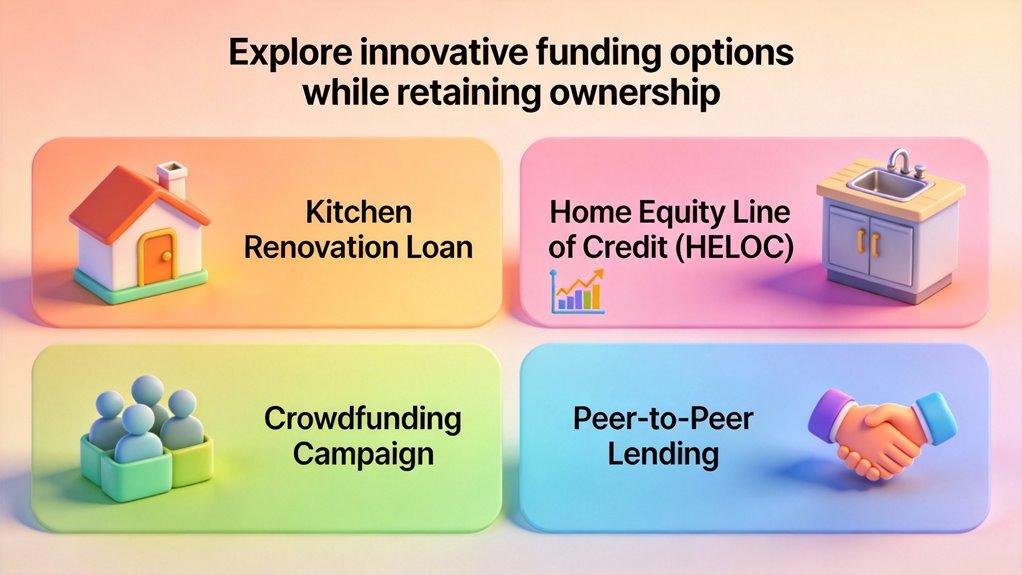
Let’s investigate strategic alternatives for raising equity for your kitchen renovation that keep you in full control. Revenue-based financing lets you fund improvements through your cash flow, while equipment sale-leasebacks release capital tied up in existing assets. Furthermore, unsecured working capital can cover leasehold upgrades without risking ownership or collateral. Another option to consider is a personal loan, which provides a lump sum with fixed interest rates and set repayment terms without using your home as collateral. Additionally, exploring smart financing solutions can help you make informed decisions that support your business growth while maintaining full control over your assets.
Revenue-Based Financing: Funding Your Renovation Via Cash Flow
Since kitchen renovations in 2026 are vital for staying competitive, funding them without giving up ownership should be a priority for every restaurant owner.
Revenue-based financing offers a smart alternative, letting you fund revenue based kitchen upgrades by repaying a percentage of your monthly cash flow. This approach adjusts fluidly to your sales, easing pressure during slow periods. You keep full ownership and avoid the equity trap common in traditional financing.
Consider these benefits related to revenue-based financing:
- Flexible repayment tied to actual revenue
- No equity dilution or ownership loss
- Quick access to capital, ideal for timely renovations
- Suitable for steady cash flow businesses like restaurants
Unlike traditional loans, options like Home Equity Line of Credit (HELOC) can also provide flexible financing solutions tailored to renovation projects.
Revenue-based kitchen upgrades enable owners to innovate confidently without sacrificing their company’s future value.
Equipment Sale-Leasebacks: Unlocking Capital From Your Current Assets
Although tapping into new equity might seem like the easiest way to fund a kitchen renovation, equipment sale-leasebacks offer a smart alternative that keeps ownership intact while releasing the cash tied up in your existing assets.
By selling your kitchen equipment to a lender and leasing it back, you release immediate capital without interrupting operations. With an equipment leaseback for restaurants, you can access up to 100% of your equipment’s value in as little as three to five intervals. This type of financing often provides lower initial costs due to reduced need for large upfront capital outlays.
This enhances your cash flow and funds renovations or technology upgrades without giving up equity. Moreover, lease payments are often tax-deductible, enhancing financial flexibility. It’s a strategic move that turns owned assets into working capital, supporting innovation while protecting your legacy.
Unsecured Working Capital For Leasehold Improvements
Releasing capital through equipment sale-leasebacks keeps your ownership intact while financing vital upgrades. Another strategic tool is unsecured working capital lines which provide necessary liquidity for leasehold improvements without surrendering equity. It is important to note that these qualified costs for leasehold improvements must be carefully tracked to comply with the IRS’s Safe Harbor Qualification guidelines.
These lines of credit cover site acquisition, designer fees, and initial working capital, repaid promptly from your construction loan draws.
Speed: Access funds quickly to launch renovations without equity dilution
Flexibility: Use for multiple upgrade expenses under one credit facility
No Collateral: Avoid tying up assets beyond your leasehold improvements
Strategic Repayment: Align repayment with cash flow from operational efficiency gains
Embracing unsecured working capital lines allows you to fund smart kitchen upgrades intelligently, keeping ownership and innovation fully in your hands.
The 2026 Smart-Kitchen ROI Blueprint

Let’s focus on how smart-kitchen upgrades can fund themselves by cutting down labor and utility expenses. These modern tools simplify operations and improve energy efficiency, which directly lowers your overhead. In fact, many dining establishments are now securing funding for futuristic renovations that enhance both profits and sustainability.
Calculating How High-Tech Upgrades Pay For Their Own Financing
When we assess high-tech kitchen upgrades, the key is in understanding how their operational savings and efficiency improvements cover the financing costs.
By using precise ROI tools, we can quantify energy reductions, maintenance savings, and increased throughput, core to securing equity-free kitchen funding. These upgrades pay for themselves by cutting expenses and enhancing capacity.
Consider these points:
- Invoq ovens cut steam and convection energy use by up to 70% and 19%, lowering utility bills.
- Thermodyne’s reliable appliances reduce maintenance costs over 12 years.
- Increased cooking capacity by 17% means higher revenue potential.
- Water savings via streamlined cleaning reduce operational overhead.
This clear calculation supports non-dilutive funding, letting us modernize without sacrificing ownership.
Reducing Labor And Utility Overhead Through Modernization
After calculating the hard savings from energy and capacity improvements, we should look closely at how kitchen modernization cuts labor and utility overhead.
In 2026, smart technologies reduce manual tasks and errors, easing labor shortages and supporting higher productivity. Mechanized systems like voice-activated appliances and AI-driven inventory management help control staffing costs and minimize waste.
Energy-efficient equipment saves 10-15% in utility bills, thanks to smart load sensors and coordinated energy use. These upgrades pay for themselves by lowering operating expenses.
When pursuing restaurant renovation loans 2026, focusing upon labor and utility reductions strengthens your financing case. Modernization is not only about appearance, it’s about creating a smooth, tech-enabled environment where capital drives measurable operational efficiency without sacrificing equity or control.
Navigating The 72-Hour Approval Process
Let’s look at how connecting your POS data can accelerate revenue verification and cut out the bank’s paperwork. Fintech lenders now use real-time sales info to approve loans in as little as 72 hours, making the process quicker and smoother. This shift allows businesses to leverage uncapped revenue financing that doesn’t require giving up equity or extensive documentation. The shift lets us focus upon running your renovation without waiting weeks for funding decisions.
Connecting Your POS Data For Instant Revenue Verification
Because lenders now depend considerably on real-time data for verifying our revenue, linking our POS systems directly with their platforms has become essential.
This connection gives us immediate revenue verification, accelerating culinary infrastructure finance decisions while ensuring accuracy. By integrating POS telemetry, we provide transparent, detailed sales data that lenders trust for rapid approvals. This means no delays, fewer manual errors, and clear proof of our operational efficiency.
Key benefits include:
- Precise transaction tracking with timestamps and unique IDs
- Mechanized reconciliation aligning sales with bank deposits
- Real-time inventory and fraud monitoring during sales
- Full line-item and payment method documentation for verification
The approach optimizes funding, protecting our ownership while fueling growth without sacrificing equity.
Bypassing The Bank: Why Fintech Is The New Commercial Lender
While traditional banks often struggle to keep up with the swift pace in home improvement financing, fintech platforms have stepped in to fill the gap.
These platforms use advanced analytics and digital tools to approve loans promptly—often within 72 hours—streamlining ghost kitchen expansion funding. Unlike banks, fintech lenders integrate directly with your POS system, allowing instant revenue verification and more accurate risk assessments.
This signifies we can bypass lengthy bank approvals and get funding more quickly, without sacrificing flexibility. Fintech also offers customized repayment options based upon real-time data, making it easier to manage cash flow during renovations.
For owners committed to keeping equity, fintech provides an innovative, efficient alternative that supports smart kitchen investments without the delays and complications traditional lenders impose.
Frequently Asked Questions
How Does Pos-Telemetry Protect My Financial Privacy During Underwriting?
We trust POS-Telemetry secures our financial privacy by sharing only real-time sales data, not sensitive personal info, under strict GLBA rules. This allows lenders to assess performance without exposing our detailed nonpublic personal information.
What Happens if My Delivery Volume Doesn’t Increase Post-Renovation?
If our delivery volume doesn’t increase post-renovation, our ROI suffers and fixed costs weigh heavier. We’ll need to pivot marketing, enhance workflows, or innovate menu choices to drive demand and fully capitalize upon operational efficiencies.
Can Small, Standalone Kitchens Benefit From Non-Dilutive Financing as Well?
Absolutely, we believe small standalone kitchens can utilize non-dilutive financing to upgrade effectively. Quick approvals, no equity loss, and scalable repayment fit perfectly with their needs, enabling innovation without compromising ownership or cash flow.
Are There Penalties for Early Repayment of Revenue-Based Financing?
We’re glad you asked—most revenue-based financing deals don’t charge early repayment penalties. We can repay quickly without extra fees, accelerating growth. Such flexibility keeps our cash flow agile while protecting our ownership and innovation momentum.
How Do Sale-Leaseback Agreements Affect My Restaurant’s Tax Situation?
Sale-leasebacks enhance tax efficiency by making rental payments fully deductible as operating expenses—unlike debt interest. We utilize these deductions to lower taxable income, improve cash flow, and sidestep debt limits, keeping our restaurant agile and innovative.
