
We provide direct-to-consumer brand financing for Meta advertisements reliant upon actual revenue, allowing you access adaptable capital swiftly without hindering growth or relinquishing equity.
Our real-time underwriting connects your ad expenditure to your daily sales, modifying budgets fluidly to keep campaigns effective and avoid expensive interruptions.
You may be interested


Such signifies you can scale advertisements assuredly, maintain complete ownership, and react immediately to market changes.
Keep exploring in order to see how this method eliminates traditional financing hurdles and propels sustained growth.
Key Takeaways
- Direct integration with Meta Ads Manager enables real-time revenue-based funding decisions for DTC ad campaigns without traditional credit checks.
- Funding limits dynamically adjust to live ad performance, preserving ad momentum and maximizing sales velocity.
- Capital allocation is based on multi-touch attribution metrics like ROAS to align spend directly with revenue generation.
- Non-dilutive, revenue-based funding preserves founder equity while enabling scalable Meta ad spend.
- Daily ad budgets scale with prior revenue trends, capping spend to maintain efficient growth and healthy returns.
The Evolution Of Marketing Capital In The DTC Space
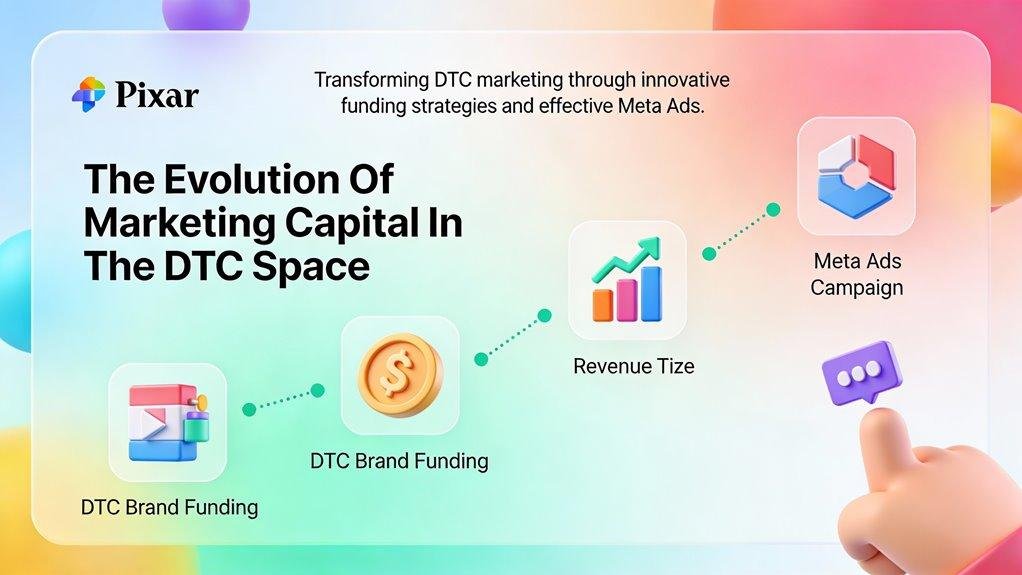
Traditional credit limits are limiting growth because they rely on outdated measures like collateral rather than how well your ads perform. Now, lenders connect directly to real-time data from Meta and Shopify to assess the true return for your ad spend. This shift from static credit checks to lively performance attribution gives us the power to scale more rapidly and smarter. By leveraging first-party data strategies, brands can optimize customer experience and improve the accuracy of funding assessments. Additionally, the rise of revenue lending opportunities provides franchises the tools necessary to fuel expansion and enhance their marketing efforts.
Why Traditional Credit Limits Are Strangling Modern Growth
Though today’s growing DTC brands face more pressure than ever in scaling quickly, credit limits at conventional funding sources hold them back when they need cash the most.
These tight limits choke growth, forcing brands to pause Meta Ad spend and hinder momentum. In 2026, innovative founders seek non-dilutive growth capital that flexes with performance, not outdated credit formulas.
Traditional lenders fixate on fixed lines that ignore real-time revenue perspectives, limiting timely investments in customer acquisition. As a result, many brands struggle to capitalize on viral spending windows accelerated by no-contact shopping trends.
| Problem | Impact |
|---|---|
| Rigid credit limits | Halt ad momentum |
| Slow approval processes | Miss viral spending windows |
| Debt tied to collateral | Limits flexibility |
| Outdated underwriting criteria | Ignores fluid revenue |
| Equity dilution risk | Undermines founder control |
We must move beyond these constraints to fund growth based on actual performance.
Understanding The Shift From Collateral To Performance Attribution
As we move further into 2026, funding for Meta ads is no longer anchored by physical collateral but driven by how much revenue those ads truly generate.
Traditional models relied upon last-click or position-based attribution, tying budgets to impressions without showing real impact. Today, performance-based ad capital connects spend directly to revenue outcomes using multi-touch attribution and incrementality testing. Multi-touch attribution captures the influence of all marketing touchpoints, offering a complete view of customer engagement and improving budget allocation.
This shift reveals the true value across the entire funnel, allowing us to allocate resources smarter and defend budgets with data-backed ROI. By focusing on metrics like ROAS and Marketing Efficiency Ratio, we align funding with actual growth potential.
This evolution replaces guesswork with precision, ensuring brands can scale Meta ad campaigns efficiently without risking equity or relying upon outdated collateral.
How Revenue Based Ad Funding Accelerates Growth

We connect directly with Meta Ads Manager’s API in order to underwrite funding in real time, aligning your ad spend closely with your current sales velocity. That allows us to provide capital that scales with your growth without risking dilution or control. By choosing revenue-based funding, you’re investing in sustained momentum and preserving equity for the long run. This approach leverages the proven cost-effectiveness of online advertising, which 90% of startups consider vital for business survival and growth. Additionally, revenue-based financing helps e-commerce businesses adapt quickly to market changes, ensuring they remain competitive in a dynamic landscape.
Integrating Meta Ads Manager API For Real-Time Underwriting
When we connect Meta Ads Manager’s API directly with our funding process, real-time underwriting becomes more than a buzzword, turns into a growth engine. Meta ads manager API integration lets us access live metrics like spend, clicks, and ROAS instantly. This operational efficiency enables launching and managing large-scale ad campaigns seamlessly.
This direct feed powers underwriting decisions based on current performance, not past reports. We verify business credentials and pull data securely using permissions like ads_read and ads_management.
Then, the system flexibly adjusts funding limits reflecting real-time ad yield. The result? Brands keep their ads firing without pause, maintaining algorithm momentum and avoiding costly resets.
This smooth integration guarantees capital flows aligned with ongoing campaign success, accelerating growth while protecting equity. For founders focused on scaling, real-time underwriting via Meta Ads Manager’s API is a game changer.
Synchronizing Your Daily Spend With Sales Velocity
Three key principles guide how we synchronize daily Meta ad expenditure with sales velocity to enhance growth through Revenue Based Ad Funding.
Initially, we align daily budgets to a percentage of previous day revenue, typically between 10-20%, ensuring expenditure matches sales momentum without overextending.
Secondly, we trigger scaling only when daily revenue surpasses the 7-day average by at least 20%, capping expenditure at 15% of trailing revenue to maintain a healthy ROAS.
Data from the Quarterly Services Survey by the U.S. Census Bureau underscores the importance of tracking revenue dynamics in service industries to optimize spending strategies.
Third, we pause or reduce expenditure if velocity dips below baseline targets, protecting campaign efficiency.
This dtc ad funding approach ties capital directly to real-time revenue, enabling mechanized, data-driven expenditure adjustments.
The outcome? Brands grow 2-3 times quicker while minimizing cash burn and keeping the Meta engine running continuously at peak efficiency.
The Strategic Importance Of Non-Dilutive Capital
Although traditional funding options often require giving up equity or control, non-dilutive capital through Revenue Based Ad Funding (RBF) offers a powerful alternative for DTC brands seeking to accelerate growth.
Revenue based financing for Meta ads preserves our ownership and lets us scale without investor interference. Instead from fixed debt, repayments align with revenue, making cash flow manageable.
This indicates our Meta ad spend grows right alongside sales velocity, fueling continuous algorithmic learning without pause. By keeping 100% founder equity intact, we maintain strategic freedom and avoid dilution pitfalls common in venture capital rounds.
Non-dilutive capital accelerates growth cost-effectively, ensuring we’re not trading long-term control for short-term cash. Moreover, ad services provide seamless integration options that optimize ad placement for maximum revenue impact.
For innovative founders, RBF is the tool that powers Meta’s engine endlessly, driving scalable, sustainable DTC success.
Bypassing The Scaling Bottlenecks Of Traditional Finance
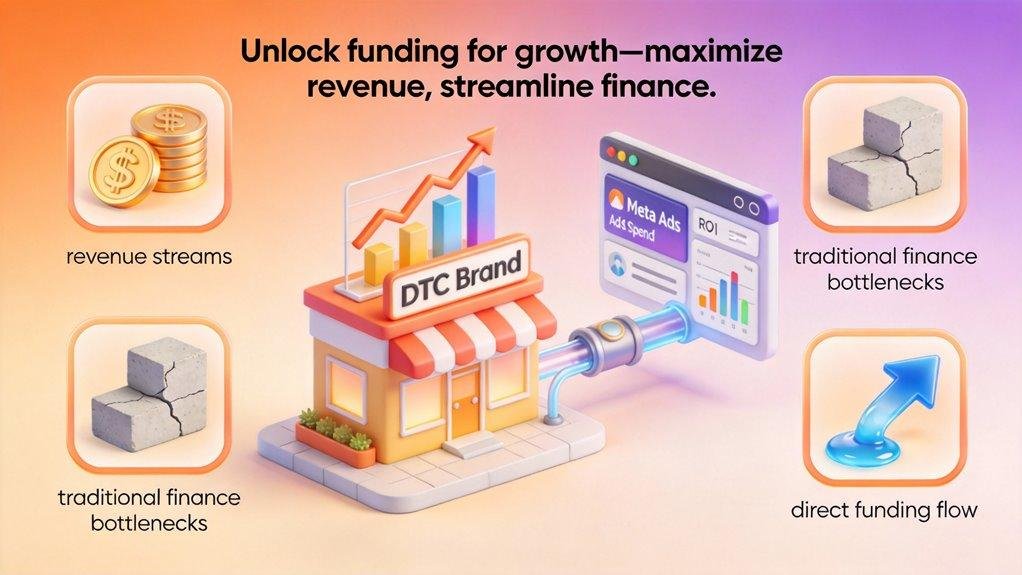
We know that pausing your Meta ads interferes with the pixel learning phase, which causes customer acquisition costs to spike. By using revenue-based funding, we can manage these fluctuations with flexible payments tied to your sales, ensuring your campaigns keep running smoothly. Such an approach lets us scale rapidly without giving up any equity, preserving full ownership as you grow toward eight figures. Additionally, uncapped revenue financing options create a viable alternative to traditional funding methods, allowing for greater adaptability in response to market changes.
Protecting Your Meta Pixel Learning Phase With Continuous Funding
When your Meta Pixel enters its learning phase, maintaining steady ad spend is crucial to avoid resets that can spike your acquisition costs by up to 50%.
Interruptions in funding cause the pixel to re-learn from scratch, hurting your customer acquisition financing efficiency and inflating costs. Traditional financing often causes these breaks, introducing delays that throttle scaling and fragment data flow.
Instead, tying your ad budget directly to revenue helps sustain consistent spending, keeping the pixel’s optimization continuous and effective. By using revenue-based customer acquisition financing, you bypass approval bottlenecks and maintain real-time funding aligned with sales performance.
This approach protects your pixel’s learning curve, reduces fluctuations in CAC, and guarantees your Meta Ads algorithm runs at peak power, positioning your brand for rapid, reliable growth.
Managing CAC Fluctuations Through Variable Remittance
Maintaining constant ad spend keeps the Meta Pixel improved, but real-world factors often push customer acquisition costs (CAC) toward fluctuate. Seasonal demand swings and ad competition cause variable CAC that traditional fixed budgets can’t handle.
That’s where variable remittance models shine, modifying capital flow based on actual ad performance. With roas-based funding, we align repayment with revenue generated, bypassing scaling bottlenecks in traditional finance.
This flexibility allows we quickly ramp or reduce spend without pausing campaigns. Additionally, by tying capital directly to real-time ROAS data, we keep the Meta algorithm fueled efficiently.
Variable remittance keeps liquidity flexible, preventing costly learning phase resets when CAC spikes unexpectedly. It alters how growth brands manage risk and seize scaling opportunities in Meta Ads, revealing true momentum without diluting equity or relying on rigid loan structures.
Keeping 100% Equity While Scaling To Eight Figures
Although traditional financing options may seem like the default route for scaling, they often come with hidden costs that erode your ownership and control.
In 2026, we see DTC brands bypassing these scaling bottlenecks by utilizing revenue-based funding tied directly to their Meta Ads performance. This method keeps you at 100% equity while fueling growth through the Meta algorithm’s real-time data.
Unlike venture capital, which demands control and shares, revenue-based funding aligns capital flow with actual sales, preventing dilution. As we focus on scaling Meta ads 2026, this approach eliminates the momentum gaps caused by paused or limited spends.
It guarantees continuous ad fueling without surrendering equity, allowing your brand to hit eight-figure revenues without selling a single share or sacrificing control.
The 24-Hour Deployment Blueprint For High-Growth Brands
We link your digital growth stack to release instant funding approvals without touching personal credit scores. By using real-time store performance data, lenders see your actual revenue impact and approve more quickly. That 24-hour blueprint lets high-growth brands access capital the moment they prove their Meta Ads are working. Additionally, leveraging sales data can enable brands to unlock even more funding opportunities tailored to their specific growth metrics.
Connecting Your Digital Growth Stack For Instant Approvals
When you connect your digital growth stack correctly, you gain access to the ability to push campaigns live and receive approvals within 24 hours. This efficient process is crucial for high-growth brands relying on dtc cash flow solutions to fuel Meta Ads effectively.
Here’s how to enhance your stack for instant approvals:
- Integrate lead ads with your CRM using tools like LeadsBridge for automatic data flow.
- Confirm compliance with privacy policies and include consent fields to pass Meta’s automated AI review quickly.
- Use simple, established account structures with rich creatives to accelerate approvals.
- Avoid peak seasons and complex ad formats to prevent delays.
Bypassing Personal Credit Checks Using Store Performance Data
Since traditional credit checks often slow down funding and exclude many high-potential founders, leveraging store performance data offers a quicker, fairer alternative.
By bypassing credit checks using store performance data, we tap into real-time metrics from e-commerce transactions, spend trends, and payment processors. This approach reveals a brand’s true revenue potential, not just historical creditworthiness. It enables lenders to approve funding more swiftly, sometimes within 24 hours, and expands access for those with thin or no credit files.
We use secure open banking links for instant data gathering, creating hundreds of predictive features that outperform traditional scores. For high-growth DTC brands, this means continuous capital flow aligned with actual revenue, preserving momentum without the delays and barriers associated with personal credit checks.
Embracing this method fuels smarter, quicker scaling.
Frequently Asked Questions
How Does Revenue Based Ad Funding Affect My Brand’s Credit Score?
We see revenue-based ad funding improving our credit score by showcasing consistent sales and strong cash flow in real time. This helps us move beyond old metrics, proving our brand’s financial health vigorously and transparently.
Can Small DTC Brands With Less Than $1m Revenue Qualify for RBF?
Yes, we can qualify even under $1M revenue by leveraging real-time data from Meta Pixels and Shopify. Lenders focus at 7-day trailing ROAS, not old financials, enabling rapid funding for innovative small DTC brands like ours.
What Happens if My Meta Ads ROAS Suddenly Drops After Funding?
If your Meta Ads ROAS suddenly drops, we act swiftly—diagnosing tracking issues, revitalizing creatives, and adjusting targeting to prevent learning resets. We don’t pause; we fuel momentum, keeping the algorithm enhanced and scaling without interruption.
Are There Restrictions on the Types of Products Eligible for RBF?
Yes, we face some restrictions with RBF eligibility—typically, regulated products like financial services, alcohol, or adult content are excluded. We focus on innovative, compliant DTC brands to guarantee steady revenue and smooth scaling with Meta ads.
How Do Lenders Verify Real-Time Sales Data Without Accessing Full Financials?
We verify real-time sales by connecting directly with your Shopify and payment processors via secure APIs, matching timestamped transactions and ad spend without full financials. Such keeps data private while confirming revenue instantly and accurately.
