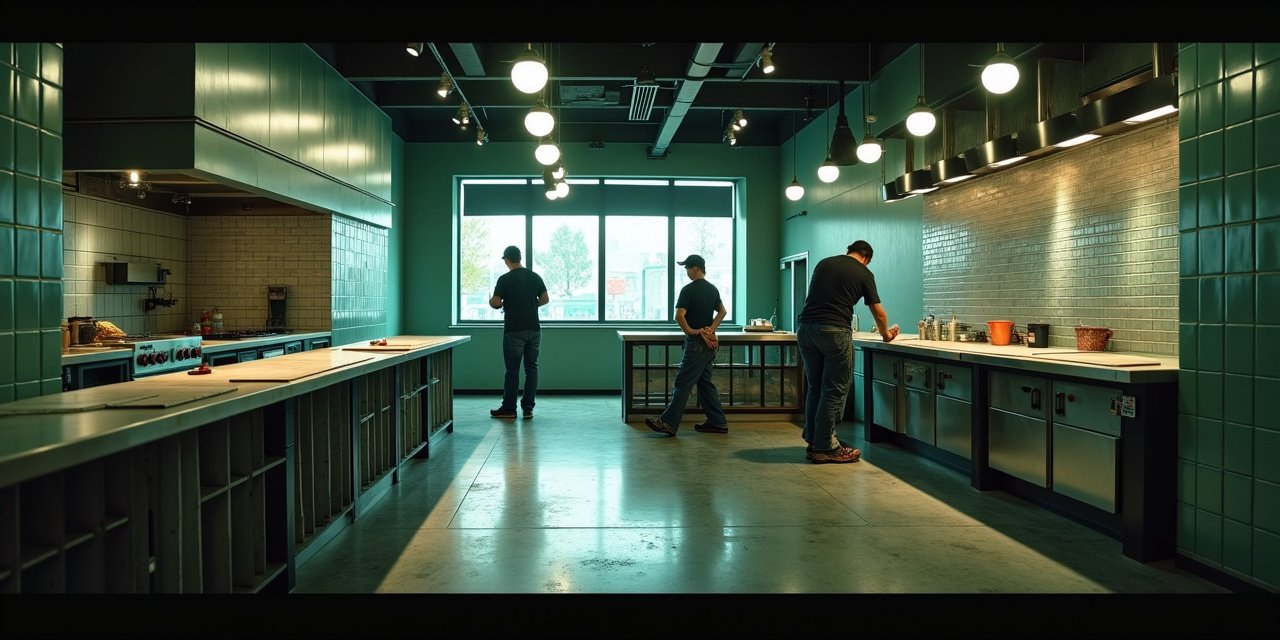
Pizza restaurant remodel loans funded in 72 hours on revenue history — no bank approval, no collateral, no personal guarantee required for most operators.
What a Pizza Restaurant Remodel Covers
Pizza restaurant remodels span a wide range of project types — from a single oven replacement to a full interior and kitchen overhaul. The scope of your remodel determines the right loan amount and the right financing instrument. Mixing up the two is the most common and costly mistake operators make.
Kitchen equipment and systems: Deck ovens ($8,000–$40,000 each), conveyor ovens ($15,000–$60,000), commercial refrigeration ($5,000–$30,000), walk-in cooler installation ($10,000–$40,000), hood systems ($8,000–$25,000), make-line upgrades ($5,000–$20,000). Equipment financing is worth comparing for any single purchase over $15,000 — rates are often lower than a general revenue-based advance.
POS and technology modernization: Replacing legacy POS with an integrated system (online ordering, loyalty, kitchen display) typically runs $5,000–$15,000. This is one of the highest-ROI remodel investments for pizza operators — faster ticket times and direct online ordering reduce third-party commission drag.
Dining room and exterior: New seating, tables, lighting, and flooring average $20,000–$60,000 for a mid-size dining room. Exterior signage — channel-letter signs, LED monument signs — runs $8,000–$25,000. Updated exterior signage has a measurable impact on walk-in traffic and delivery platform visibility.
ADA compliance: Accessible restrooms, ramps, and door modifications are increasingly required for lease renewals and can cost $10,000–$40,000. These projects are often fundable separately from cosmetic remodels and qualify for SBA accessibility improvement programs in some markets.
Pizza Restaurant Remodel Costs in 2026
Construction and equipment costs have increased 18%–25% since 2022 due to material inflation and skilled trades shortages. Budget planning needs to reflect 2026 pricing, not pre-inflation estimates from older renovation cycles.
| Remodel Scope | Typical Cost Range | Key Components | Typical Timeline | Best Financing Instrument |
|---|---|---|---|---|
| Cosmetic Refresh | $15,000–$40,000 | Paint, seating, signage, POS | 1–2 weeks | Revenue-based advance |
| Dining Room Remodel | $40,000–$100,000 | Flooring, seating, lighting, bar | 2–4 weeks | Revenue-based advance |
| Kitchen Equipment Upgrade | $50,000–$150,000 | Ovens, hoods, refrigeration, make-line | 1–3 weeks | Equipment financing + RBF |
| Full Kitchen Remodel | $100,000–$250,000 | Layout, plumbing, electrical, equipment | 4–10 weeks | SBA 7(a) or RBF stack |
| Full Renovation | $200,000–$400,000+ | All of the above + structural work | 8–20 weeks | SBA 7(a) or construction loan |
For projects under $100,000 where speed matters, revenue-based financing is almost always the most accessible option. For projects over $150,000 where you have 90+ days of lead time, the interest savings from an SBA 7(a) loan (9%–13% APR vs. 30%–60% annualized for RBF) become significant enough to justify the documentation burden.
Remodel Loan Options for Pizza Restaurants
Four financing instruments are realistically available to most pizza restaurant operators. Each serves a different project scope, timeline, and borrower profile. Matching the instrument to the project is the most important step in the financing process.
Revenue-based advances are the fastest and most accessible — no collateral, no hard credit pull, approval in 24 hours. MCAs are similar but tied to card volume rather than total revenue, making them a weaker fit for delivery-heavy pizza operations. SBA 7(a) loans offer the lowest rates but require 8–12 weeks and full documentation. Equipment financing is purpose-built for single equipment purchases and carries rates in the 6%–18% APR range. For the general mechanics of applying entirely online — document lists, underwriting speed, and franchise-specific approval quirks — see our guide to restaurant makeover financing online.
| Loan Type | Typical Cost | Max Amount | Speed | Collateral | Best Scope |
|---|---|---|---|---|---|
| Revenue-Based Advance | 1.10–1.35x factor | Up to $250K | 24–72 hours | None | Any scope under $150K |
| MCA | 1.20–1.49x factor | Up to $500K | 24–48 hours | None | High-card-volume, under $75K |
| Equipment Financing | 6%–18% APR | Up to $500K | 2–5 days | Equipment only | Oven/refrigeration purchases |
| SBA 7(a) Loan | Prime + 2.75%–4.75% | Up to $5M | 8–12 weeks | Required | Full renovation, $150K+ |
| Bank Term Loan | 7%–14% APR | Varies | 4–8 weeks | Required | Established relationships only |
Revenue-Based Pizza Restaurant Remodel Loans: How They Work
A revenue-based remodel loan advances a lump sum against your future monthly revenue. The lender reviews your last 4–6 months of bank statements to establish your average monthly deposit volume. The advance amount is typically 75%–150% of that average, depending on your credit profile and time in business.
Repayment works as a percentage of your monthly revenue — typically 8%–15% — automatically remitted via ACH each month. There is no fixed term. If your revenue drops during the remodel period (reduced covers due to construction), your repayment amount drops proportionally. When revenue recovers and grows post-remodel, repayment accelerates naturally.
The factor rate — typically 1.15–1.35x for pizza restaurants with 12+ months in business — determines your total repayment. A $75,000 advance at 1.25x means you repay $93,750 total. At a 12% holdback on $80,000/month average revenue, that's approximately 9.8 months to full repayment. At $100,000/month post-remodel, payoff accelerates to about 7.8 months.
This structure aligns well with remodel economics. The remodel disrupts revenue short-term and grows it long-term. A fixed-payment loan demands the same payment during the disruption phase as during the growth phase. Revenue-based repayment adjusts automatically — lower during the disruption, higher as the remodel pays off.
How Much Can a Pizza Restaurant Borrow for a Remodel
Advance amounts scale with average monthly revenue. The table below shows indicative ranges based on revenue tiers. Actual offers vary by lender, credit profile, and deposit consistency.
| Avg. Monthly Revenue | Typical Advance Range | Factor Rate Range | Total Repayment (midpoint) | Est. Term (12% holdback) |
|---|---|---|---|---|
| $20,000–$30,000 | $15,000–$30,000 | 1.25–1.40x | $28,125 (on $22,500) | 9–12 months |
| $30,000–$60,000 | $25,000–$65,000 | 1.20–1.35x | $58,500 (on $45,000) | 8–11 months |
| $60,000–$100,000 | $50,000–$120,000 | 1.18–1.30x | $103,950 (on $85,000) | 7–10 months |
| $100,000–$200,000 | $85,000–$200,000 | 1.15–1.25x | $175,500 (on $150,000) | 6–9 months |
| $200,000+ | $150,000–$250,000 | 1.12–1.22x | $253,000 (on $220,000) | 5–8 months |
Operators at the lower revenue tiers should evaluate whether the remodel ROI justifies the factor rate cost at that tier. A $25,000 cosmetic refresh on a $25,000/month revenue operation at 1.35x means repaying $33,750 — a $8,750 fee over 9–11 months. If the refresh adds $3,000/month in incremental revenue, it pays back in 3 months and continues generating return for years. If it adds $500/month, the math doesn't work.
Application to Funding: Step-by-Step Timeline
The revenue-based remodel loan process is designed to close in 72 hours or less. Every step happens online — no branch visit, no in-person appraisal, no physical document submission.
Day 1 — Application (10–20 minutes): Complete the online application with basic business information. Upload 4–6 months of bank statements as PDFs. Most lenders accept statements from any major bank and do not require a pre-existing account relationship. Submit by noon Eastern for same-day underwriting.
Day 1 — Underwriting (2–8 hours): Automated systems analyze deposit volume, consistency, NSF frequency, and average balance. Applications flagged for manual review (irregular deposits, recent NSFs, multiple accounts) take 4–8 hours. Straightforward applications from established operators often return in under 2 hours.
Day 1–2 — Approval and Offer: You receive an offer via email or portal showing advance amount, factor rate, holdback percentage, and total repayment. Compare offers from multiple lenders before signing — factor rates can vary by 0.10–0.20x between providers on the same application profile.
Day 2 — Contract Signing: Review and execute documents electronically via DocuSign or equivalent. Read the full agreement — specifically the holdback percentage, total repayment amount, prepayment terms, and any default provisions. Signing same day as offer receipt is possible but not required.
Day 2–3 — Funding: ACH initiated upon executed contract. Funds typically arrive in your business checking account within 1–2 business days. Some lenders offer wire transfer for same-day funding at a small fee.
The Pizza-Specific Cost Drivers Other Remodels Don't Have
Pizza remodels carry two cost drivers most restaurant remodels skip: oven ventilation code and delivery-versus-dine-in footprint.
Any gas or wood-fired pizza oven requires a Type I exhaust hood under NFPA 96. That means fire-rated ductwork, UL-listed grease filters, and automatic suppression. A single Type I hood system runs $10,000–$50,000+ installed, per commercial kitchen hood cost data.
Most health departments won't issue occupancy approval without it. This is code, not a discretionary upgrade.
Delivery footprint is the other driver. More than 78% of pizzeria operators use online ordering. Among those on third-party delivery, 46% see 11%+ of sales from that channel, per Pizza Today's 2025 Pizza Industry Trends Report.
Remodel dollars are shifting accordingly — from dining room seats toward pickup shelving and second make-lines.
Franchise pizza operators face a third layer: brand-mandated asset-action cycles with real dollar minimums. A Pizza Hut franchise agreement filed with the SEC sets Minor Remodels at $75,000–$100,000. Major Remodels run $150,000–$400,000, due roughly every 7–10 years.
Delivery/carryout-only ("Delco") formats carry a separate, lower tier: $50,000–$250,000, per the SEC-filed Pizza Hut franchise amendment. These compliance windows don't move for a slow bank approval.
For documentation speed once the notice arrives, see our quick restaurant remodel financing guide. For sequencing capital across a multi-year remodel cycle, see our 2026 remodel capital planning guide.
Quick Check
See what you qualify for in under 3 minutes.
No personal guarantee required. No hard credit pull. Revenue history is what qualifies you.
Check Capital Eligibility →Frequently Asked Questions
Most revenue-based lenders advance 75%–150% of average monthly revenue. A pizza restaurant averaging $60,000/month can typically access $45,000–$90,000. High-volume operations averaging $150,000/month may qualify for $112,000–$225,000. The advance ceiling for most online lenders is $250,000 for a single advance, though stacked advances are possible after partial repayment.
For a revenue-based remodel loan, you typically need 4–6 months of business bank statements, a government-issued ID, your business EIN, and a voided check. Tax returns are generally not required for advances under $100,000. Larger advances may require a business tax return and lease agreement. No business plan, no collateral appraisal, no personal financial statement in most cases.
It depends on the remodel scope and your timeline. For cosmetic refreshes under $50,000 needed in under a week, a revenue-based advance is the best fit. For kitchen overhauls at $75,000–$150,000, revenue-based advances combined with equipment financing can reduce total cost. For full renovations over $150,000 with 90+ days of lead time, an SBA 7(a) loan delivers the lowest interest cost but requires significant documentation.
Yes. Revenue-based lenders typically approve operators with FICO scores as low as 500–550, provided monthly revenue exceeds $15,000 and there are no open bankruptcies. Expect factor rates in the 1.30–1.45x range at that credit tier. Improving your score above 620 before applying can meaningfully reduce your factor rate and improve your advance amount.
External Resource
SBA.gov Business Financing Guide — U.S. Small Business Administration
Ready to check your options?
Rev Boost Funding connects operators with independent financing partners. Not a lender.
Affiliate partnerships present.
Check Capital Eligibility → You Finished This — Add as Preferred SourceRevenue Financing Estimator
How Much Capital Can You Access?
Adjust the inputs to estimate your funding range. Illustrative only — no credit pull.
Illustrative estimate only. Not a lending commitment. Actual terms depend on lender underwriting and business profile. Results vary.
Verify Actual Eligibility →