
We understand that minority-owned businesses often face higher loan denial rates and scrutiny, making mobilization funding challenging.
Programs like SBA 7(a) and 8(a) loans, grants such as the HerRise MicroGrant, and support from Community Development Financial Institutions offer focused capital and flexible terms.
You may be interested


Leveraging these alongside strong credit and customized applications improves your funding chances.
States and local initiatives also provide customized support.
Keep exploring these options to find the best path for your business’s growth.
Key Takeaways
- SBA 7(a) and 504 loans provide substantial capital for minority-owned businesses’ working capital and fixed asset needs, aiding mobilization efforts.
- Community Development Financial Institutions (CDFIs) offer low-interest, flexible loans and technical support specifically targeting minority entrepreneurs.
- Federal programs like the SBA 8(a) Business Development Program and Minority Business Development Agency facilitate access to contracts and capital.
- Grants such as the HerRise MicroGrant and Power Forward Small Business Grant provide non-repayable funds for operational and growth activities.
- State and local initiatives, including Comcast RISE and MWBE grants, combine funding with technology upgrades and tailored assistance for minority firms.
Why Minority-Owned Businesses Face Loan Denials
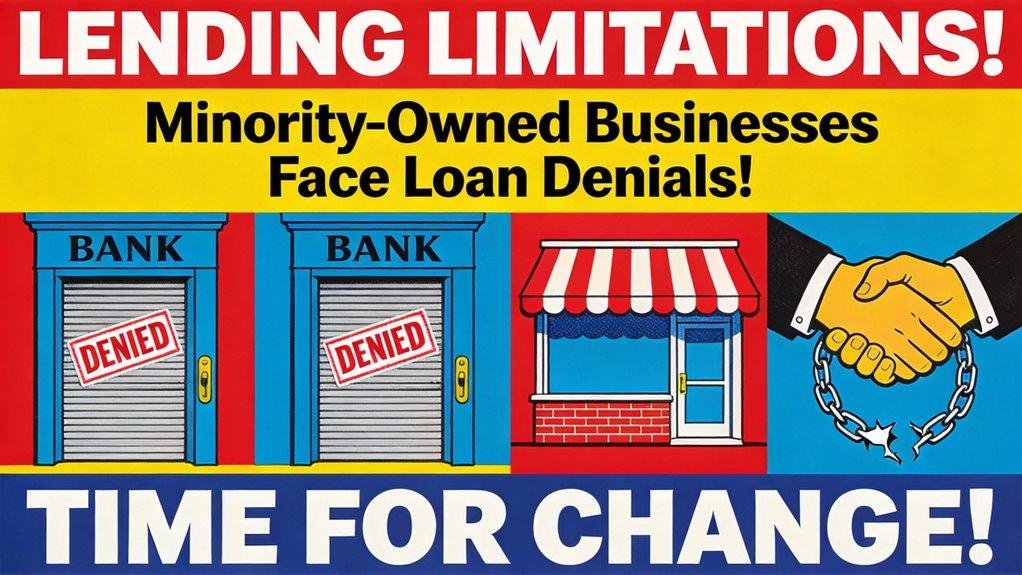
When we look closely at loan denial rates, minority-owned businesses face significant challenges that go beyond typical financial obstacles. Black-owned businesses are denied loans at a striking 39% rate, much higher than the 18% denial rate for white-owned firms. Hispanic- and Asian-owned businesses also experience heightened denial rates. These disparities demonstrate the significant funding challenges minority entrepreneurs encounter.
Smaller businesses, especially those with fewer than five employees or revenues between $50,001 and $100,000, face greater scrutiny due to perceived risks. Newer firms, particularly those operating under five years, are often flagged as higher risk. Furthermore, certain loan types, like SBA loans, have denial rates over twice the average. Economic uncertainty and lender caution compound these challenges. Finding non-dilutive funding alternatives can be a crucial strategy for overcoming these roadblocks.
Recognizing these patterns helps us devise innovative strategies to improve access to capital and build more equitable funding paths.
Types of Loans and Grants for Minority-Owned Businesses

Access for funding remains a significant barrier for growth for many minority-owned businesses. Understanding the range of loan and grant options available can help us better navigate this landscape. Research shows that loan costs are higher for minority-owned businesses, which impacts their ability to secure financing on favorable terms. Furthermore, leveraging federal contracts can provide additional financial stability for service providers.
SBA 7(a) loans offer up to $5 million for working capital. SBA 504 loans support fixed assets with up to $5.5 million. These loans are crucial, although disparities in approval rates and interest costs persist.
| Loan Type | Purpose |
|---|---|
| SBA 7(a) | Working capital, expansion |
| SBA 504 | Fixed assets, real estate |
| Minority Grants | Non-repayable capital |
| Microloans | Small-scale funding |
Federal Programs Boosting Capital Access for Minority-Owned Businesses

Although securing capital remains challenging for many minority-owned businesses, federal programs have stepped up to bridge the gap. These initiatives provide practical support to access funding and contract opportunities.
For example:
- The Minority Business Development Agency facilitated $1.5 billion in capital access and offers one-on-one financial counseling.
- The SBA 8(a) Business Development Program awards set-aside contracts and offers training to disadvantaged small business owners.
- The State Small Business Credit Initiative supports financing access and technical assistance for underbanked firms.
- Federal Procurement Set-Aside Programs create pathways to government contracts targeting minority-owned businesses.
In addition, swiftly securing federal funding can help businesses overcome traditional funding obstacles when banks say no. Together, these programs create an innovative ecosystem that strengthens capital access and promotes growth. With over 35% of all U.S. businesses being minority-owned, these programs serve a critical role in supporting a substantial segment of the entrepreneurial community. Leveraging these resources helps us maneuver financing challenges and build sustainable success.
Community Development Financial Institutions and Minority Loan Access
Because traditional lenders often view minority-owned businesses as higher risk, Community Development Financial Institutions (CDFIs) play a crucial role in filling financing gaps. These mission-driven organizations bring capital and customized support to underserved communities where conventional banks hesitate.
By offering low-interest loans, flexible collateral options, and business coaching, CDFIs make financing accessible to minority entrepreneurs who might otherwise struggle. Nearly 500 CDFIs are members of the Opportunity Finance Network, demonstrating a strong, collaborative presence in the industry. Certified by the U.S. Treasury, they combine funding with technical assistance to strengthen small businesses, create jobs, and improve local economies.
CDFIs operate across urban, rural, and Native areas, bridging the gap for borrowers with less-than-perfect credit. Their innovative approach builds sustainable economic ecosystems by supporting growth in sectors often overlooked by mainstream finance, positioning minority-owned businesses for long-term success.
Top Private Grants and Loans for Minority-Owned Businesses
Let’s investigate several leading private grants and loans that assist minority-owned businesses, concentrating on programs aimed at enhancing growth and operational needs.
From monthly grants like Freed Fellowship to larger awards such as the Power Forward Small Business Grant, these options provide practical funding opportunities. Understanding these sources helps us discover the best methods to secure capital and promote our businesses.
Leading Minority Loan Sources
Access for funding is a critical step for minority-owned businesses looking to grow and succeed. We can turn to several leading loan sources designed for our unique challenges. The SBA 7(a) Loan Program offers flexible terms for expansion or refinancing. Community Development Financial Institutions (CDFIs) focus on underserved entrepreneurs with lower denial rates and local impact.
Microloan programs provide smaller, accessible amounts for startups, coupled with training to improve success. Here are key loan options to investigate:
- SBA 7(a) and Microloans with community lender partnerships
- CDFI loans targeting disadvantaged areas
- Wish Local Enablement Program microgrants
- HerRise MicroGrant for women of color entrepreneurs
These resources help us innovate and scale while overcoming traditional funding barriers.
Key Entrepreneur Grant Programs
While securing loans is crucial, grant programs offer another significant pathway for minority-owned businesses in obtaining funding without repayment obligations. These grants target various groups, including women, Native owners, and LGBTQIA+ entrepreneurs. They help fuel innovation and growth.
Here are some key programs to evaluate:
| Grant Program | Benefits & Focus |
|---|---|
| MBDA Grants | Workshops, events, and capital access support |
| DigitalUndivided Breakthrough | $5,000 grants for Black women and Latinas |
| NASE Growth Grants | Up to $4,000 for business growth initiatives |
| Primary Nations Development | Funds Native-owned businesses and cultural projects |
Key States and Local Programs Supporting Minority-Owned Businesses
LET’S INVESTIGATE HOW STATE LOAN APPROVAL RATES AND LOCAL GRANT INITIATIVES PLAY AN ESSENTIAL ROLE IN SUPPORTING MINORITY-OWNED BUSINESSES. STATES LIKE RHODE ISLAND AND MASSACHUSETTS OFFER TARGETED PROGRAMS THAT ENHANCE ACCESS FOR FUNDING AND TECHNICAL ASSISTANCE.
UNDERSTANDING THESE OPPORTUNITIES HELPS US PINPOINT WHERE MINORITY ENTREPRENEURS CAN FIND THE MOST EFFECTIVE SUPPORT.
State Loan Approval Rates
Though loan approval rates for minority-owned businesses vary widely across the nation, some states stand out for their supportive local programs and high approval metrics. Vermont leads with top SBA microloan and Community Advantage loan approvals, supporting long-term minority-owned business success.
Hawaii boasts the highest minority business ownership rate, reflecting strong alignment between demographics and ownership opportunities. Yet, national disparities persist, with white entrepreneurs enjoying remarkably higher approval rates than minority groups.
To drive innovation and equity, we must focus upon:
- Increasing approval rates like Vermont’s targeted SBA programs
- Leveraging Hawaii’s population-aligned ownership models
- Addressing national racial disparities in capital access
- Encouraging borrower confidence to reduce fear of rejection
Local Grant Initiatives
Several local grant initiatives have proven crucial in supporting minority-owned businesses across key states. These programs offer targeted funding, technical assistance, and networking opportunities designed to enhance growth and job creation.
For example, California’s MWBE grants require certification and focus on economic development. The NAACP partner grants provide significant capital specifically for Black-owned businesses in New England and other states. The Wish Local program offers smaller grants in addition to access to a consumer base. Comcast RISE combines funding with technology upgrades.
Here’s a quick overview:
| Program | Grant Amount | Eligibility & Focus |
|---|---|---|
| California MWBE | Varies | MWBE certified, growth plans |
| Wish Local Authorization | $500-$2,000 | Black-owned, small revenue/employee size |
| NAACP Black-Owned | $5,000-$25,000 | Black-owned, regional focus |
| Comcast RISE | $5,000 + tech support | Minority/women, select cities |
These initiatives reinvent support structures for a thriving diverse business ecosystem.
Strategies to Overcome Loan Denials for Minority-Owned Businesses
Since loan denials pose a persistent challenge for minority-owned businesses, we need to adopt targeted strategies that address these barriers directly. Understanding the reasons behind high denial rates allows us to innovate effective solutions.
Loan denials challenge minority businesses, necessitating targeted strategies to overcome funding obstacles effectively.
We should focus on building strong credit profiles, seeking out community development financial institutions with flexible criteria, and improving financial literacy around lender requirements. Furthermore, pursuing multiple funding options reduces dependency upon any single source, enhancing our chances of success.
Key strategies include:
- Enhancing credit scores through personal and business financial management
- Leveraging alternative lenders like CDFIs with mission-driven goals
- Preparing thorough loan applications based on specific lender criteria
- Exploring non-traditional financing paths such as peer-to-peer lending and grants
Additionally, female entrepreneurs may benefit from exploring revenue-linked funding options that align with their business growth trajectory.
Together, these approaches can help us break through funding barriers and secure the capital needed for growth.
Leveraging Funding to Grow Minority-Owned Businesses
When we tap into available funding sources effectively, minority-owned businesses can accelerate their growth and expand their impact. Programs like the MBDA have revealed billions in capital, helping thousands of minority entrepreneurs secure contracts and create jobs.
We can capitalize on these resources by working with MBDA Business Centers for customized financial counseling and capital identification. In addition, SBA 7(a) loans and grants from organizations such as the NAACP Powershift and FedEx provide focused support. Alternative lenders like Accion and Kiva U.S. offer flexible loan terms that address credit challenges. Embracing these diversified funding options allows us to innovate and scale rapidly, contributing to strong revenue growth and stronger community influence.
Frequently Asked Questions
How Do Minority-Owned Businesses Build Credit for Better Loan Approval Chances?
We build credit by legally incorporating our business and obtaining an EIN to separate personal from business credit. Opening a dedicated business bank account is key. We register with credit bureaus and use business credit cards carefully, keeping utilization low and paying early. Working with suppliers who report payments helps establish positive trade lines. Ultimately, we pursue flexible financing options like CDFIs and utilize financial education to strengthen our loan applications.
What Role Do Personal Networks Play in Securing Minority Business Funding?
Personal networks play an essential role in securing funding for minority-owned businesses. We know these networks provide mentorship, advice, and connections that open doors to capital sources. Nevertheless, many minority entrepreneurs face limited access, so actively building diverse, supportive networks is critical. By engaging local chambers, peer groups, and industry-specific organizations, we can strengthen relationships, improve funding chances, and create pathways for more equitable financial opportunities.
How Does Loan Denial Impact Long-Term Growth of Minority-Owned Businesses?
Loan denial slows minority-owned businesses’ growth by limiting essential funding at key stages. Without capital, accessing funding is harder to scale, innovate, and compete. We see owners often avoid applying due to past rejections, creating a cycle of missed opportunities. In order to break this, we must improve funding access, simplify applications, and build stronger support networks. That way, we enable businesses to expand sustainably and drive long-term success for their communities.
Are There Mentorship Programs Paired With Funding Opportunities for Minority Entrepreneurs?
Yes, many programs combine mentorship with funding for minority entrepreneurs. For example, the NAACP Powershift Grant offers cash along with mentorship, and Gold House Ventures provides significant funding together with a structured fellowship. SCORE also pairs mentoring with training and access toward capital. These programs help businesses grow by offering practical guidance and financial resources, ensuring entrepreneurs don’t just get funds but the support required to use them effectively and scale sustainably.
What Technology Resources Are Available to Minority-Owned Businesses Seeking Capital?
We have access for beneficial technology resources like Comcast RISE, which offers not only $5,000 grants but also technology makeovers and consultations. Programs like DigitalUndivided Breakthrough provide mentorship concerning tech startups alongside funding. The Black Founders network connects us with events and resources for growing tech businesses. These tools help us build scalable, tech-savvy companies that attract capital while enhancing efficiency and innovation in our operations.
