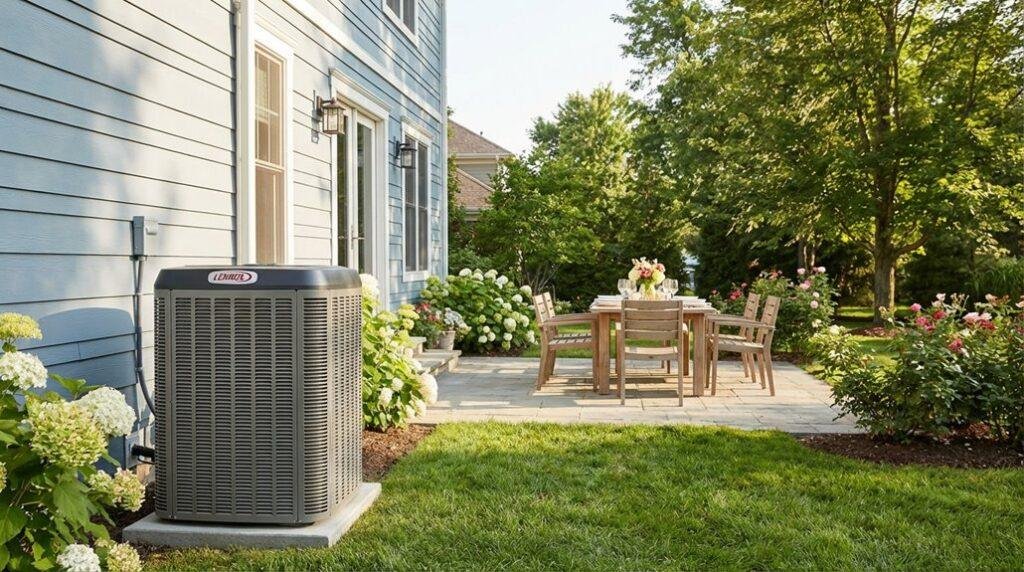
Financing your HVAC system before summer helps secure better rates and avoid the price hikes expected in 2026 due to new regulations and material costs.
You’ll start saving in energy bills immediately with high-efficiency units.
You may be interested


Financing plans often include low monthly payments or deferred interest options.
Additionally, you can benefit from federal tax credits and local rebates in order to lower upfront costs.
Knowing how to pick the right system and financing can save you even more.
Let’s investigate your best options.
Key Takeaways
- Financing HVAC before summer lets homeowners enjoy immediate energy savings from high-efficiency systems, often offsetting payment costs.
- Early installation prevents costly emergency repairs and ensures reliable cooling during peak summer demand.
- Financing plans may include low monthly payments and deferred interest options to ease upfront expenses.
- Completing HVAC upgrades by end of 2025 qualifies for valuable federal tax credits on energy-efficient equipment.
- Comparing multiple financing offers helps secure the best APR, terms, and rebates for affordable, long-term savings.
Why You Should Finance Your HVAC Before Summer
Although summer may feel far off, financing your HVAC system now can save you significant money and stress later. High-efficiency systems reduce energy bills, meaning the savings often cover your monthly financing payments. In addition, having a reliable HVAC system can help avoid emergency liquidity situations when appliances fail during peak service times.
You’ll notice immediate benefits from lower utility bills right after installation, especially when paired with smart thermostats for precise temperature control. Financing plans now often include deferred interest or low monthly payments, making upgrades more accessible. It is important to complete your HVAC installation by the end of 2025 to qualify for federal tax credits.
Taking action before summer also lets you claim useful federal tax credits that offset costs—up to $3,200 annually for efficient air conditioners or heat pumps. These credits and savings combine to make financing a practical, innovative choice. By investing ahead of the season, we guarantee comfort without breaking the bank and position ourselves for lasting energy benefits.
How HVAC Prices Will Rise In 2026
Since the HVAC industry faces new regulations and supply challenges, prices will rise noticeably in 2026. Reduced production of R-410A refrigerant under the EPA AIM Act will tighten supply and push refrigerant costs up by 10-40% early next year. Early acquisition of R-32 and R-454B will be critical for controlling refrigerant costs. Additionally, businesses can consider federal funding opportunities to offset some of these rising expenses.
Material costs like copper and steel remain heightened, further inflating prices for critical parts such as coils and compressors. Labor shortages add to overall costs, increasing installation prices by 10-15%. As a result, equipment like mid-range SEER2 systems could see price jumps in the range of 10-12%, with full replacements rising similarly.
Import tensions and semiconductor scarcity also contribute to higher costs. Understanding these trends helps us prepare financially and stay ahead as innovation drives us toward more efficient, sustainable HVAC solutions despite rising expenses.
What Incentives And Rebates Can Lower Your HVAC Costs?
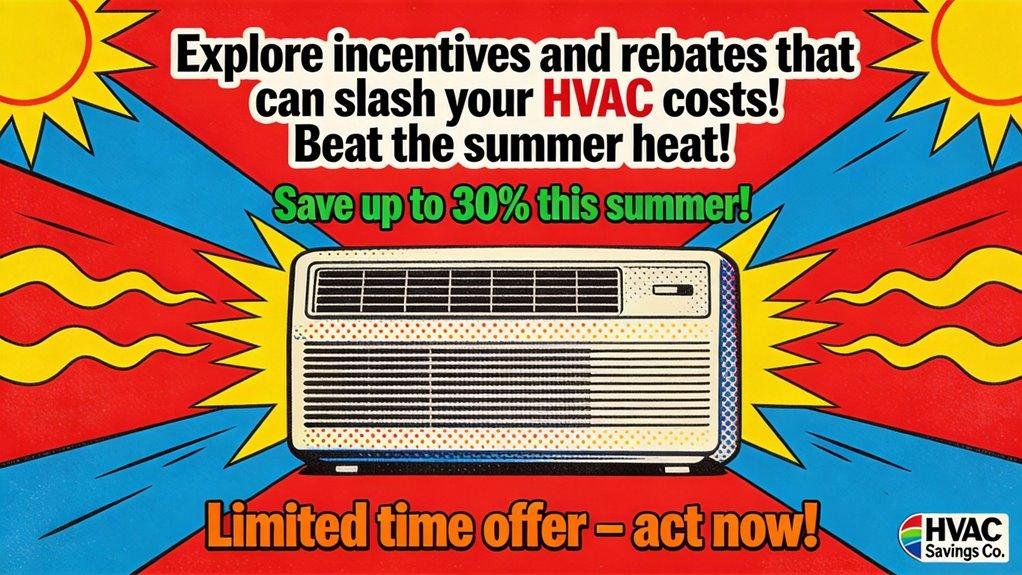
We can reduce our HVAC costs considerably by taking advantage of federal tax credits designed to cover a portion of equipment and installation expenses. Many local utilities also offer rebates that lower upfront costs and encourage energy-efficient upgrades. In 2026, these incentives transition from primarily federal tax credits to more diverse state and utility programs, providing opportunities to save through state rebates and utility offerings. Let’s investigate how these incentives work and what options are available for maximizing our savings.
Federal Tax Credits
When looking for an upgrade in your HVAC system, taking advantage of federal tax credits can greatly reduce your upfront costs. We can claim a 30% credit on qualifying equipment like heat pumps, central air conditioners, and furnaces under the Energy Efficient Home Improvement Credit (25C), capped at $3,200 annually. These credits require that the equipment is produced by a qualified manufacturer and that specific identification numbers are included on your tax forms starting in 2025.
Geothermal heat pumps also qualify under the Residential Clean Energy Credit (25D), offering 30% back with no specific cap. To qualify, equipment must meet strict efficiency ratings and CEE’s highest tiers. Keep in mind, these credits expire shortly after 2025, so timely action is crucial.
We should save all documentation and file IRS Form 5695 with our tax returns to claim these non-refundable credits and greatly lower our HVAC upgrade costs.
Local Utility Rebates
Beyond federal tax credits, local utility rebates offer significant opportunities for reducing the cost associated with upgrading HVAC systems. These incentives vary by region and utility, targeting efficient technologies like heat pumps and weatherization improvements. By tapping into these programs, you can lower your upfront investment and accelerate energy savings.
For example, some programs offer generous rebates for electric heat pumps. Others provide bonuses for insulation or integrated controls. These options create a customized approach for HVAC financing that supports both innovation and affordability.
Consider these local rebate opportunities:
- Up to $8,000 for qualifying electric heat pump systems through state programs
- $2,800 rebates for energy-efficient installs via TVA
- $500 weatherization bonus with a home energy assessment
- $60 per Energy Star electric water heater or window AC from certain utilities
Exploring these can make state-of-the-art HVAC upgrades more accessible.
How To Choose The Right HVAC System For Your Budget And Financing
Choosing the right HVAC system means balancing upfront costs with long-term savings. It is important to consider budget-friendly options like window units or ductless mini-splits alongside higher-efficiency systems.
We will also compare financing plans to see which suits best with your financial situation. This will help you spread out payments without sacrificing comfort. By understanding both the system types and financing choices, we can make an informed decision that works for your home and your wallet.
Budget-Friendly System Options
In exploring budget-friendly HVAC alternatives, we can find systems that balance cost with performance to suit various needs and financing plans. For those seeking efficiency without breaking the bank, window units and single-stage compressors provide reliable cooling at a modest price. Portable location coolers offer targeted comfort without ductwork. Packaged systems combine all components in one efficient unit, ideal for smaller spaces or commercial setups.
Goodman and Amana models cost $2,800 to $4,500 installed with straightforward operation. Window units are up to 30% more efficient than older models and come with 5-year warranties. Portable location coolers and heat pumps cool individual rooms, minimizing installation impact. Packaged systems provide compact, flexible solutions that fit various home sizes and layouts.
These options pave the way for practical, innovative HVAC choices within budget.
Financing Plans Comparison
Finding budget-friendly HVAC options is just the initial step when planning your new system. To choose the right financing plan, we need to compare key options.
In-house and contractor financing offer quick approvals, flexible monthly payments, and competitive interest rates, often with 0% interest for 12 months. Manufacturer financing provides 0% APR promotions lasting up to 24 months along with rebates and extended warranties.
Home equity and personal loans offer lower rates but may require equity or credit checks. Alternative plans like rent-to-own or utility programs require no credit check and spread costs over time.
We should evaluate APRs, payment terms, fees, rebates, warranties, and energy savings. Obtaining multiple quotes guarantees we find the best combination of affordability and innovation customized for our budget and priorities.
Comparing Your HVAC Financing Options
When we look at HVAC financing options, it’s crucial to weigh the benefits and drawbacks from each choice carefully. Each option offers different advantages that suit varying needs and budgets.
Manufacturer and contractor financing usually features promotional rates and rapid approval, ideal for swift installations. Home equity loans provide lower interest and higher loan amounts but come with foreclosure risk. Personal loans offer fixed terms and prompt funding, though often at higher interest rates.
Manufacturer financing offers fast approvals and promos; home equity loans have low interest but foreclosure risks; personal loans provide fixed terms.
Utility and government programs deliver rebates and support but may involve longer processing times. Flexible payment plans and rent-to-own remove upfront costs and offer payment customization.
Additionally, you can explore immediate funding for acquiring necessary HVAC equipment, which can facilitate quick installation and help manage upfront costs effectively.
- Promotional rates and warranties with manufacturer financing.
- Lower interest with home equity loans but foreclosure risk.
- Quick approval and fixed terms from personal loans.
- Rebates and assistance via utility and government programs.
Monthly Payment Examples For HVAC Financing Plans
Let’s look at some monthly payment examples for HVAC financing plans in order to give you a clearer idea regarding what to expect.
Typical residential systems cost between $8,000 and $12,000, with monthly payments ranging from $150 through $250 over five years at 6-9% APR. Short-term 0% APR plans can have higher monthly payments but no interest.
Here’s a breakdown of common scenarios:
| Plan Type | Loan Amount | Monthly Payment (Approx.) |
|---|---|---|
| 5-Year Standard | $10,000 | $156 – $313 |
| 12-Month 0% APR | $8,000 | $667 |
| Long-Term (20 yrs) | $10,000 | $99 – $120 |
These examples help you innovate by matching plans to your budget and needs efficiently. Many financing options allow borrowers to secure funding based on performance over credit scores, making your financing experience smoother.
How To Qualify For Same-As-Cash And Extended Payment Plans
Although qualifying for same-as-cash and extended payment plans may seem complex, understanding the key requirements puts you in a stronger position. We can qualify by focusing on credit health, steady income, and preparing proper documentation.
Lenders assess credit scores, with 620 and above revealing more options and higher scores improving terms. Stable income verification is crucial to demonstrate repayment ability.
Below are key steps to keep in mind:
- Maintain a credit score preferably above 620 for better deals.
- Show consistent income with pay stubs or bank statements.
- Keep debt-to-income ratio below 43% to improve approval chances.
- Prepare application documents like ID, utility bills, and HVAC estimates.
Tips To Maximize Savings When Financing Your HVAC
We’ve covered what is required to qualify for same-as-cash and extended payment plans, so now let’s focus on how to stretch your dollar further. Initially, we should take advantage of manufacturer rebates and tax credits, which can total over $3,200 for qualified heat pumps. Acting quickly is vital as tax credits expire after 2025.
Comparing contractor financing against traditional lenders is also smart. Contractors often offer zero-interest periods, quick approvals, and no prepayment penalties, unlike banks. Prioritizing 0% APR financing offers up to 48 months helps reduce costs, but watch for fine print after promotional periods end.
Finally, preserving emergency funds by financing HVAC investments keeps cash flexible while enjoying long-term savings on energy bills. These steps guarantee innovation meets practicality for maximum savings.
Frequently Asked Questions
How Often Should I Service My HVAC System After Financing a New Installation?
We recommend servicing your HVAC system annually for standard units, with tune-ups to guarantee efficiency and prevent breakdowns. For heat pumps, twice-yearly maintenance keeps performance consistent year-round. Regularly inspect and replace air filters every 1-3 months to maintain airflow and air quality. Furthermore, keep condenser coils clean and check drainage systems yearly. Staying with this schedule protects your investment and maximizes your system’s lifespan.
Can I Refinance My Existing HVAC Loan if Interest Rates Drop?
Yes, we can usually refinance an existing HVAC loan if interest rates drop. We should initially contact the original lender to check eligibility and requirements. Refinancing can lower our monthly payments or reduce interest costs, but we need to evaluate any fees involved. Using a refinance calculator helps determine if savings outweigh costs. Choosing a fixed-rate loan could offer stability as we adjust to new payment terms.
What Maintenance Costs Should I Budget for Alongside My Financing Payments?
We should budget around $250 annually for routine HVAC maintenance to keep systems operating efficiently. Repairs can vary widely—expect $350 typically with some costs reaching up toward $3,000 for major fixes. Including maintenance agreements at about $225 yearly helps guarantee discounts and prevent costly breakdowns. By planning these expenses alongside your financing payments, we guarantee continuous comfort without unexpected financial strain.
Are There Financing Options Specifically for Commercial HVAC Systems?
Yes, we offer commercial HVAC financing customized for your needs. Terms range from 24 to 72 months with fixed interest rates for predictable payments. Loan amounts go up to $1,000,000, covering equipment, installation, and soft costs. Approval is quick with simple applications and no building ownership required. In addition, financing helps preserve working capital and may offer tax advantages. We create flexible plans created to align with your business goals and cash flow.
How Do Weather Patterns Affect the Timing of HVAC Financing Needs?
We see weather patterns strongly influence when people seek HVAC financing. Heatwaves spike urgent cooling repairs and replacements, increasing financing needs in summer. Cold snaps prompt heating system fixes, driving financing in winter. Shoulder seasons slow demand, focusing upon maintenance. Understanding these cycles helps us propose timely financing solutions that match customers’ reactive and preventive needs. This guarantees they access funds precisely when unexpected weather challenges arise or systems require upgrades.
