

We’re moving beyond traditional credit checks by focusing upon cash flow and real-time financial data to secure funding for contractors.
Lenders now use capacity-based underwriting, evaluating actual cash movement and operational performance instead of credit scores. This approach opens pathways to revenue-based financing, bank statement loans, and sale-leasebacks without credit penalties.
You may be interested


Organizing your finances and optimizing your debt-to-income ratio enhances approval chances.
Keep investigating this strategy to reveal how to rebuild commercial credit and access sustainable funding options.
Key Takeaways
- Contractors can secure funding through cash flow performance-based underwriting, bypassing traditional credit scores and focusing on real-time financial data.
- Revenue-based financing provides capital linked to daily deposits without requiring credit checks or impacting credit reports.
- Bank statement loans use actual business cash flow from bank statements to qualify contractors without credit evaluations.
- Equipment sale-leaseback programs unlock machinery capital without credit checks or equity dilution.
- Organizing and normalizing financial data enhances AI underwriting accuracy, facilitating fast approval without relying on credit history.
The Shift From Credit Scores To Cash Flow Performance
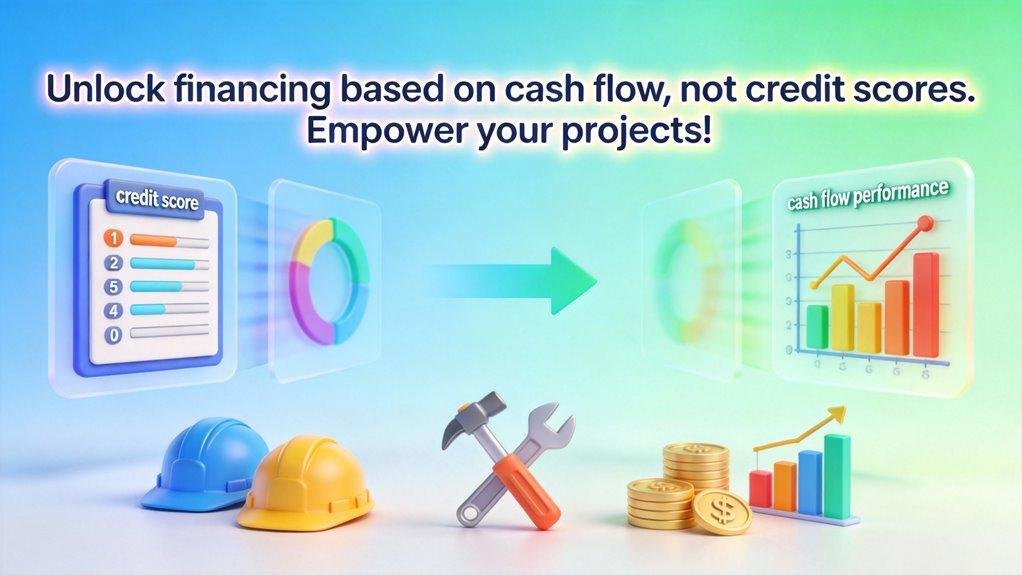
Traditional credit scores just don’t capture the true financial health of a construction business anymore. Instead, lenders are turning towards capacity-based underwriting that focuses around cash flow performance and real-time financial data. This shift means contractors get funding grounded in how well their business manages income and expenses, not just a number in a credit report. Understanding cash flow KPIs is crucial because they provide real-time insight into actual cash movement compared to accrual-based results. This method allows lenders to evaluate a contractor’s performance over credit scores, ensuring that funding is accessible to those with strong cash management skills.
Why Traditional FICO Metrics Fail The Modern Construction Industry
While credit scores have long been the standard for evaluating borrowers, they’ve never fully captured the financial health from construction businesses. Traditional FICO metrics overlook cash flow activity, a critical element for contractors facing fluctuating project cycles.
That’s why no credit check contractor loans are revolutionizing funding by focusing on real-time performance instead of past credit history. We can’t rely on outdated credit evaluations when:
- Cash flow projections predict problems early, unlike lagging credit scores
- Negative working capital signals urgent financial distress missed by FICO
- Periods Sales Outstanding reflect invoicing efficiency, not creditworthiness
- Unbillable costs erode profitability and cash reserves unnoticed by credit reports
Consistent financial monitoring is essential, as it supports making data-driven decisions that ensure business viability beyond what credit scores reveal.
This shift toward cash flow-based funding lets us back businesses on true financial footing, revealing growth that credit scores simply can’t disclose.
The Rise Of Capacity-Based Underwriting Models
As we move further into 2026, underwriting models are shifting away from credit scores and focusing more at a contractor’s actual cash flow and operational capacity.
This capacity-based risk focus allows lenders to evaluate real-time business health by analyzing bank statements, contract velocity, and payment patterns. AI-driven tools process vast data immediately, identifying positive momentum and financial exposures that traditional credit checks miss. These tools also enable accelerated time to quote, increasing the speed at which accurate underwriting decisions are made.
By prioritizing operational capacity, we release funding for contractors who may have poor credit but strong revenue streams. This shift quickens decisions, cuts manual work, and matches risk appetite with real business performance.
For innovators seeking smarter lending, these models represent a breakthrough, offering swifter, fairer access to capital based on tangible business strength, not outdated credit scores.
Top Alternative Funding Vehicles For Credit-Challenged Contractors
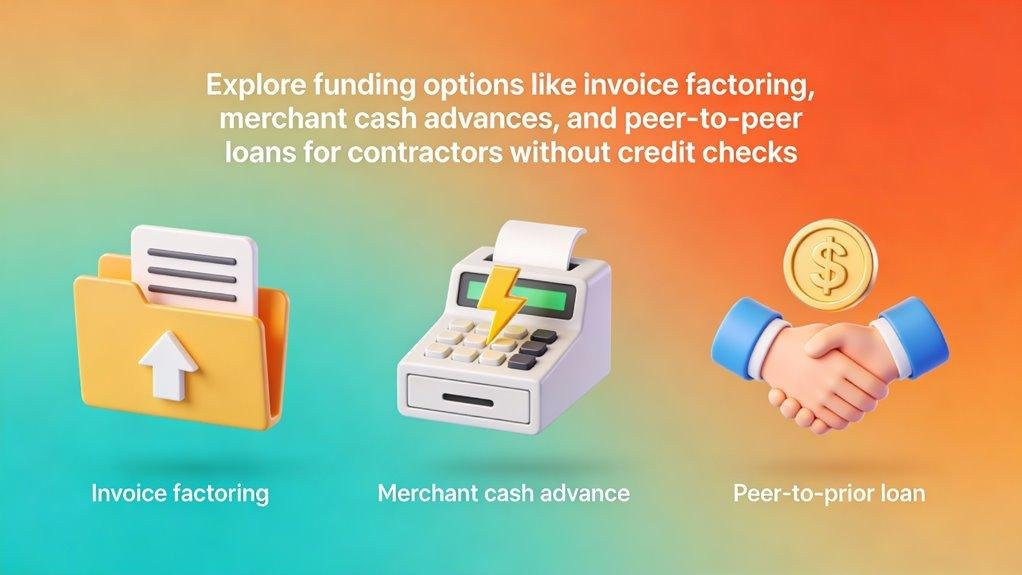
Let’s investigate some effective funding options that don’t hinge on your credit score. Revenue-based financing uses your daily deposits to tailor payments, while bank statement loans turn your cash flow into reliable collateral. Another smart choice is equipment sale-leasebacks, which release capital without impacting your credit. These methods provide fast approval and flexible repayment plans well-suited for irregular income patterns common among independent contractors. Additionally, exploring non-dilutive funding options can empower contractors to access capital without giving up equity in their business.
Revenue-Based Financing: Funding Based On Your Daily Deposits
Contractors seeking funding without the barriers of credit checks can turn towards revenue-based financing, which bases capital availability directly regarding daily deposits.
In 2026, this approach offers rapid decisions and flexible repayment aligned with actual business performance rather than fixed installments. Using real-time revenue data, lenders provide lump sums typically one to two times your monthly income.
Repayments adjust automatically, easing cash flow during slow seasons and scaling up with busy periods. This flexibility is particularly beneficial for contractors with seasonal fluctuations.
Key features of revenue based financing 2026 include:
- Capital linked to daily deposits, bypassing credit scores
- Flexible repayment tied to monthly revenue percentages
- No physical collateral required, relying on consistent cash flow
- Quick approval, often within moments not weeks
This model enables contractors to fund growth smartly without the usual credit barriers.
Bank Statement Loans: Turning Your Cash Flow Into Collateral
While traditional lending often hinges regarding credit scores and tax returns, bank statement loans offer a practical alternative by using your actual cash flow as the foundation for qualification.
These loans analyze 12 through 24 months of your business bank statements, focusing regarding real deposits rather than taxable income, which can be skewed by deductions. This makes bank statement loans for contractors ideal for those with strong revenue but complex tax situations. Understanding your cash flow patterns and properly documenting contract milestones can significantly improve approval chances.
Typically, eligibility requires two years of self-employment and a minimum credit score, alongside documents like major contracts and profit-and-loss statements. Loan terms range from 1 through 5 years, with competitive interest rates based regarding your cash flow health.
Equipment Sale-Leasebacks To Unlock Capital Without Credit
Equipment sale-leasebacks offer a powerful way to release cash tied up in your machinery without giving up its use or facing credit barriers.
This asset based alternative lending strategy helps contractors access liquidity by selling equipment at fair market value and leasing it back immediately. You keep working without interruption while freeing capital. Additionally, this approach provides financial flexibility by allowing businesses to maintain access to essential tools while unlocking capital.
Why we recommend it:
- Converts equipment into quick cash to enhance working capital or pay down debt
- Avoids long credit checks, relying on owned assets instead of personal credit scores
- Offers flexible lease terms from 12 months to 10 years, often with tax advantages
- Supports a wide range of equipment types, from heavy machinery to IT infrastructure
Sale-leasebacks enable credit-challenged contractors to innovate financially and grow sustainably.
How To Prepare Your Business For A Credit-Blind Application

To prepare for a credit-blind application, we need to clean up our digital ledger so AI underwriters get an accurate view of our financial health. Optimizing our debt-to-income ratio will also enhance our chances for approval by showing lenders we can manage repayments. Building firms often liquidize accounts receivable to improve cash flow, which is essential for meeting these key requirements. Let’s focus upon organizing bank statements and managing cash flow for meeting these key requirements.
Cleaning Up Your Digital Ledger For AI Underwriters
How can we make certain our digital financial records impress AI underwriters and accelerate funding? It starts with cleaning up the digital ledger for smooth mechanized contractor funding.
We need to present organized, consistent, and accurate data that AI tools can promptly analyze.
- Use mechanized document preparation to guarantee all tax returns, bank statements, and financials are clearly classified and error-free.
- Eliminate inconsistencies by cross-checking business plans against actual financial data.
- Normalize and categorize transactions to avoid manual entry mistakes.
- Adopt workflow orchestration that routes documents to specific AI models for swift, reliable underwriting.
Optimizing Your Debt-To-Income Ratio For Maximum Approval
When preparing your business for a credit-blind application, refining your debt-to-income (DTI) ratio is one amongst the most effective strategies for enhancing approval chances.
We focus upon reducing monthly debt payments and increasing verified income in order to lower your DTI below 43%, which maximizes success with non-fico business loans. Paying off high-interest debts, consolidating obligations, and timing applications after debt reductions show lenders your discipline and repayment capacity.
Remember, construction loans and small business lenders often prefer DTIs under 45%, but lower ratios signal stronger financial health. Combining an enhanced DTI with clear cash flow data and reserves creates a strong profile for AI underwriters evaluating your business’s performance, not personal credit.
The Strategic Path To Rebuilding Your Commercial Credit
We can use alternative debt for paying off high-interest legacy obligations and improve cash flow quickly. By demonstrating consistent performance data, we show lenders that our business is ready to graduate towards traditional banking options. Such strategic approach helps us rebuild commercial credit steadily while strengthening our financial foundation. Additionally, exploring revenue based structures can provide a viable alternative to cash advances, ensuring more sustainable funding solutions.
Using Alternative Debt To Retire High-Interest Legacy Obligations
Although legacy high-interest debts can weigh heavily on your cash flow and credit standing, using alternative debt solutions gives us a clear path toward retiring these obligations more strategically.
By leveraging high growth alternative debt, we reveal flexible financing that adjusts to business performance rather than relying on outdated credit metrics. This approach helps us simplify payments and lowers overall borrowing costs.
Let’s investigate key options:
- Revenue-Based Financing modifies repayments based on sales, easing cash flow.
- Merchant Cash Advances provide quick capital, scaling with card payment volumes.
- Invoice Financing accelerates cash by selling outstanding invoices without credit scrutiny.
- Asset-Based Lending secures funds using business assets, bypassing personal credit.
These innovative options help us retire costly debts while rebuilding our commercial credit based on real business performance.
Leveraging Performance Data To Graduate To Traditional Banking
Since traditional lenders now prioritize business performance over personal credit history, leveraging real-time financial data has become the key for accessing better financing options.
Performance based underwriting uses daily cash flows, invoice histories, and banking activity to assess business health. This data-driven approach lets us prove stability and payment reliability, easing the path for traditional bank loans.
| Performance Metric | Impact on Financing |
|---|---|
| Real-time income | Validates consistent cash flow |
| Invoice factoring | Builds credit history |
| Payment punctuality | Demonstrates reliability |
| 3+ months revenue | Proves business stability |
Using alternative funding smartly helps us graduate to lower-cost bank credit. Consistent performance data replaces outdated credit scores, revealing more strategic growth capital.
Frequently Asked Questions
How Quickly Can Funding Decisions Be Finalized With Agentic AI Underwriting?
We can finalize funding decisions within minutes, thanks to agentic AI underwriting. By automating data intake, risk assessment, and compliance, we accelerate capital allocation up to 80%, making funding swift, precise, and customized for your business’s real health.
What Specific Accounting Software Integrations Support Ledger-Lending Processes?
We rely upon integrations like Great Plains via Lendfoundry, SoftLedger’s API-first platform, and GOLDPoint Systems’ smooth ledger syncing. These tools connect accounting and lending, enabling real-time data flow and accurate, mechanized ledger-lending decisions.
Are There Industries Beyond Construction Benefiting From Credit-Blind Funding?
Absolutely, we see healthcare, retail, creative freelancing, and manufacturing embracing credit-blind funding. They thrive in real-time cash flow perspectives, revealing capital quickly, fueling innovation beyond traditional credit metrics, and powering growth in vibrant business environments.
How Does a Tax Lien Impact Funding Eligibility Under Capacity-First Finance?
A tax lien complicates funding under capacity-first finance, but this isn’t a deal-breaker. We focus regarding your business’s cash flow and momentum, allowing innovative lenders to fund you despite liens by prioritizing real-time financial health above past credit marks.
What Privacy Protections Exist for Syncing Bank Data With Lenders?
We depend upon strong privacy safeguards like GLBA and CFPB rules that uphold encrypted data transfer, user consent, and easy revocation of access. These guarantee your bank data sync remains secure while you utilize innovative funding options.
