

If you’ve been rejected for a bank loan, don’t worry—we can investigate alternative options designed for contractors like you.
Flexible financing methods such as revenue-based loans, invoice factoring, and asset-based lending offer quick access to capital without strict credit checks or collateral needs.
You may be interested


These solutions align repayments with cash flow and project cycles, helping maintain steady operations.
Non-bank lenders and fintech platforms provide agile funding to accelerate project timelines.
Let’s reveal how these alternatives can keep your business moving forward efficiently.
Key Takeaways
- Contractors rejected by banks can access financing through revenue-based loans that adjust repayments according to business performance and cash flow.
- Invoice factoring enables contractors to get immediate cash advances against unpaid invoices without stringent credit checks.
- Asset-based lending allows contractors to use equipment as collateral, preserving cash flow while securing necessary funds.
- Non-bank lenders and fintech platforms offer quick, flexible capital without strict credit requirements or heavy collateral demands.
- Embedded financing solutions tied to project milestones provide agile funding aligned with contractor cash flow and project progress.
The Evolution Of The Post-Bank Lending Landscape
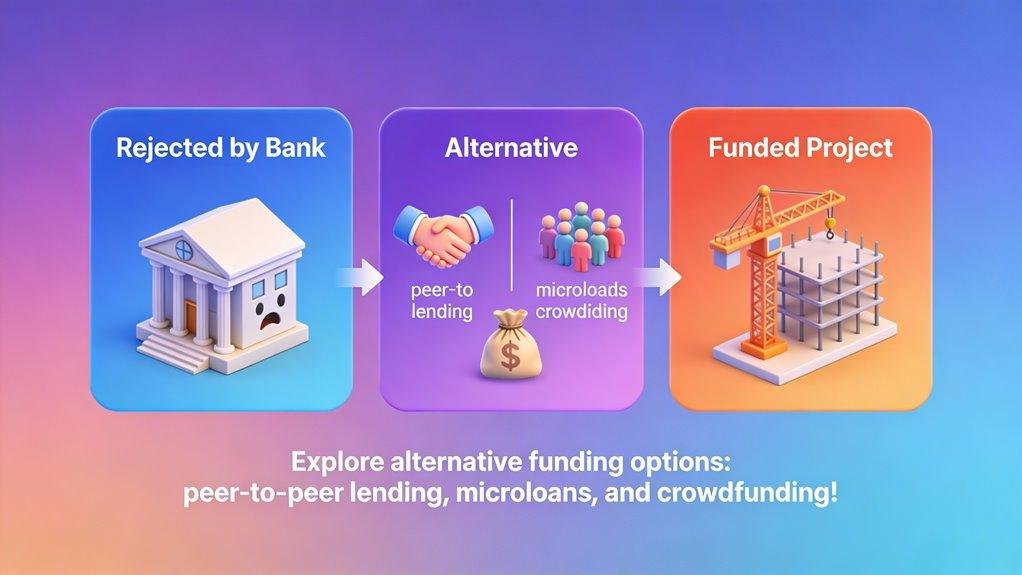
Conventional bank underwriting frequently misses the target for contemporary contractors because they concentrate excessively about personal credit and fixed snapshots. Nowadays, lenders are transitioning towards assessing project performance and real-time cash flow information for making wiser decisions. This shift is driven by the rise of alternative lenders who use data-driven personalization to better match financing options with contractor needs. These lenders often prioritize performance over credit scores, allowing contractors with strong project management skills to access necessary funding despite previous financial setbacks.
Understanding Why Traditional Underwriting Fails Modern Trades
While banks have long been the go-to for loans, their approval process often misses the mark for modern transactions.
Traditional underwriting demands clean balance sheets, personal credit checks, and collateral—criteria that don’t fit the cash flow realities of contractors. Revenue based financing for contractors offers flexibility standard bank loans lack.
Instead of fixed payments, repayments align with actual project revenue, easing cash flow pressure. Many contractors also face delayed payments that complicate cash flow management, making flexible financing solutions critical.
| Underwriting Factor | Traditional Banks | Alternative Financing |
|---|---|---|
| Payment Structure | Fixed, rigid | Revenue-based, agile |
| Collateral Requirement | High | Often none or minimal |
| Cash Flow Alignment | Poor | Directly tied to project income |
This shift moves us from rigid restrictions to agile capital suited for developing construction needs.
The Shift From Personal Credit To Project Performance
As banks narrow their lending criteria, contractors and their customers are turning to indirect lending partnerships that simplify financing and reduce risk. These partnerships handle loans from start to finish, allowing customers to pay lenders directly while contractors focus upon their projects. Acorn Finance, for example, offers such partnerships by connecting contractors with reliable lenders like PayPal, Capital One, and Chase, enabling financing setup within 24 hours and ensuring high approval rates.
This shift highlights a move from relying upon personal credit to evaluating project performance for financing decisions. Project cost financing ties loan repayment to billing cycles, matching cash flow with expenses and reducing the need for personal guarantees.
Revenue-based repayment structures and materials financing options like those offered by Billd further align funding with project milestones. By embedding finance solutions into project management, we enable smarter, performance-driven capital access that removes barriers and cultivates growth in today’s private credit terrain.
High-Velocity Alternatives To Traditional Term Loans
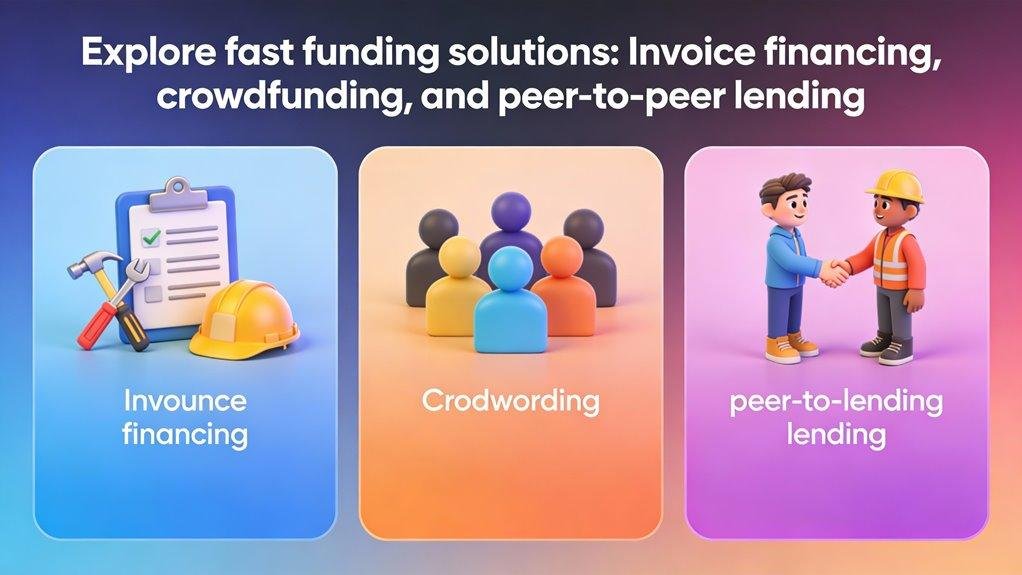
Let’s investigate some high-speed financing options that progress quicker than traditional term loans. Revenue-based financing offers growth capital that adjusts as your business scales, and it can be a great way to access flexible funding. Invoice factoring turns unpaid invoices into immediate cash flow. For contractors with heavy equipment or fleets, asset-based lending releases capital tied to physical assets, giving you flexibility without wait. These alternative methods can typically provide cash access within 24 to 48 hours, helping contractors address urgent capital needs swiftly.
Revenue-Based Financing: Growth Capital That Scales With You
Because steady revenue drives their repayment, revenue-based financing fits contractors who want growth capital that adjusts to how they perform month-to-month.
Instead of fixed payments, repayments flex as a percentage of monthly revenue until a set cap is reached. This aligns well with project cycles and seasonal ups and downs, letting you scale without fixed burdens.
Revenue-based financing offers flexibility compared to traditional financing options by aligning repayments with actual business performance instead of fixed payments.
Here’s how revenue-based financing stacks up:
| Feature | Revenue-Based Financing | Traditional Bank Loans |
|---|---|---|
| Repayment Structure | % of revenue, variable | Fixed monthly payments |
| Collateral | Often unsecured, revenue-secured | Requires assets |
| Approval Time | Periods | Weeks to months |
This approach offers quick, flexible capital that matches your growth, perfect for scaling in today’s agile contractor world.
Invoice Factoring: Turning Receivables Into Immediate Liquidity
When cash flow stalls while waiting for client payments, invoice factoring offers a powerful way to release immediate liquidity. Unlike traditional bank loans, factoring advances 75-90% of your invoice value within intervals, letting you cover payroll, materials, and subcontractors without delay. This method provides funds within a few business days by advancing against unpaid invoices, giving you quick access to money already owed.
Factoring vs bank loans isn’t just about quickness; factoring requires no credit check regarding your company and adds no debt. It’s flexible—no long-term contracts and selective factoring for project needs.
Additionally, factoring companies handle collections, reducing your administrative load. This approach matches construction’s long payment cycles, turning slow receivables into quick capital.
For contractors rejected by banks, factoring serves as a strategic upgrade, enabling smoother operations, quicker growth, and stronger vendor relationships. It’s an innovative alternative perfectly suited to the current agile capital environment.
Asset-Based Lending For Heavy Equipment And Fleet
As contractors, we often face the challenge regarding funding heavy equipment and fleet upgrades without tying up large amounts of upfront capital.
Asset-based alternative lending offers a strategic solution by using machinery and vehicles as collateral, releasing liquidity while preserving cash flow. This approach provides flexible, lower-cost financing customized for asset-intensive operations. The asset-based lending market size was valued at USD 661.7 billion in 2023, underscoring its growing importance in financing.
Unlike traditional term loans, these high-velocity alternatives allow us to access capital quickly, often integrated directly into our project software for smooth implementation. With loans typically covering up to 50% of equipment value, the risk is managed, benefiting both lender and borrower.
In today’s market, asset-based lending supports contractors facing tightening credit by offering reliable, scalable funding options. It’s not just a backup, it’s a smarter financial strategy for growth and operational agility.
How To Build Your 24-Hour Alternative Finance Stack
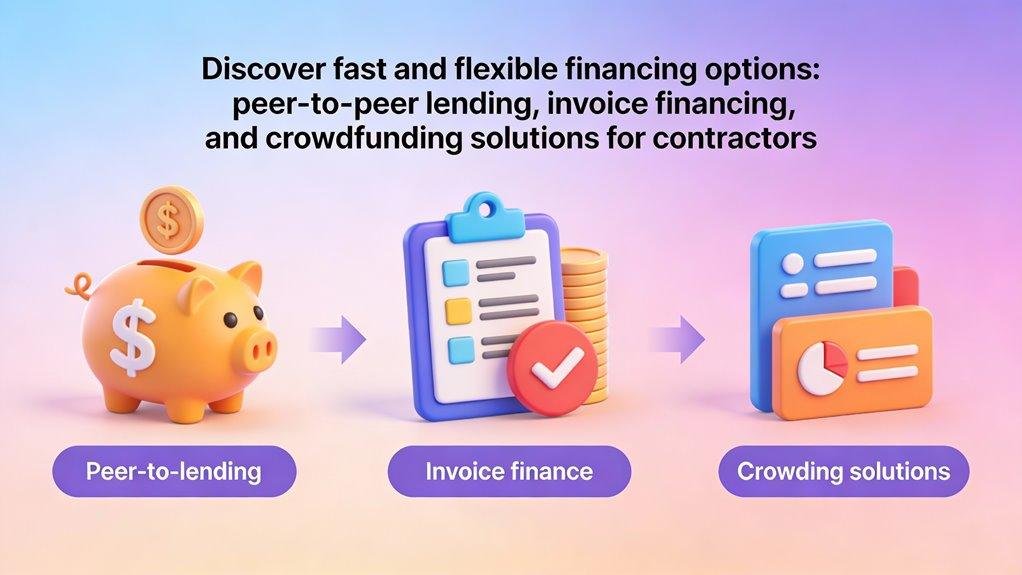
Let’s investigate how integrating real-time accounting can reveal instant approvals and keep your projects funded without delays. Steering through today’s private credit and fintech options lets us build a finance stack that works around the clock. Together, we’ll map out a system that turns every contract milestone into a funding opportunity. Leveraging non-dilutive funding strategies can further enhance your financial stability while preserving equity.
Integrating Real-Time Accounting For Instant Approvals
How do we build a 24-hour alternative finance stack that keeps capital flowing without delay? The key is integrating real-time accounting into our finance systems.
Platforms like Premier and Sage Intacct synchronize job costing, budgets, and cash flows instantly. This allows us see project performance live, identifying overruns and approving payments immediately. Automated workflows from tools like Redhammer eliminate duplicate entries and speed up approvals.
When billing aligns with actual work and we track labor and expenses in real time, finance teams gain the agility to implement capital as soon as milestones are reached. Real-time accounting turns finance from a slow checkpoint into a responsive enabler.
This level of visibility and automation fuels swift private lending decisions, keeping our projects advancing without the bottlenecks of traditional banking.
Navigating The World Of Private Credit And Fintech
While traditional banks have tightened their lending criteria, private credit and fintech platforms have stepped up to fill the financing gap for contractors.
In the private credit markets 2026, these platforms deliver capital instantly by embedding financing within your project management tools. This integration lets you access equipment leasebacks, factoring, and revenue-based financing accurately when you need them.
By leveraging AI and real-time data from job sites, underwriting happens quicker and smarter. This means you won’t wait periods or weeks for approval. Building a 24-hour alternative finance stack is more than convenient – it’s a strategic upgrade.
It positions us to outpace traditional constraints, accessing agile capital customized for modern contracting challenges as the private credit markets expand rapidly in 2026.
The Competitive Edge Of Non-Bank Capital
We know that non-bank capital gives us the freedom to operate without restrictive bank covenants, letting us focus upon growing our projects. This flexibility helps speed up timelines as funding arrives right when we hit key milestones.
Operating Without Restrictive Bank Covenants
Bank covenants can feel like a tight leash that limits our ability in responding swiftly and creatively with project demands. Traditional bank loans often come with strict requirements that restrict how we allocate funds or modify strategy.
In contrast, non-bank business loans offer flexibility that matches our rapid industry. These loans avoid cumbersome committee approvals and don’t burden us with rigid financial ratios or collateral demands.
By operating without restrictive covenants, we gain agility and control over capital use, adjusting as project needs evolve. This freedom lets us focus upon execution and growth instead of constantly managing compliance.
Embracing non-bank capital means we’re no longer confined by outdated banking rules. It’s a strategic upgrade that authorizes us to compete and innovate without limits.
Accelerating Project Timelines With Agile Funding
Non-bank capital frees us from outdated banking restrictions, letting us respond more swiftly to project demands and shifting priorities. By tapping into merchant capital for contractors, we accelerate project timelines through agile funding mechanisms closely tied to real-time milestones.
This approach lets us break projects into smaller, manageable units, speeding delivery and improving throughput. Contractors adopting agile funding see up to a 50% reduction in delivery times and higher flexibility to shifting project needs.
Embedded finance solutions integrate directly with our project management systems, releasing funds immediately when milestones are met. Such guarantees we maintain momentum without waiting for bank approvals.
In today’s competitive market, leveraging merchant capital for contractors isn’t just an alternative, it’s a strategic enhancement that sharpens our edge and elevates project success rates.
Frequently Asked Questions
How Does Embedded Finance Integrate With Existing Contractor Software Systems?
We integrate embedded finance with your existing contractor software via real-time APIs, syncing data effortlessly into ERPs and project tools. Such allows us implement capital instantly and maintain smooth workflows without interrupting your operations or branding.
What Risks Do Contractors Face When Using Revenue-Based Financing?
We know revenue-based financing risks include higher costs, cash flow strain from variable payments, eligibility limits, and legal traps. But by understanding these, we can strategize smarter, turning risks into agile capital advantages for growth.
Can Private Credit Facilities Affect a Contractor’s Credit Score?
Yes, private credit facilities can impact our credit scores. High utilization or missed payments lower them, while multiple inquiries may compound effects. Nevertheless, leveraging them smartly within our modern finance stack keeps our agility and growth intact.
How Do AI Underwriters Verify Real-Time Telemetry Data Accuracy?
We rely upon AI underwriters to cross-reference telemetry with historical claims, GPS data, and API-verified invoices, using real-time anomaly detection and flexible learning to guarantee the data’s accuracy, maintaining flawless underwriting precision every stage.
What Industries Beyond Contracting Benefit Most From Agile Capital Solutions?
We see healthcare, industrials, engineering, and R&D thriving with agile capital. Their rapid innovation cycles and capital mismatches demand flexible funding that propels breakthroughs, enhances productivity, and aligns with their progressing project needs—just like modern contractors.
