

We can pay off a rent-to-own (RBF) agreement early, but that depends on your contract’s terms.
Some agreements charge prepayment penalties or early termination fees which can reduce savings.
You may be interested


It’s crucial to review option fees, rent credits, and any penalty clauses before deciding.
Preparing financially by evaluating credit and income helps when refinancing.
Understanding these details guarantees you avoid surprises and can maximize your benefits.
Keep exploring to find strategies for the best payoff and refinancing alternatives.
Key Takeaways
- Paying off rent-to-own agreements early depends on contract terms and may involve forfeiting option fees or rent credits.
- Prepayment penalties can include fixed fees or percentages of the remaining balance, impacting savings from early payoff.
- Reviewing contract clauses for early termination fees and prepayment penalties helps avoid unexpected financial burdens.
- Negotiating penalty waivers or reductions with lenders can improve flexibility for early payoff or refinancing.
- Refinancing options after the lease period can use accumulated rent credits toward down payment and require meeting credit criteria.
What Is Rent-to-Own and How Does It Work
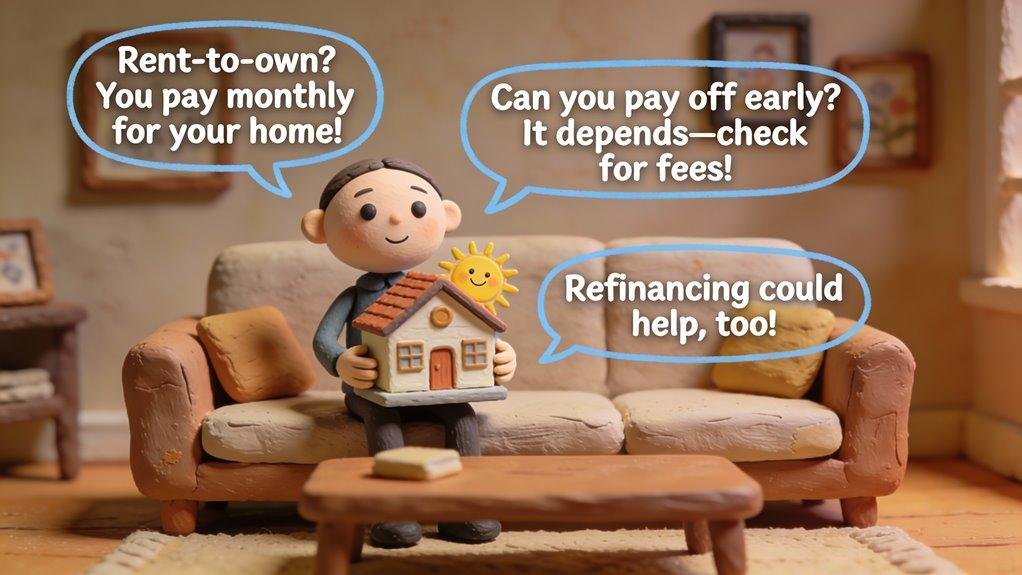
When we’re considering a rent-to-own agreement, we’re looking at a legal contract that lets us rent a home for a set duration, usually one through three years, while also giving us the option to purchase it later.
A rent-to-own agreement lets you rent a home with the option to buy it later.
This approach blends lease agreements with a purchase option, offering a clear path toward ownership. We pay an upfront option fee, typically 1-7% of the home’s value, which secures our right to buy but is non-refundable if we decide not to proceed.
During the lease, part of our monthly rent often contributes toward the future down payment. The purchase price is locked in at the start, shielding us from market fluctuations. Rent credits can help accumulate funds towards that payment.
This setup allows us to test living in the home while building credit and savings toward eventual ownership.
Can You Pay Off Your Rent-to-Own Agreement Early?

We can pay off a rent-to-own agreement early, but this depends upon the contract terms. These agreements often include specific penalties and conditions that influence how early payment is managed. Understanding these details helps us avoid unexpected fees and make informed decisions regarding paying off the balance ahead of schedule. Early termination of a rent-to-own contract may involve financial ramifications if not done according to the agreed terms.
Early Payment Options
Although rent-to-own agreements offer flexibility, paying off the contract early involves several considerations.
Early termination might seem appealing, but it carries notable financial implications. Walking away before your lease ends usually means forfeiting your option fee and any accumulated rent credits, making early exit costly.
In addition, failing to meet payment deadlines can void these credits, further impacting your investment. While some sellers may negotiate applying the option fee toward the purchase price, this requires clear documentation. Importantly, option period typically lasts less than three years, so timing your payoff carefully within this period is crucial.
We recommend reviewing your agreement carefully to understand maintenance responsibilities and possible penalties for early payoff. By doing so, you’ll avoid financial surprises and make informed decisions about leveraging early payment options innovatively and effectively throughout your rent-to-own experience.
Contract Terms Impact
Three key contract terms often determine whether you can pay off your rent-to-own agreement early. Initially, early termination clauses define penalties like paying one or two months’ rent or losing option fees. Breaking a lease constitutes a breach of contract, which may lead to damages calculated based on expected rent owed.
Secondly, buy-out clauses may let you negotiate a fixed early exit cost, including unpaid rent and landlord expenses. Third, liquidated damages provisions require careful contract interpretation to guarantee penalties are reasonable under relevant laws.
When considering early payoff, we recommend reviewing these terms closely and engaging in penalty negotiation to lessen fees. Contracts may also include dispute resolution that offers alternatives for lawsuits.
How Prepayment Penalties Affect Early Payoff Options

Let’s start by understanding how prepayment penalty clauses can impact our options for paying off a loan early.
We’ll look at how to calculate the extra costs involved and investigate ways to negotiate waivers or reductions. Such an approach helps us make informed decisions and avoid unexpected fees when refinancing or settling a loan ahead of schedule. It’s important to note that prepayment penalties typically apply to closed mortgages and can involve charges like three months’ interest or an interest rate differential (IRD).
Understanding Prepayment Penalty Clauses
A prepayment penalty clause can greatly influence your options when paying off a loan early. This clause is part of a prepayment penalty overview that spells out fees lenders charge if you settle your loan ahead of schedule.
These fees protect the lender’s expected interest income but can affect your flexibility. Understanding these clauses helps safeguard borrower rights by clarifying when penalties apply, especially in cases like refinancing or selling your property. There are generally two types of prepayment penalties: hard and soft.
It’s important to review your loan agreement because penalties vary, some charge a percentage of the remaining balance while others use fixed amounts. By knowing these details upfront, we can better maneuver early payoff decisions and avoid unexpected costs, keeping innovation in managing your finances straightforward and efficient.
Calculating Early Payoff Costs
While prepayment penalties can discourage early loan payoff in traditional financing, repayment structures like Revenue-Based Financing (RBF) handle early payoff costs quite differently.
In RBF, repayment flexibility is built in—payments scale with your revenue, and the total cost remains fixed by a pre-agreed repayment cap. This guarantees cost predictability, as you’ll never owe more regardless of when you pay off the loan.
That simplifies financial planning, removing surprises often tied to early repayment fees. Furthermore, borrower incentives exist for accelerated payoff when revenue grows, enabling quicker repayment without penalties.
This innovative approach ties your payments to business performance, making RBF a growth-friendly alternative. Calculating early payoff costs under RBF is straightforward—knowing your repayment cap upfront helps you plan confidently and modify your strategy as your business evolves.
Negotiating Penalty Waivers
How can we reduce the impact relating to prepayment penalties regarding our early payoff options? One effective approach is to implement penalty negotiation strategies during initial loan discussions.
By managing lender relationships carefully, we can request waivers or reductions based on creditworthiness and loyalty. Negotiating no-penalty windows or step-down penalties aligned with expected refinance timelines creates flexibility.
We should also investigate penalties allowing partial prepayments without extra cost. Professional assistance, such as brokers skilled in lender relationship management, helps secure favorable terms before loan closing.
These strategies allow us to minimize prepayment fees while maintaining flexible payoff plans. Being proactive and transparent with lenders guarantees we enhance penalty terms and avoid surprises, keeping our early payoff options viable and cost-effective.
How to Check Your Rent-to-Own Contract for Prepayment Fees
Three key steps help us check a rent-to-own contract for prepayment fees efficiently. Initially, we obtain the original or digital contract and verify its date, signatures, and any amendments to confirm contract legality.
Next, we locate sections labeled prepayment penalties or early termination fees to identify specific fees or forfeiture clauses. This includes reviewing option fees, rent credits, and any balloon paympayment terms that might trigger penalties.
Locate prepayment penalty sections and check option fees, rent credits, and balloon payments for potential charges
Ultimately, we consider state regulations that could affect prepayment considerations like redemption periods or disclosure requirements. By methodically examining these elements, we gain clarity regarding all potential costs involved with paying off early.
This approach keeps us informed and confident when exploring innovative rent-to-own agreements without surprises.
Pros and Cons of Paying Off Your Rent-to-Own Early
Paying off your rent-to-own agreement early can offer significant financial advantages, but it also comes with potential drawbacks that we need to contemplate carefully.
On the additional side, early payoff can eliminate ongoing rental agreement impacts, allowing us to secure ownership benefits sooner, such as locked-in purchase prices and avoiding extra rental fees. This speeds up full ownership without lingering obligations and reduces overall costs compared to long-term rentals.
However, early payoff isn’t always straightforward. Some contracts include prepayment penalties or require us to pay substantial rental fees despite early payoff, which can offset savings.
Moreover, higher monthly rents and loss of upfront option fees can strain budgets. Ultimately, evaluating provider terms and contract details is crucial to determine if early payoff delivers real value. Additionally, understanding your revenue-based financing options can help determine if an early payoff aligns with your long-term financial goals.
Refinancing Options for Rent-to-Own Buyers
Because rent-to-own agreements combine rental and purchase elements, refinancing options for buyers require careful planning once the lease period concludes.
At that point, buyers can investigate traditional mortgage financing options, applying accumulated rent credits toward the down payment. This approach utilizes contract flexibility, especially in lease-option agreements, where the purchase price may be fixed or market-based.
Buyers can leverage rent credits as down payments and explore traditional mortgages after the lease period ends.
It’s crucial to align refinancing timing with lender requirements, as securing approval happens independently from the original contract. We recommend considering down payment assistance programs, which often work well alongside rent credits.
For innovative buyers, combining these financing options creates a smooth path to ownership. By understanding the contract terms and preparing early, we can enhance refinancing strategies and shift seamlessly from rent-to-own to full homeownership without unexpected obstacles.
What Lenders Want When You Refinance Your Rent-to-Own
When refinancing your rent-to-own property, lenders will pay close focus on your credit score and income verification.
They typically require a minimum credit score to qualify and will verify your income to guarantee you can handle the new payments.
Understanding these requirements helps us prepare a stronger application and improve our chances for approval.
Credit Score Requirements
Several factors determine the credit scores lenders seek when you refinance your rent-to-own home. Different loan types set varying credit score standards.
Conventional loans often require scores starting at 620, with higher scores like 740 revealing better rates. FHA loans allow lower scores, sometimes as low as 500, especially with simplified options that may skip credit checks.
VA loans don’t have a set minimum but generally expect scores around 620, focusing more on payment history. Jumbo loans demand stronger credit, typically between 660 and 740, depending upon the loan length.
USDA loans usually require 640 or more, aligning closely with conventional loans. Understanding these requirements helps us prepare and choose the right loan for refinancing, making early payoff smoother and more cost-effective.
Income Verification Expectations
Income verification plays a major role when we refinance a rent-to-own home. Lenders want clear understanding into our income sources to ascertain we meet loan requirements.
For traditional jobs, they typically ask for W-2 forms, pay stubs, and tax returns from the last two years. If we’re self-employed, verification methods broaden to include business tax returns, profit and loss statements, and sometimes CPA letters.
Alternatives exist too, like bank and investment statements, to confirm asset-based income. Non-traditional income sources such as gig work or rental income require specific documentation like 1099s and lease agreements.
For certain government-backed simplified refinances, these verification methods might be relaxed or waived. Grasping these expectations helps us prepare and innovate our refinancing approach with confidence and clarity.
How to Prepare Your Finances Before Refinancing
Before refinancing, it is crucial that we take a close look at our financial situation and goals. A thorough financial assessment helps us clarify if we want to lower monthly payments, shorten the loan term, or use equity for upgrades.
Next, a detailed credit evaluation is vital. We should obtain a free credit report to correct errors and guarantee our credit score meets lender minimums, typically around 620. Checking our debt-to-income ratio helps verify eligibility as well.
We also need to prepare income documents and gather asset and debt statements to show financial readiness. Finally, we must calculate the affordability of closing costs and confirm any prepayment penalties.
This preparation sets a smart foundation for a successful refinancing process.
Steps to Pay Off or Refinance Your Rent-to-Own Deal
When we’re ready for pay out or refinance our rent-to-own agreement, the initial step is to carefully review the loan documents. Understanding the contract negotiation terms helps us anticipate any prepayment penalties or step-down structures.
Next, we calculate the total prepayment costs including penalties, interest, and fees to enhance financial planning. Then, we contact the lender to request an up-to-date payoff quote, ensuring clarity.
Calculating total prepayment costs and securing a current payoff quote helps ensure clear financial planning.
Ultimately, if refinancing, we investigate new lenders and terms that align with penalty-free periods or reduced fees.
- Examine penalty schedules and prepayment clauses
- Calculate exact costs to avoid surprises
- Obtain a written payoff quote from the lender
- Shop for refinancing options with better terms
Additionally, exploring uncapped revenue financing options can provide alternative funding strategies that may suit future needs.
This approach keeps us informed and enriched throughout the process.
Avoid These Mistakes When Paying Off or Refinancing
Paying off or refinancing a rent-to-own agreement involves more than just calculating figures. We must consider prepayment implications, such as penalties that vary by contract structure and timing.
Ignoring these can lead to unexpected fees, sometimes based upon a percentage of the remaining balance or months of interest. It is crucial to verify early payoff terms because some agreements allow penalty-free payoff, while others impose hefty charges.
We also need to factor in hidden costs like nonrefundable option fees and inflated monthly rents that affect our overall financial strategy. Skipping due diligence regarding the contract details or failing to understand penalty types can derail our plans. Additionally, understanding the use of profit-sharing plans can provide alternative funding sources for managing or refinancing obligations.
How Refinancing Helps You Clear Your Rent-to-Own Balance Faster
Although refinancing might seem complex, it can significantly accelerate clearing your rent-to-own balance by lowering interest rates and freeing up cash flow.
Leveraging refinancing benefits, we can reduce monthly payments or principal quicker, enhancing equity and hastening ownership. Payment flexibility allows us to customize terms that suit changing financial situations.
Refinancing lets us lower payments or principal faster, boosting equity and speeding up ownership with flexible terms.
Here’s how refinancing helps:
- Lower interest rates cut monthly costs, directing more to principal.
- Freed-up cash flow enables extra payments without strain.
- Improved credit scores increase refinancing options and rates.
- Fixed pricing and locked savings protect against market shifts.
- Understanding revenue-based loans can also help you make informed decisions about financing options.
Frequently Asked Questions
How Does Rent-To-Own Affect My Credit Score?
We see rent-to-own implications impacting your credit score mainly through payment reporting, often limited. On-time payments can help credit score impact positively, but missed ones hurt. Innovatively, exploring credit and reporting methods could improve results.
Can Rent-To-Own Agreements Be Transferred to Another Buyer?
Yes, rent-to-own flexibility often allows buyer transferability, but we must get landlord consent and seller approval. This innovative approach lets us modify agreements, ensuring smooth alterations while protecting all parties involved in the lease purchase process.
What Happens if I Miss a Payment in a Rent-To-Own Contract?
If we miss a payment, rent-to-own consequences kick in immediately—late fees, grace period expiry, and notices. These missed payment repercussions risk termination, eviction, and loss from purchase rights, so we must stay proactive and communicate promptly.
Are Taxes Included in Rent-To-Own Monthly Payments?
We know taxes aren’t usually included in rent-to-own monthly payments, so when analyzing your payment breakdown, account for tax implications separately. This clarity helps us innovate financing strategies and avoid surprises regarding property tax responsibilities.
Can I Negotiate Terms in a Rent-To-Own Contract?
Yes, we can negotiate terms in a rent-to-own contract using smart negotiation strategies to improve contract flexibility. Such an approach lets us tailor timelines, payments, and responsibilities creatively, making the agreement truly innovative and beneficial for both parties.
