

We recommend replacing merchant cash advances with revenue based financing because MCAs drain your daily cash flow through fixed automatic deductions, often leading to costly debt cycles.
In contrast, RBF ties repayments directly with your actual sales, offering flexibility that adjusts alongside your revenue. Such transparency reduces hidden fees and eases financial pressure, helping you regain control and improve liquidity.
You may be interested


By switching, you create a more sustainable path for growth and financial stability—there’s more regarding learning about restructuring your business debt effectively.
Key Takeaways
- Revenue Based Financing (RBF) adjusts repayments based on actual revenue, easing cash flow compared to fixed daily draws in Merchant Cash Advances (MCAs).
- RBF consolidates multiple debts, improving liquidity and simplifying financial management unlike MCAs that can cause debt stacking.
- RBF is non-dilutive, allowing business owners to maintain equity and control while accessing necessary capital.
- Transparent fee structures in RBF eliminate hidden MCA costs like administrative fees and inflated factor rates.
- Transitioning to RBF requires auditing current MCA agreements and connecting digital ledgers for accurate revenue verification.
The Hidden Cost Of Staying In An MCA Debt Trap

We all know the daily draw from MCAs can interfere with cash flow when business is uneven, but its real impact often goes unnoticed. The traditional factor rate hides these costs, especially when your company is growing quickly and needs flexibility. Many businesses overlook the hidden administrative fees embedded in the contracts that significantly increase overall costs. Additionally, the lack of uncapped revenue financing options can severely limit a business’s ability to scale effectively. Let’s investigate why this old model traps you in debt and how understanding this can guide you in the direction of smarter financing.
Understanding The “Daily Draw” Friction On Modern Operations
How do everyday draws from Merchant Cash Advances affect a business’s cash flow on a routine basis? These automatic deductions, typically 5% to 20% of daily card sales, siphon funds before they even reach your account.
For businesses with tight margins and uneven revenue, this constant cash outflow hinders planning and reduces working capital. Slow periods mean less repayment but don’t ease the strain of frequent withdrawals. Repayment methods vary but often include holding back a percentage from credit card sales or making fixed ACH debits from the business bank account, which can be disruptive to cash flow (repayment methods).
Integration with payment processors adds administrative burdens, and multiple stacked MCAs multiply these frictions. The daily draw exit isn’t just about stopping payments, it’s about reclaiming operational freedom and cash flow predictability.
Shifting to Revenue Based Financing, where repayments flex with your actual revenue, offers that clarity and control our modern businesses need to innovate and grow without being trapped in outdated, rigid debt structures.
Why Traditional Factor Rates Are Deceptive In High-Growth Phases
Although factor rates might seem straightforward, they can disguise the true financial burden regarding high-growth businesses. MCA refinancing often reveals hidden costs locked in fixed factor rates that don’t flex with your revenue.
This structure extracts more capital when you need to reinvest most, creating an unseen trap. Here’s why traditional factor rates deceive during expansion:
- They mask effective APRs soaring up to 350%, far beyond traditional loans
- Repayment escalates with revenue, draining cash flow when reinvestment is critical
- Fixed rate models ignore improved creditworthiness, benefiting lenders, not you
- Underused reconciliation clauses often fail, leaving businesses stuck with inflated costs
Unlike merchant cash advances, revenue-based financing adjusts repayment according to your actual sales, providing much-needed flexibility.
Transitioning to Revenue Based Financing offers clear, transparent costs and modifies repayments to your cash flow, powering smarter growth.
The Strategic Pivot To Revenue Based Financing (RBF)
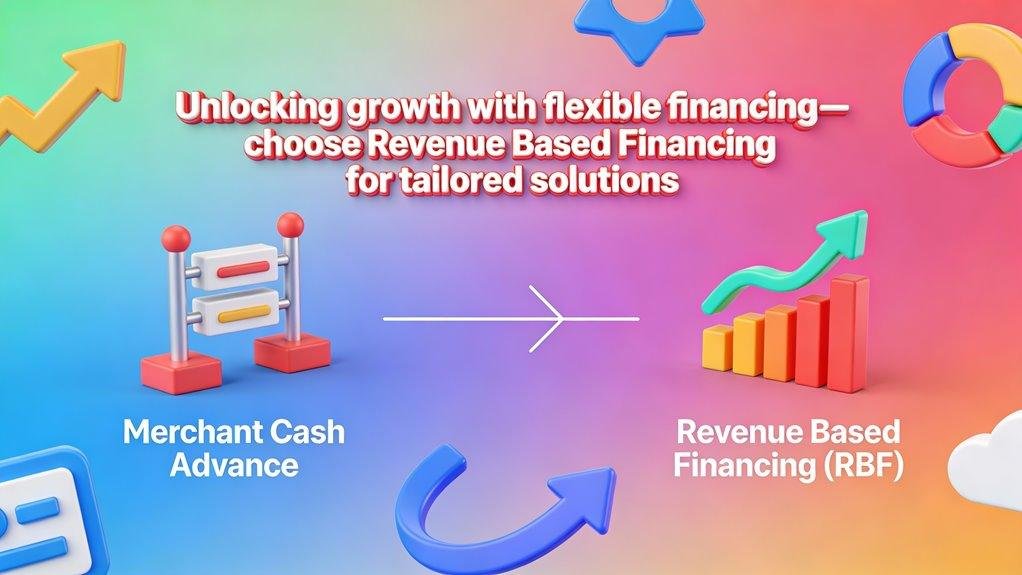
Let’s investigate how revenue-based financing aligns repayments directly with your cash flow, easing the burden when revenue dips. By consolidating multiple debts into a single RBF arrangement, we eliminate the stress of debt stacking and release maximum liquidity. At the same time, RBF lets us protect equity, so your ownership stays intact while you focus upon scaling. This funding approach is especially suitable for small and mid-sized businesses that need quick access to capital for growth and operational costs.
How RBF Aligns Repayment With Your Actual Cash Flow
When we switch from Merchant Cash Advances to Revenue Based Financing, the payment structure adjusts directly with your business’s actual revenue.
This signifies repayments rise with your sales and fall when revenue dips, matching your cash flow rhythms. With revenue based financing 2026, the alignment isn’t just a feature, it’s a game changer for financial control and growth. This innovative model offers us:
- Payments that flex with our ups and downs, easing pressure during slow months
- Clear total repayment costs replacing hidden fees from older financing
- No fixed monthly debt stretching our cash thin when business lulls
- A natural hedge that preserves working capital allowing us to concentrate on scaling
- A financing option preferred by founders for its non-dilutive funding and flexibility.
The End Of “Debt Stacking”: Consolidating For Maximum Liquidity
After seeing how revenue based how revenue based financing results based financing align aligns repactualuals cash flow, the next step is addressing a common challenge a challenge many among deal: debt st.stacking. This occurs happens as businesses trigger multiple vendor cash costs without paying off previous ones, costly, enhancing expensive requirements presscompressing liquidrevenue. Debt stacking increases total debt service costs.
Merchant cash advantage consolidthroughput revenue financing offers strategic rotation. replacing ststacked MCwith resources single Rfacility,
simplpayments into negotifeasible requirement what undulates with earnings income. revenue
This procedure eliminoresatesapping bur,ases economic pressure, and maximmaximizing operational liquidity. It reretransforms cash cash management from reactive scramto towardering strategicical postureacking. coming redefinition assists recovering functional concentration, preventserts risks,
andradications baseline sustainable escalation without
constant financial requirements.
Non-Dilutive Capital: Protecting Your Equity While You Scale
Although raising capital often means sacrificing equity, revenue-based financing offers a significant alternative that protects your ownership as you grow. Unlike traditional equity financing, RBF provides non-dilutive capital by tying repayments to future revenue without giving up control.
This is a smarter choice for businesses seeking non-predatory business loans that scale with cash flow. However, it’s important to note that revenue-based funding requires consistent revenue and proof of strong monthly revenue for at least the past 3 months.
Retain full equity and decision-making control
Avoid collateral and personal guarantees
Repay through a flexible percentage from your revenue
Access capital without the uncertainty associated with equity dilution
Steps To Successfully Restructure Your Business Debt
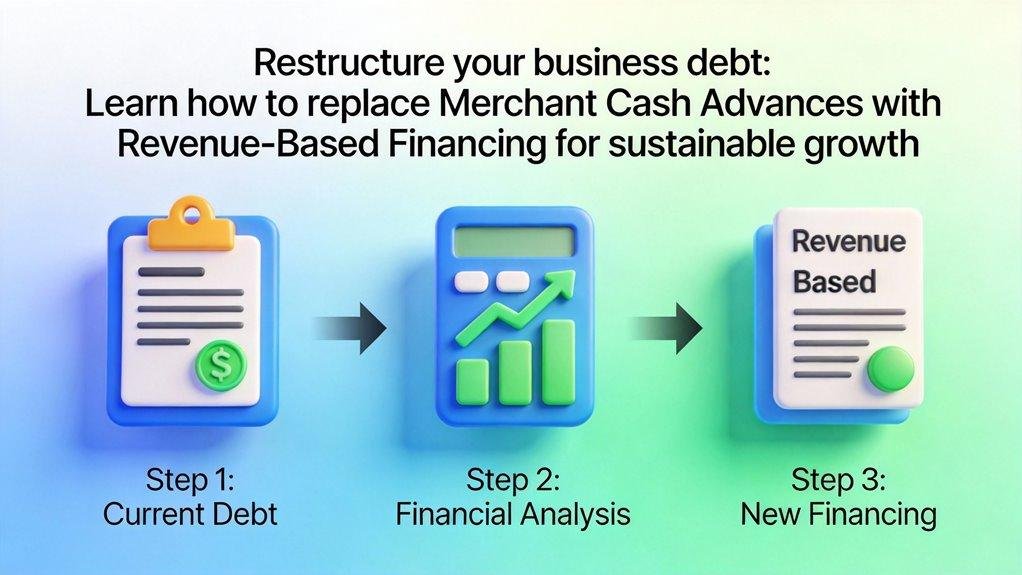
Let’s start by auditing our current MCA agreements to identify any exit clauses that can ease our shift. Next, we’ll connect our digital ledger systems to enable quick and accurate underwriting for Revenue Based Financing. These steps set the foundation for a smoother, more efficient debt restructuring process.
Auditing Your Current MCA Agreements For Exit Clauses
Many business owners find that carefully auditing their current Merchant Cash Advance agreements is the crucial initial step toward successfully restructuring debt. This audit reveals exit clauses and reconciliation rights that can be powerful tools in shifting to smarter financing like RBF underwriting.
To steer through this, we need to:
- Locate reconciliation clauses allowing payment adjustments based on actual revenue.
- Identify timing requirements for submitting financial documentation.
- Record default triggers such as missed payments or processor holds.
- Gather supporting documents like recent bank statements and sales reports.
Connecting Your Digital Ledger For Rapid RBF Underwriting
Now that we’ve identified exit clauses in your existing agreements, the next step is linking your digital ledger to speed up the RBF underwriting process.
Connecting financial platforms like Xero or Stripe allows RBF providers to access real-time revenue data quickly. This integration shifts underwriting from slow manual reviews to a rapid, technology-driven assessment.
By sharing your digital ledger, lenders evaluate your business’s cash flow and revenue trends accurately, ensuring customized repayment terms. This transparency sets Revenue Based Financing apart from Merchant Cash Advances, where factor rates often obscure true costs.
In 2026, the rbf vs mca debate clearly favors RBF as it promotes cash flow optimization through smart, data-driven observations. Embracing this digital connection accelerates funding decisions and positions your business for sustainable growth.
Life After The MCA: A Sustainable Growth Roadmap
Now that we’ve moved beyond the constraints of high-interest MCAs, we can utilize improved cash flow in order to negotiate better terms with suppliers and build stronger partnerships.
With consistent revenue performance under Revenue Based Financing, businesses become more attractive for Tier-1 banks and can qualify for traditional lines of credit.
This shift allows us to manage debt responsibly while setting a solid foundation for sustainable growth.
Using Improved Cash Flow To Negotiate Better Supplier Terms
Enhanced cash flow provides us a strong advantage when negotiating better supplier terms after transitioning away from Merchant Cash Advances. With cash flow friendly financing like Revenue-Based Financing, our payments adjust relative to revenue, keeping cash accessible when it matters most.
This stability allows us to confidently request longer payment cycles or volume discounts. Suppliers see us as trustworthy partners, elevating trust and flexibility. We can plan bulk purchases or early payments, fortifying relationships.
- Predictable cash flow liberates us from aggressive daily draws
- Flexible payments align with sales, preserving working capital
- Enhanced financial stability opens doors to net-60 or net-90 terms
- Reduced costs mean more resources to invest in supplier partnerships
Qualifying For Tier-1 Banking Through Responsible Debt Management
Securing access toward Tier 1 banking represents a significant milestone for any small or medium-sized business aiming for sustainable growth after moving away from high-cost Merchant Cash Advances.
Achieving this requires strategic debt restructuring for contractors to build a strong corporate credit profile separate from personal credit. By consolidating and managing debt responsibly through Revenue-Based Financing, we demonstrate financial stability that aligns with Tier 1 capital requirements.
This approach helps us meet Basel III standards like CET1 ratios and capital thresholds, crucial for qualifying as well-capitalized entities. Establishing proper business credit and avoiding personal guarantees paves the way for Tier 1 trade credit and larger bank lines.
Ultimately, responsible debt management alters our financial health and opens doors to advanced capital solutions, fueling sustainable growth beyond the MCA.
Frequently Asked Questions
How Does Cash Flow Telemetry Work in Underwriting RBF Deals?
We utilize cash flow telemetry by syncing real-time financial data, analyzing revenue trends, and modeling scenarios. This energetic perspective lets us tailor repayments to your actual performance, ensuring flexible, transparent, and growth-aligned revenue-based financing deals.
What Legal Risks Should I Watch for in RBF Smart Contracts?
We must watch for enforceability issues, ambiguous terms, and code vulnerabilities that cause unintended outcomes. Additionally, litigation risks from UDAP claims or usury allegations can arise. Let’s design smart contracts with transparency, flexibility, and strong legal compliance.
Can RBF Financing Improve My Business Credit Score?
Yes, we can improve our business credit score by consistently repaying RBF in a timely manner. While RBF focuses in revenue, responsible payments build credit history, showcasing fiscal discipline that attracts future lenders and supports stronger financing opportunities.
How Do RBF Repayment Amounts Adjust During Seasonal Revenue Dips?
We see RBF repayments flex consistently, scaling down as your revenue dips seasonally. That keeps cash flowing smoothly and reduces pressure, letting your business stay agile without the stress of rigid, fixed payments during slow months.
Are There Industries Where RBF Isn’T a Good Fit?
Yes, we know RBF isn’t ideal for cash-heavy, consumer-facing sectors like retail or hospitality, or pre-revenue startups. High-risk, volatile industries with inconsistent cash flow often face challenges securing RBF funding that adjusts to their unique cycles.
