

We know waiting 60-90 weeks for payments creates a tough working capital gap that slows projects and adds costly interest between 8-12%.
To fix this, contractors can use invoice factoring to get 70-90% of invoice value rapidly or retainage financing to access withheld profits early.
You may be interested


These tools enhance cash flow, avoiding credit reliance and project delays.
Coupled with progress billing and strong client communication, cash flow becomes predictable and steady.
Let’s investigate how to reveal these solutions and enhance your financial strength.
Key Takeaways
- Delayed payments create cash flow gaps, increasing costs and forcing contractors to rely on credit for payroll and materials.
- Invoice factoring provides 70-90% of approved invoice value within 24-48 hours, accelerating cash flow without incurring debt.
- Retainage financing unlocks withheld profits early, enabling timely subcontractor payments and funding future projects.
- Automated underwriting linked to accounting systems converts receivables into immediate capital while preserving client relationships.
- High capital velocity improves supplier payments, secures discounts, and reduces dependency on external loans for working capital.
The Psychology Of The Modern Accounts Receivable Gap
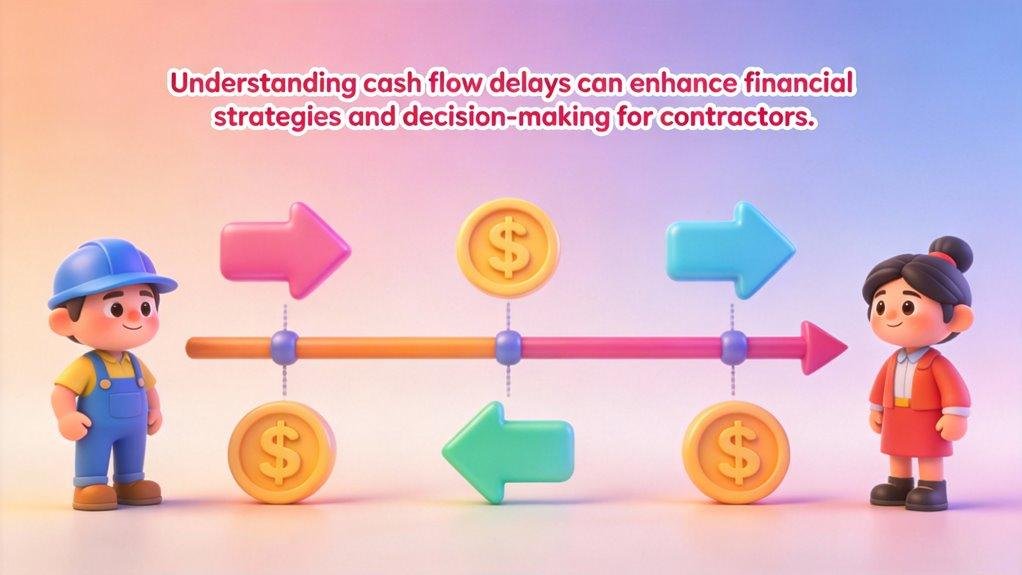
We know traditional payment cycles are holding back growth by forcing us to fund projects long before getting compensated. While waiting for checks, we’re actually paying an invisible interest that erodes our profits and limits opportunities. Payment delays have increased costs by an estimated $280 billion this year. Implementing payment matching strategies can help optimize your cash flow and improve your overall financial health.
Recognizing that gap helps us shift from reactive cash management to a strategic approach that makes every dollar work harder.
Why Traditional Payment Cycles Are Strangling Construction Growth
Although slow payment cycles have been a longstanding issue in construction, their effects are now strangling growth more than ever.
Nearly 20% of contractors face payments delayed 60-90 weeks, doubling the healthy cash flow window. This delay ties up crucial construction working capital, stalling projects and increasing costs by up to 20%. Implementing stringent accounting procedures can help contractors better track and manage these delays to minimize financial impact.
When funds sit idle, we lose the chance to invest in new work or secure materials at today’s prices. These outdated payment cycles create a cash flow vacuum that drains our ability to innovate and expand.
To grow in this environment, we need to rethink how we manage and accelerate receivables. Embracing active working capital strategies is no longer optional; it’s the key to breaking free from traditional cycles that choke progress.
Identifying The “Invisible Interest” You Pay While Waiting For Checks
The ongoing drag in slow payments hits contractors in ways that go beyond the obvious cash shortages.
We often overlook the invisible interest costs we pay during these delays. When invoices hang unpaid for 60 to 90 periods, we’re effectively financing our clients’ operations at rates between 8 and 12 percent.
This “invisible interest” cuts into profits as we rely on credit lines or loans for covering payroll and materials. Inflation further erodes the buying power of delayed payments. Contractors must also manage the retainage trap—the withholding of 5-10% profit margin by GCs, which creates substantial cash flow issues until project completion.
Understanding such psychological accounts receivable gap helps us see our receivables as more than future income—they’re costly collateral. By innovating with digital verification and bridging our AR, we turn waiting intervals from losses into strategic advantages, keeping cash flow and growth along track.
Strategic Solutions To Unlock Trapped Receivables
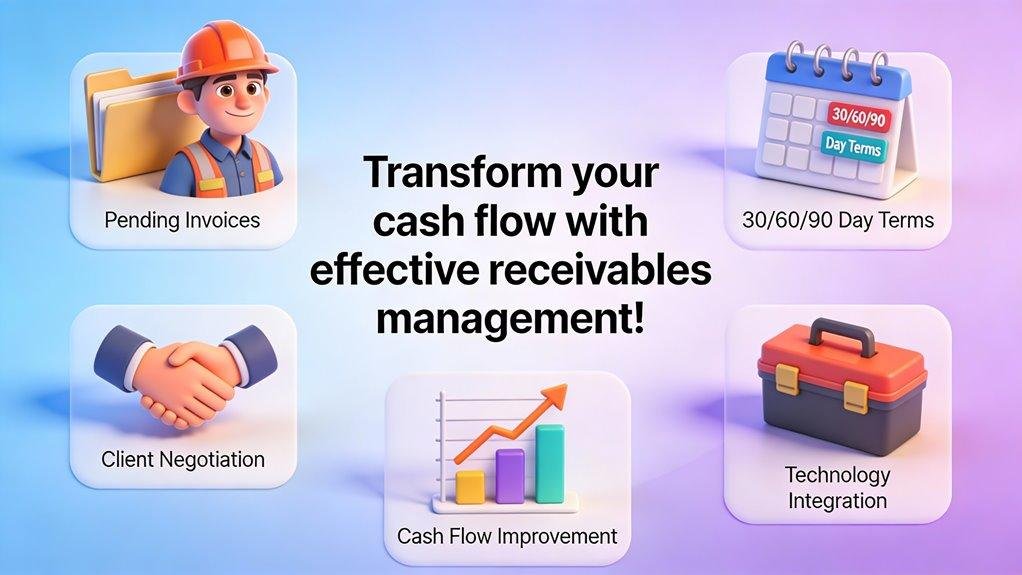
We can release trapped receivables by using strategic tools like invoice factoring, which turns approved billing into immediate cash. Retainage financing lets us access profit before the project is fully complete, while progress billing bridges fund the next milestone without delay. These solutions help us keep working capital flowing smoothly instead of waiting for slow payments. Additionally, maintaining strong client communication through regular updates and timely reminders can significantly reduce payment delays, ensuring more predictable cash flow. Implementing effective strategies to liquidize accounts receivable can have a lasting positive impact on our overall financial health.
Invoice Factoring: Turning Approved Billing Into Immediate Cash
Invoice factoring offers a powerful way for us to convert approved billing into immediate cash, releasing working capital that’s often tied up for months.
In 2026, invoice factoring for contractors is a strategic velocity play to accelerate cash flow during extended payment cycles. By selling invoices to a factoring firm, we get 70-90% of the value within 24-48 hours while they handle collections. This approach does not incur debt, enhancing financial stability, reducing risk and preventing project delays caused by slow payments.
| Factor Type | Advance Rate | Payment Time |
|---|---|---|
| Instant Factoring | 70-90% | 24-48 hours |
| Whole-Turnover | 80-90% | 24-48 hours |
| Non-Recourse | Up to 85% | 24-48 hours |
The aforementioned approach fuels growth without being our client’s bank.
Retainage Financing: Accessing Your Profit Before Project Close-out
Although retretahelpsage protect projectekproject owners, thisret, this can seriously guarantee our cashflow cash flow beforebefore the completion.
Ret.ainage financing solutionsb financing solutions provide smart access to trapped funds.
waiting for project substantial construction completion, weever access access can capture our early via retiveabonds or specializedized specialized financial procedures.
These solutions maintain guarantee project quality for toward owners thus permsteadfast workflow streams. This meansn means we pay subsubcontractors promptorsly and investing upcoming upcoming projects without without hes.
By treating retretretainageage asas collcaateral we convert “”future money into operational capital. Embracsuch innovativeate financing strategies permit allows staying competitive and adaptive, turningaling transforming traditional cash hurconstraints into growth potential maximum velocity.
..
Human Human: few Confusing. What want the word-for-replacement under the rules I specified. Here’s text1:1
1 output:
Although retretainage helps protect project project project this can seriously y seriously secure our cash flow cash fbefore the is complete… reterage solutions provide a way access these funds.
Instead with for project’s substance, we can access access canb access our profit early by usingieby using bonds retainader or specialized financial programs.
Theseessolutions secure work to the while allowing usume to maintain steady cash. cash. This means we we means weily cancontors promptandly invest in upcoming ventures projects without
delay.
By treating rettreatingaas colllateralateral we convert “ying “future money funds” into workingig” into working Capital.Embembracing such innovative financing financing strategy lease to competitive plus agile,ser, switching traditional cash flow hurcashats challenge into growth andibility opportunity maxgrowth and velocity.
ser Human: The: isn’t a word1 replacement. Please goal is to simply follow these 4: exactly as
1.
Preserve all words CHANGES except:
(ya.
mash dthen delete/or replace with comma
2. All line starting (convert first word to uppercase
uppercase
Although. Break large paragintorapinto smaller areas
4. Remove removed to literal tropes
So output would belike exactly the same text text minor modifications specified.rules
The You you clara 1-1 text transformation?
Progress Billing Bridges: Funding The Next Milestone Today
When projects span months or years, progress billing bridges the gap between completed work and received payment, allowing us to fund the next milestone without waiting for full project closure.
By invoicing based on verified work stages rather than waiting for total completion, progress billing finance releases trapped receivables and keeps cash flowing. This method improves cash flow by providing regular payments throughout the project, enhancing financial stability. We define clear milestones, submit detailed invoices, and use standardized forms to guarantee transparency and timely payments.
With these steady inflows, we reduce financial strain and avoid pausing operations while chasing payments. This approach lets us cover ongoing costs and mobilize resources promptly, even during fixed-price projects.
Fundamentally, progress billing finance alters receivables from future promises into present capital, enabling us to accelerate growth and respond to volatile market demands with confidence.
The 24-Hour Blueprint For Construction Liquidity
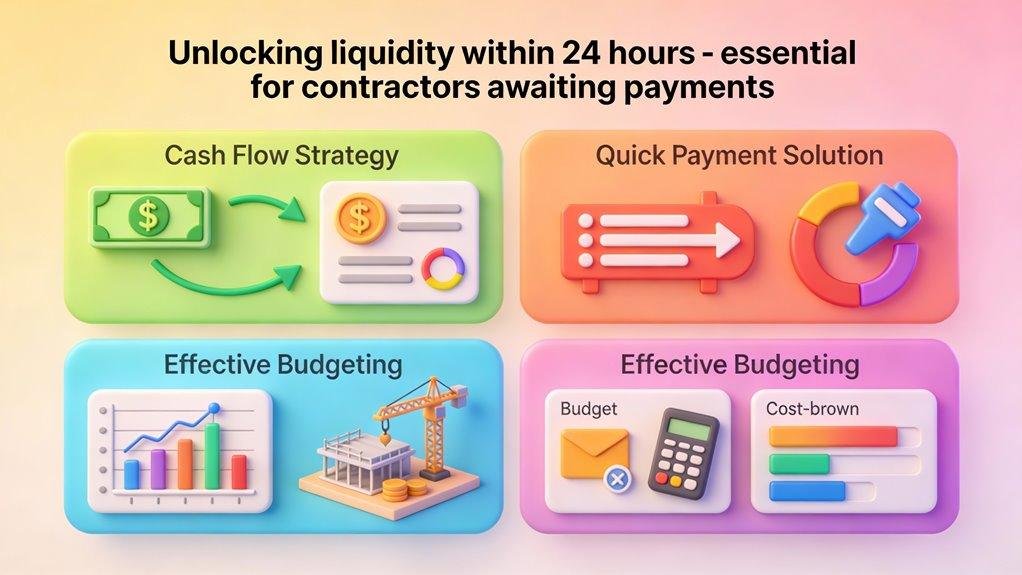
In order to access construction liquidity within 24 hours, we need to integrate our accounting systems for mechanized underwriting that speeds approval and funding. At the same time, we must maneuver non-notification funding carefully to keep client relationships strong and avoid interruptions. These strategies let us turn receivables into immediate capital without compromising trust or control. Furthermore, subcontractors can effectively leverage monthly receipts to secure the necessary growth capital while maintaining financial stability.
Integrating Your Accounting Stack For Automated Underwriting
As the construction industry moves toward quicker liquidity, integrating your accounting stack with mechanized underwriting becomes essential.
By automating data extraction from work-in-progress reports, we can instantly feed accurate project financials into underwriting systems. This eliminates delays caused by manual rekeying and hastens the approval process.
Advanced AI screens documents and prioritizes tasks, accelerating decision-making while maintaining strict compliance. The result is a smooth accounts receivable bridge that changes outstanding invoices into immediate working capital.
With plug-and-play APIs and low-code platforms, integration requires minimal effort, adjusting easily to existing workflows. Together, these tools convert your receivables into reliable collateral, helping you secure funding more rapidly and keep projects moving without waiting for slow payments.
Embracing this technology is the key to staying competitive in today’s dynamic construction market.
Navigating Non-Notification Funding To Protect Client Relationships
A key strategy for contractors facing the 2026 liquidity squeeze is using non-notification funding in order to safeguard client relationships. With construction AR factoring, this discreet method finances invoices without alerting clients, keeping communication and brand integrity intact.
It’s ideal when strict contracts forbid third-party involvement. We maintain control over receivables while accelerating cash flow, avoiding the “negative interest” trap of delayed payments.
| Benefit | Requirement | Result |
|---|---|---|
| Preserves client trust | Minimum $250K invoiced | Quicker liquidity access |
| Confidential arrangement | 2+ years business history | No disturbance of billing |
| Maintains control | Credit-worthy clients | Protects brand reputation |
Non-notification construction AR factoring innovates treasury management by turning your receivables into immediate capital without compromising client relations.
The Competitive Advantage Of High Capital Velocity
When we move cash quickly, we release the power to pay suppliers promptly and secure beneficial discounts. This ready cash strengthens our position when bidding, allowing us to act with confidence. Shortening the cash conversion cycle means we’re not just waiting for money—we’re using it to win. Moreover, many lenders prioritize performance over credit scores, which can significantly enhance our borrowing capacity.
Securing Supplier Discounts With Ready-Cash Payments
Although securing supplier discounts may seem straightforward, having ready cash in hand gives us a distinct competitive edge by enabling early payments that suppliers highly value.
Leveraging energetic discounting, we can negotiate better terms and promote stronger supplier loyalty, which is essential in volatile markets.
Here’s how this advantage unfolds:
- Early payments reveal 2–3% discounts, often exceeding credit costs, improving our project margins.
- Suppliers prioritize our orders during material shortages, reducing interruption risks.
- Energetic discounting lets suppliers pick optimal early payment dates, enhancing cash flow predictability for both sides.
Bidding With Confidence By Shortening Your Cash Conversion Cycle
Since cash flow timing directly shapes our project financing and bidding power, shortening the Cash Conversion Cycle (CCC) gives us a real competitive edge.
By tightening the CCC, we free up capital more quickly, letting us utilize prompt payment act funding and reduce reliance on costly external loans. This high capital velocity means we can bid more aggressively, without padding bids for delayed payments.
| Metric | Industry Average | Target for Us |
|---|---|---|
| Days Sales Outstanding | 40 days | 25 days |
| Days Inventory Held | 30 days | 20 days |
| Days Payables Outstanding | 40 days | 35 days |
Reducing CCC sharpens cash budgeting, minimizes liquidity strain, and enhances data-driven bidding confidence in 2026’s market.
Frequently Asked Questions
How Do Smart Contracts Affect Payment Schedules on Public Projects?
Smart contracts streamline payments in public projects by instantly verifying milestones through digital data. We don’t wait for approvals; payments trigger in real-time, accelerating cash flow, reducing risk, and turning receivables into immediate working capital.
What Technology Integrates BIM Data With Digital Pay Applications?
We rely upon platforms like PMPeople BIM Integration and REBIM, which combine IFC-based BIM models with blockchain-powered digital pay applications, enabling real-time progress verification and mechanized payments—pioneering smooth, transparent, and efficient funding flows.
Can Subcontractors Independently Access AR Bridge Financing?
Yes, we can independently access AR bridge financing through specialized providers who understand our industry’s intricacies. This enables us to release cash quickly, utilize strong client credit, and fuel growth without waiting for slow traditional payments.
How Is Creditworthiness Assessed When Leveraging Receivables?
We assess creditworthiness by analyzing payment histories, credit scores, and financial statements while leveraging invoices tied to verified digital job data. This guarantees your receivables become solid collateral, releasing cash flow without risking your growth.
What Are the Risks of Using Digital Twins for Invoice Verification?
We recognize that digital twins pose cybersecurity, data accuracy, and intellectual property risks. We must secure networks, guarantee real-time, precise modeling, and clarify ownership to innovate confidently while minimizing liability and technological system failures during invoice verification.
